
The Methodology of Logisticswall Indian Container Freight Index
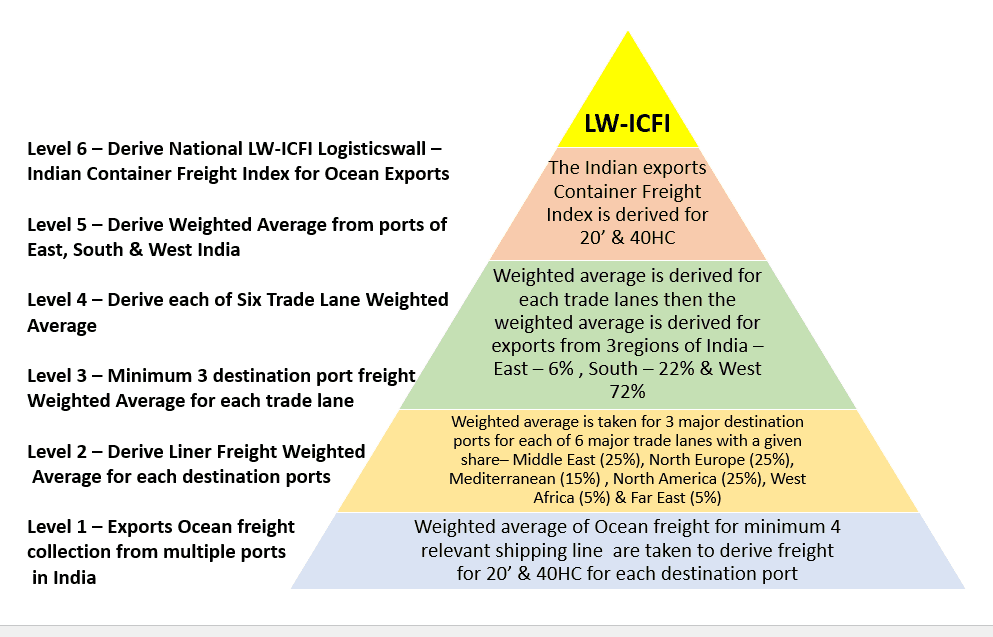
How LW ICFI is calculated - A transparent, weighted-average approach to tracking India’s ocean export freight market.
Container freight rates from India can vary significantly depending on the port of origin, destination, shipping line, container type and prevailing market conditions. A single freight quotation cannot represent the entire export market. This is why LogisticsWall developed the LogisticsWall Indian Container Freight Index (LW-ICFI) — a structured benchmark designed to track changes in India’s ocean export container freight market.
The index consolidates freight assessments across major Indian export regions and international trade lanes into separate national benchmarks for 20GP and 40' HC containers, expressed in US dollars per container.
1. Freight data collection
LW-ICFI is derived from freight assessments collected from multiple shipping lines, Non-Vessel Operating Common Carriers (NVOCCs) and other market participants. The methodology considers representative Indian origin ports and major international destination ports rather than relying on a single carrier or individual quotation.
This approach helps capture variations in freight pricing across the market and provides a broader reference for monitoring monthly movements.
2. Regional weighting: Representing India’s export gateways
India’s container export activity is distributed unevenly across its western, southern and eastern port regions. LW-ICFI reflects this structure through the following regional weightings, based on container-handling shares:
Indian export region | Weight |
West India | 72% |
South India | 22% |
East India | 6% |
Total | 100% |
West India carries the largest weight because of its share of container traffic of all India container exports. South and East India are included proportionately, ensuring that the index represents a broader national export market rather than the conditions of one port cluster alone.
The regional basket includes representative gateways such as Mundra and Nhava Sheva in the west, Chennai and Cochin in the south, and Kolkata/Haldia, Paradip and Visakhapatnam in the east, alongside other ports specified in the published methodology.
3. Shipping-line and destination-port weighting
Freight rates differ between shipping lines and destination ports. LW-ICFI therefore uses weighted averages to consolidate these differences.
Within a trade lane, the methodology applies destination-port weights and shipping-line weights where specified. The resulting port-level freight assessment is then consolidated across the relevant Indian regions.
For example, the September 2026 methodology illustrates the Middle East trade using Jebel Ali, Sohar and Jeddah, with respective destination weights of 40%, 10% and 50%. Freight assessments from different carriers and Indian regions are combined to derive representative regional and trade-lane values.
This structure ensures that the resulting assessment reflects the relative importance assigned to individual destinations and shipping-line observations, rather than treating every quotation as equally representative.
4. Trade-lane weighting: From regional rates to a national index
After the regional and destination-port assessments are consolidated, the major export trade lanes are combined using the following weights:

The trade-lane weights determine how strongly each market influences the final national benchmark. The Middle East, North Europe and North America each carry a 25% share, while the Mediterranean accounts for 15%. West Africa and the Far East each contribute 5%.
Consequently, a significant freight movement in a heavily weighted trade lane can have a greater effect on the national index than a similar movement in a lane with a smaller weight.
5. Regional freight normalisation
Freight quotations from ports within the same region may differ because of feeder connectivity, terminal arrangements, vessel calls and local market conditions. LW-ICFI applies regional adjustments where necessary to make the port assessments more representative and comparable.
The published methodology includes adjustments for certain eastern and southern ports relative to representative gateways, as well as differences between Mundra and Nhava Sheva for selected trades. These adjustments are based on prevailing market observations; they are not intended to imply that every port has an identical freight rate.
The methodology also treats Antwerp and Rotterdam as substantially similar for index purposes. For equipment classification, the published index groups 40GP and 40' HC rates together where their prevailing market freight levels are considered broadly comparable.
6. Final index calculation
The process follows a sequence: freight collection, shipping-line and destination-port weighting, regional consolidation, regional normalisation where required, trade-lane weighting and final national aggregation.
Conceptually, the final index for each container type is calculated as:
National LW-ICFI = Sum of (Trade-lane weighted-average freight × Trade-lane weight)
The calculation is performed separately for 20GP and 40' HC containers. The regional and destination-port calculations feed into the relevant trade-lane averages before the final national figures are derived.
For example, the September 2026 assessment reported an LW-ICFI of USD 6,128 per 20GP container and USD 7,009 per 40' HC container. These values represent the consolidated national benchmark for that assessment date, rather than a quotation available from every Indian port to every destination.
Why the methodology matters
The value of LW-ICFI lies in its structured approach to a fragmented market. By combining freight observations across regions, shipping lines and destinations, the index provides exporters, freight forwarders, shipping professionals and trade analysts with a consistent reference for comparing changes over time.
It is important to distinguish the index from an individual freight offer: actual rates may vary by booking date, carrier, destination, service, equipment availability and applicable charges.
As Indian export patterns and global shipping networks evolve, LogisticsWall intends to review the methodology periodically while maintaining consistency between assessments. Clear weighting rules, documented regional adjustments and consistent treatment of container types are essential to making the index useful for market analysis.
LW-ICFI is designed to do more than report a freight number. It provides a structured view of how India’s export container freight market is moving — and how changes across individual trade lanes contribute to the national picture.
Methodological notes
40' or 40HC freight represents both 40-foot General Purpose (40GP) and 40-foot High Cube (40HC) containers, as market freight levels for these equipment types are mostly same.
Freight rates for Antwerp and Rotterdam are considered substantially similar for the purpose of the index and are treated accordingly in the weighted-average calculations.
The index uses representative major Indian ports as reference gateways. Freight levels for nearby ports with similar market characteristics are derived from these representative ports using appropriate regional adjustments.
These normalisation adjustments are based on prevailing market observations and are applied solely to ensure that the LW-ICFI reflects representative freight levels across India's principal export regions.
Popular Posts

Explore Topics



Comments