
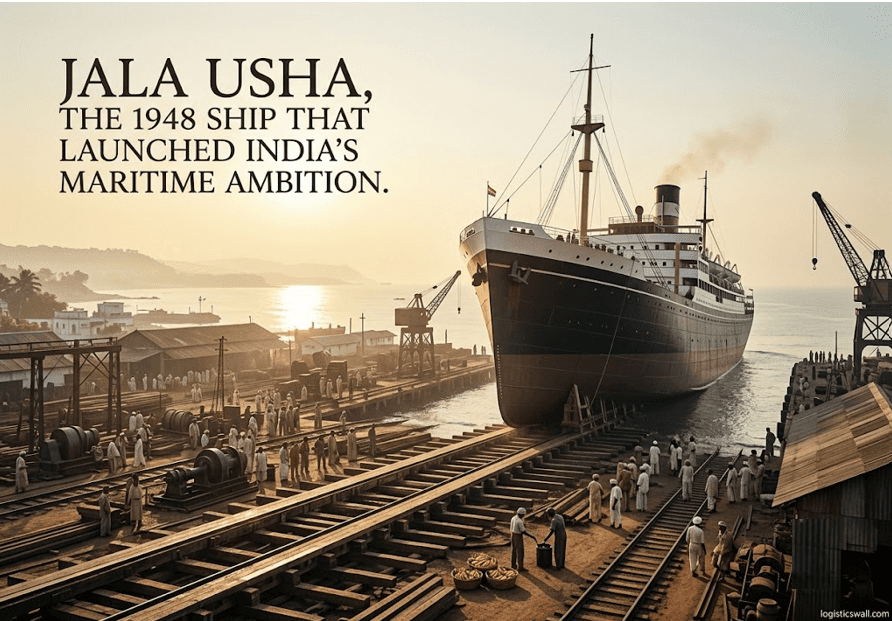
8,179 DWT. 415 feet. 2,600 HP. And, reportedly, 30,000 bananas.
On 14 March 1948, barely seven months after India became independent, a steamship slipped into the water at Visakhapatnam.
Her name was Jala Usha.
Built at the Scindia Shipyard, founded by industrialist Walchand Hirachand in 1941, she was more than a cargo vessel. She was an early test of whether a newly independent India could create industrial capability of its own. The yard's foundation stone had been laid on 21 June 1941 by Rajendra Prasad, years before Independence.
The ship was 415 feet long, 52 feet wide and powered by a 2,600-HP steam engine, with a deadweight capacity of 8,179 tonnes. She was delivered to Scindia Steam Navigation on 26 October 1948.
Then came the story that gave Indian shipbuilding one of its most memorable launch legends.
The ship reportedly refused to slide smoothly down the slipway. With insufficient grease available, workers turned to an unconventional solution: a mixture of tallow, soft soap and ripe bananas. The Hindu's historical account says approximately 30,000 bananas were used to help the vessel move down the ways. Whether every banana can be independently verified today is less important than what the story represents: an ambitious shipyard solving an immediate engineering problem with whatever it had.
But the real significance of Jala Usha was much bigger.
Jawaharlal Nehru, speaking at the launch, noted that many of the workers had been farmers only months earlier and had quickly acquired new industrial skills. He described shipbuilding as an achievement requiring hundreds and thousands of minds and hands.
That idea was central to industrial nation-building.
The United States had already demonstrated during World War II what shipbuilding could become when steel, engineering, labour, standardisation and government demand were connected. More than 2,700 Liberty ships were produced between 1941 and 1945, turning shipbuilding into an industrial production system rather than simply a craft.
Post-war Europe followed a different but equally important path: rebuilding industrial capacity, integrating steel and heavy industry and creating the foundations of the economic cooperation that eventually produced today's European Union.
India's challenge was different.
It was emerging from colonial rule with enormous development needs and a limited industrial base. Jala Usha therefore represented something fundamental: the beginning of capability, not the arrival of scale.
And the experiment continued.
Scindia Shipyard launched eight more ships between 1948 and 1952. The yard was nationalised in 1961 and became Hindustan Shipyard Limited (HSL).
Today, HSL's own FY2023–24 annual report records 200 ships built since Jala Usha, spanning commercial vessels, bulk carriers, offshore vessels and sophisticated specialised ships.
That is the bigger lesson of Jala Usha.
Countries do not become maritime powers simply because they own ships.
They become maritime powers when they develop the ability to design, finance, engineer, build, repair and operate ships — and, most importantly, train the people who can do all of it again.
America discovered that through wartime industrial mobilisation. Europe built maritime capability into a wider industrial and economic reconstruction. India began its own journey with a shipyard at Visakhapatnam and a steamship that needed an unusual amount of banana-powered persuasion to reach the water.
8,179 DWT was the ship's capacity.
The real capacity being built was India's own maritime industrial capability.
In 1948, the question was simple:
Can India build the ship here?
Jala Usha answered: Yes.
Popular Posts

Explore Topics


Comments