
Indian Container Freight Index for Ocean Exports

LW-ICFI LogisticsWall Indian Container Freight Index for Ocean Exports – October 2026
India’s container export freight market has moved higher again in October, although the pace of increase has slowed considerably compared with the sharp rise witnessed over the previous months. The LogisticsWall Indian Container Freight Index (LW-ICFI) reached USD 6,174 per 20GP container and USD 7,114 per 40' HC container on 8 October 2026.
Compared with the September assessment, the 20GP index has increased by approximately 0.8%, while the 40' HC index has risen by around 1.5%.
The latest reading indicates that freight rates remain at historically elevated levels, but the market is increasingly being shaped by regional disruptions, vessel delays, security risks and the availability of effective vessel capacity rather than demand alone.
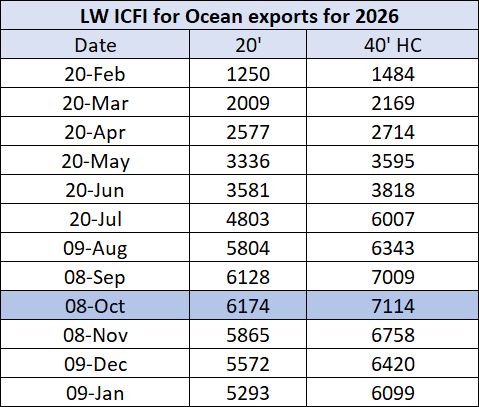
The longer-term movement is striking. Between February and October, the 20GP index increased by approximately 394%, while the 40' HC index rose by approximately 379%.
The October increase is comparatively modest, but this should not be interpreted as a return to normal market conditions. Freight rates are still several times higher than their February levels, and the underlying operational risks remain significant.
Middle East: Freight premiums and prolonged vessel delays
The Middle East remains the most challenging region in the current assessment.
Ocean freight rates for Middle East destinations have increased by approximately USD 700–1,000 per container, according to LogisticsWall’s market assessment. However, the greater concern is the deterioration in vessel turnaround time.
At Khor Fakkan and Sohar, vessel waiting and turnaround periods have reportedly extended to approximately 15–25 days in some cases. Such delays affect more than the immediate port call. They can disrupt subsequent vessel rotations, delay empty-container repositioning and reduce the availability of equipment and space for Indian exporters.
Despite these risks, some shipping lines continue to move vessels through the Strait of Hormuz. Such movements are subject to operational and security conditions, and some cargo bookings are reportedly attracting additional premiums of approximately USD 1,000–2,000 per container.
Europe: Freight eases, but opportunities vary by port
European export freight rates have declined by approximately USD 200–300 per container in the latest market assessment.
Some ports are seeing more aggressive pricing, with CMA CGM reportedly offering substantially lower rates on selected services and destinations. This suggests that the European market is not moving uniformly: pricing can vary significantly according to port, sailing, available space and the commercial strategy of individual shipping lines.
Israel: Limited carrier acceptance
Cargo destined for Israel continues to face significant booking restrictions, with most shipping lines reportedly declining certain bookings or limiting acceptance under current conditions.
ZIM remains an important option for some shipments, with freight reportedly comparable to European levels in certain cases. Market speculation about a possible acquisition of ZIM by another shipping line should be treated as unconfirmed unless supported by an official announcement. Exporters should make booking decisions on the basis of confirmed carrier terms rather than takeover rumours.
West Africa: Rates remain broadly stable
Unlike the Middle East, West Africa has shown comparatively little movement in ocean freight rates.
China Golden Week: Why freight has not fallen
China’s Golden Week holiday ran from 1 to 7 October 2026, temporarily affecting normal business and port-related activity.
Under conventional market conditions, a holiday-related slowdown might be expected to reduce demand and ease freight rates. However, the present market is more complicated. Earlier congestion at major transshipment hubs has created accumulated vessel delays, disrupted schedules and elongated port waiting times. The result is that reduced activity during the holiday period has not automatically translated into lower freight rates.
The global capacity question: What happens when the disruption ends?
One of the most important factors in the freight outlook is the balance between vessel capacity and cargo demand.
LogisticsWall’s current market assessment suggests that effective container-shipping capacity is approximately 10% higher than demand. If Middle East disruptions ease shipping lines would face the underlying supply-demand balance, including the available fleet and competing carriers’ pricing strategies. If effective capacity becomes abundant relative to demand, freight rates could come under substantial downward pressure.
What the October LW-ICFI means for Indian exporters
The October index points to a market in which the overall increase in freight has slowed, but regional risks remain pronounced.
Middle East shipments face higher premiums and extended vessel delays. Europe is offering some rate relief, while West Africa remains broadly stable. Israel continues to present carrier-acceptance challenges, and congestion across international transshipment networks is preventing a straightforward reduction in freight rates.
For Indian exporters, the immediate priority should be to evaluate the complete shipping cost rather than the headline ocean freight alone. A lower rate may not necessarily represent a better commercial outcome if the shipment faces uncertain acceptance, extended transit time or additional surcharges.
The central question for the coming months is whether the normalisation of shipping operations will release enough effective vessel capacity to push freight rates lower. If it does, the market could see a meaningful correction. Until then, the October LW-ICFI indicates that Indian exporters must continue to manage both freight costs and operational uncertainty.
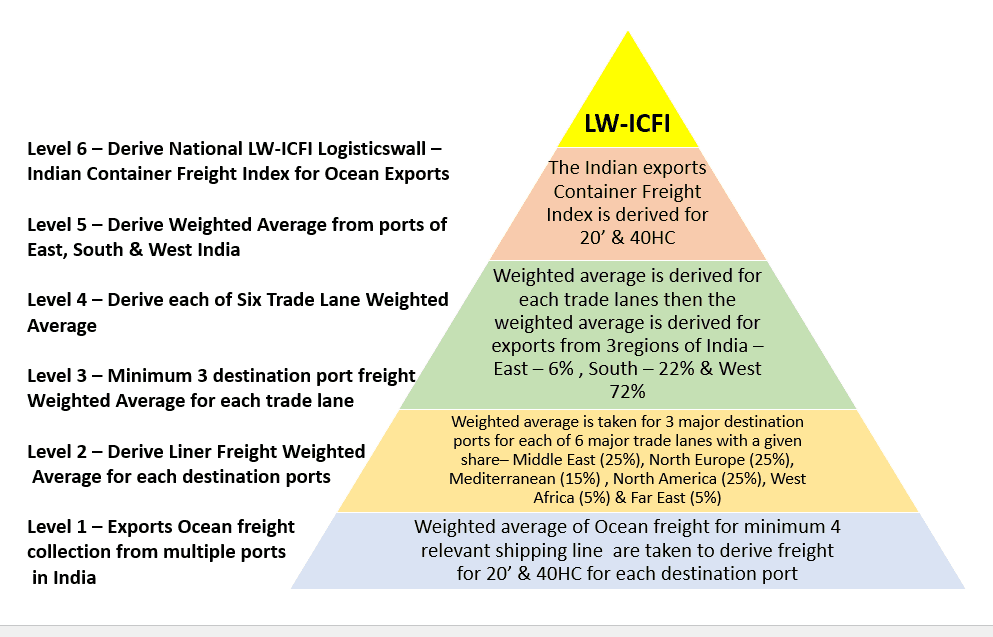
About LW-ICFI - Methodolgy.
Please click here for the full methodology of LW ICFI.
The LogisticsWall Indian Container Freight Index (LW-ICFI) is an independent benchmark developed by LogisticsWall to track prevailing container freight rates for Indian ocean exports.
The index is published separately for 20GP and 40' HC containers in US dollars per container. Its methodology consolidates freight assessments from shipping lines, NVOCCs and market participants, applying regional, destination-port and trade-lane weightings to reflect the structure of India’s export container market.
Trade-Lane Freight Analysis – October 2026

Across the major trade lanes, ocean freight movements remained mixed in October, reflecting differences in regional demand, vessel capacity and operational disruptions. The Middle East continued to face significant freight pressure amid security concerns and prolonged vessel waiting times, while North Europe and the Mediterranean experienced varying levels of rate adjustment. North America remained influenced by the balance between available vessel space and cargo demand, whereas West Africa recorded comparatively stable freight levels. The Far East trade lane saw a modest decline in October, with rates falling from USD 635 to USD 609 per 20' container and from USD 841 to USD 822 per 40' HC container. With the six trade lanes carrying different weightings in the LW-ICFI, their combined performance will determine the overall direction of the index. The October assessment therefore highlights a market in which freight movements vary by destination, even as global shipping capacity and congestion continue to influence pricing.
Popular Posts
Explore Topics



Comments