
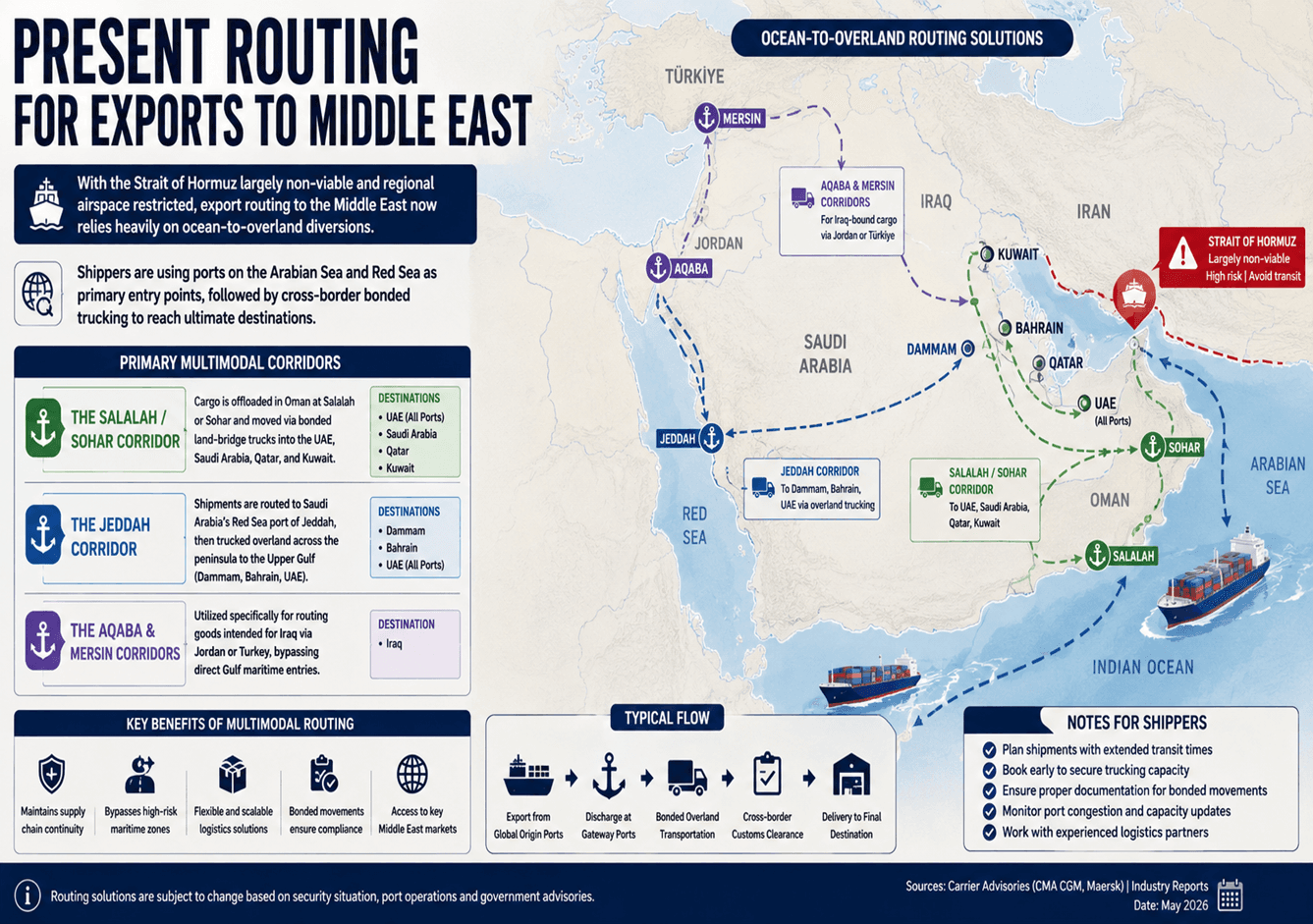
Export cargo movement to the Middle East is rapidly shifting toward multimodal ocean-to-land solutions as the Strait of Hormuz remains heavily disrupted and regional airspace restrictions continue impacting conventional supply chains.
Major global carriers including CMA CGM and Maersk have activated alternative routing networks using Arabian Sea and Red Sea gateway ports combined with bonded cross-border trucking to maintain cargo flow into Gulf markets.
Salalah and Sohar emerge as key Gulf gateways
Shipping lines are increasingly routing cargo through Port of Salalah and Port of Sohar as alternatives to direct Upper Gulf port calls.
Under the new routing model, containers are discharged in Oman and transported via bonded land bridge operations into the UAE, Saudi Arabia, Qatar and Kuwait. The corridor has become one of the most viable options for maintaining supply continuity while avoiding high-risk transit zones near the Strait of Hormuz.
CMA CGM has reportedly expanded contingency routing advisories for Gulf cargoes, while Maersk continues promoting flexible intermodal solutions for customers affected by regional disruptions.
Jeddah corridor gains importance for Upper Gulf cargo
Another major diversion route now centers around Jeddah Islamic Port on the Red Sea coast.
Cargo destined for Dammam, Bahrain and UAE markets is increasingly moving via Jeddah before being trucked overland across Saudi Arabia. Logistics operators say the corridor is helping maintain delivery schedules despite severe operational uncertainty in Gulf waters.
The shift has also increased demand for bonded trucking capacity, customs clearance support and inland warehousing across Saudi Arabia’s logistics network.
Aqaba and Mersin corridors support Iraq trade
For Iraq-bound cargo, exporters are increasingly utilizing Port of Aqaba and Port of Mersin as strategic entry points.
Containers arriving at Aqaba are transported by road into Iraq through Jordanian border crossings, while Mersin-based routing supports northern Iraq cargo movement via Türkiye.
Freight forwarders indicate these corridors are helping bypass congested or high-risk Gulf maritime routes while preserving transit reliability for critical cargo.
Freight costs and transit times under pressure
The sudden transition toward multimodal routing has significantly increased operational complexity for exporters.
Industry sources report:
Higher trucking and inland handling costs
Longer transit lead times
Increased insurance premiums
Equipment repositioning challenges
Congestion pressure at alternative gateway ports
Despite higher logistics costs, many exporters are prioritizing continuity of supply over transit economics as regional security conditions remain volatile.
The current situation is expected to accelerate long-term development of integrated ocean-rail-road logistics corridors across the Middle East, particularly through Oman and Saudi Arabia, as carriers and cargo owners seek more resilient alternatives to traditional Gulf shipping routes.
Popular Posts

Explore Topics



Comments