
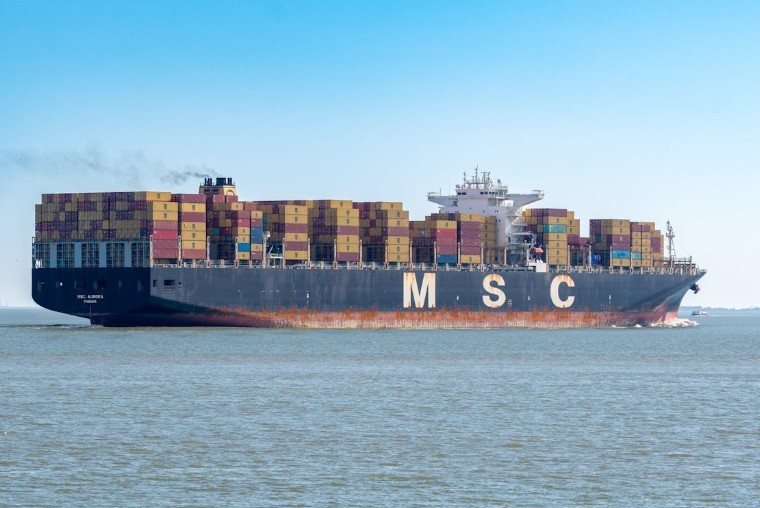
Mediterranean Shipping Company (MSC) has become the first container carrier in history to operate a fleet of 1,000 vessels, setting a new benchmark for the global liner industry. MSC’s operated fleet has crossed 7.31 million TEU capacity with 1,000 ships under operation, extending its lead far ahead of second-placed Maersk.
The milestone highlights how aggressively MSC has expanded since overtaking Maersk in 2022. What makes the achievement more significant is not just the vessel count, but the scale gap it has created in the market. MSC now controls over 21% of global container fleet capacity, with a fleet roughly 57% larger than Maersk’s operated capacity
How MSC overtook Maersk to become the world’s largest container shipping line
For decades, A.P. Moller - Maersk was the undisputed leader in global container shipping. Until 2022, Maersk held the number one position with its strong global network, advanced digital systems, and reputation for efficient online customer service. The Danish shipping giant focused heavily on transforming itself into an integrated logistics company by expanding into warehousing, e-commerce logistics, customs solutions, and inland supply chain services.
However, while Maersk diversified into multiple logistics sectors, MSC Mediterranean Shipping Company remained aggressively focused on one core business — expanding container shipping capacity worldwide.
One of the major internal shifts that industry professionals often discuss was Maersk’s gradual move away from its traditional Maersk Line culture. For years, the company was known for its highly respected MLGP (Maersk Line Graduate Program), which developed leaders with deep shipping knowledge, operational discipline, and long-term growth focus. Many of Maersk’s strongest global leaders came through this system and helped build the company’s aggressive commercial culture across regions.
Over time, however, Maersk reduced the influence of many senior leaders associated with the traditional MLGP structure and increasingly brought talent from the freight forwarding and logistics sector as part of its integrated logistics transformation. While the strategy aimed to strengthen end-to-end supply chain capabilities, many shipping industry insiders believe this weakened the strong container-shipping-focused culture that had originally made Maersk dominant globally.
Industry observers believe Maersk’s diversification strategy slowed its fleet expansion at a time when container demand was booming. Some logistics investments also faced operational challenges and lower-than-expected returns, gradually reducing Maersk’s dominance in global liner shipping capacity.
MSC, on the other hand, adopted a completely different approach.
Unlike Maersk’s technology-driven customer model, MSC built a reputation for manual support, relationship-based operations, and personalized customer handling. In many markets, MSC teams became known for directly assisting shippers, freight forwarders, and customs-related coordination instead of relying only on automated systems. This “personal touch” approach helped the company grow strongly in developing markets across Asia, Africa, Latin America, and the Middle East.
At the same time, MSC followed an aggressive expansion strategy even during periods of lower profitability. The company purchased second-hand vessels, chartered ships heavily, and continuously placed newbuilding orders while competitors remained cautious. This strategy helped MSC overtake Maersk in 2022 to become the world’s largest container shipping line.
Now, MSC has created another industry record by operating 1,000 ships globally. The company also has around 126 container vessels currently on order, indicating that its market share could rise even further in the coming years.
The global shipping industry may soon enter another intense competition cycle as excess vessel supply pressures freight rates. Analysts expect smaller shipping lines to struggle during the next market downturn due to rising operating costs and fleet overcapacity. In such a scenario, larger carriers with massive scale and financial strength are expected to gain further market share.
Many industry experts believe MSC could continue expanding through acquisitions, vessel takeovers, and strategic market capture if smaller carriers fail to survive future shipping market pressure. With its aggressive fleet strategy already reshaping the container shipping sector, MSC’s dominance in global liner shipping appears far from over.
Popular Posts


Explore Topics



Comments