
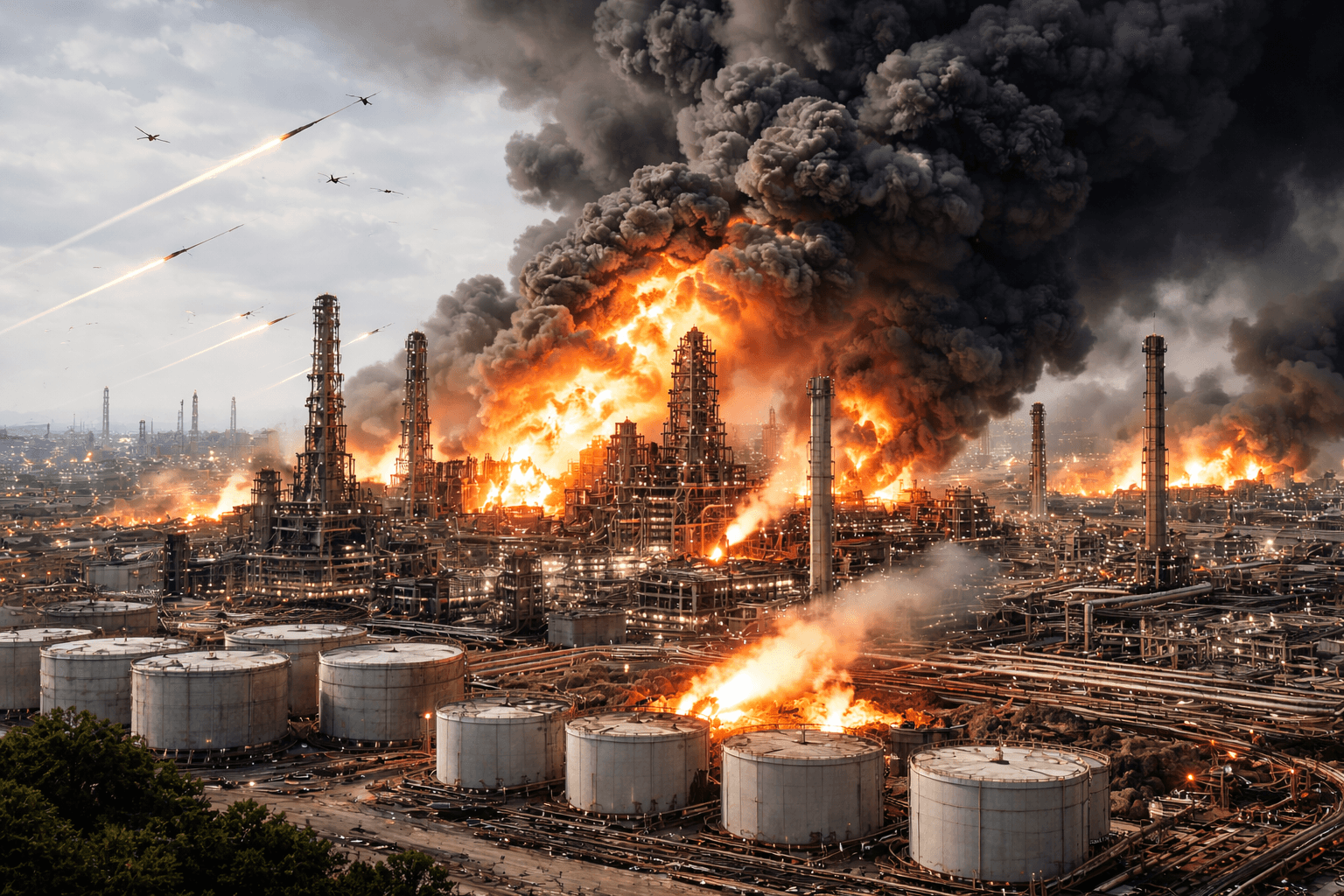
A major escalation has unfolded in the Gulf region following a coordinated missile and drone strike on Al Jubail, the largest industrial hub in Saudi Arabia and one of the most critical energy-processing zones globally.
Spanning approximately 1,000 square kilometers, Al Jubail houses more than 150 large-scale industrial facilities, primarily focused on petrochemicals, refining, and energy processing. The zone contributes an estimated 10–12% to Saudi Arabia’s GDP, making it not just an industrial city but a core pillar of the Kingdom’s economic structure.
Scale and nature of the attack
According to initial assessments, the attack involved multiple missiles and unmanned aerial systems, reportedly launched by Iran. The pattern of destruction indicates coordinated, multi-point strikes, rather than a single-point impact.
The consequences were immediate and severe:
Large-scale explosions across multiple facilities
Rapidly spreading fires, intensified by the concentration of hydrocarbons and petrochemical feedstock
Operational shutdowns in key processing units
Visible infrastructure damage across a wide industrial radius
Given the energy-intensive nature of Al Jubail, even limited damage has cascading effects—fires spread quickly, and shutdowns in one unit can disrupt entire production chains.
why Al Jubail matters globally
Al Jubail is not only central to Saudi Arabia’s domestic economy but also deeply integrated into global energy and petrochemical supply chains. The industrial city plays a key role in:
Refined petroleum exports
Petrochemical production (plastics, fertilizers, industrial chemicals)
Downstream energy logistics feeding international markets
Any disruption in this hub directly affects global supply availability, particularly for Asia and Europe, which rely heavily on Gulf exports.
geopolitical trigger and escalation chain
The strike did not occur in isolation. It follows heightened tensions surrounding the Strait of Hormuz—a chokepoint through which nearly 20% of global oil supply transits.
Earlier, Donald Trump had issued explicit warnings that failure by Iran to comply with strategic demands in the region could lead to targeted destruction of critical Iranian infrastructure, including power grids, bridges, and water systems.
In response, Iran signaled a retaliatory doctrine focused on energy infrastructure, not just military assets. This doctrine appears to have materialized with the targeting of Al Jubail—an economic nerve center rather than a conventional military base.
Simultaneously, Israel has intensified strikes on Iranian gas fields, further broadening the conflict into a multi-front energy confrontation.
shift from military conflict to economic warfare
The attack on Al Jubail represents a clear strategic shift. Modern conflict in the region is no longer limited to troop movements or battlefield engagements—it is now centered on economic disruption.
Key characteristics of this shift include:
Targeting high-value industrial infrastructure instead of military installations
Maximizing economic damage per strike
Creating long-term disruption due to complex repair requirements
Inducing global market instability rather than localized tactical advantage
Energy infrastructure, by design, is highly interconnected. Damage to one segment—such as refining or storage—can halt operations across multiple dependent units, amplifying the economic impact.
repair complexity and long-term disruption
Unlike military assets, industrial facilities—especially petrochemical complexes—require extensive time and specialized resources to repair:
High-temperature and high-pressure systems must be re-engineered and safety tested
Damaged pipelines and reactors require precision replacement
Restarting operations involves phased commissioning processes
This means the impact is not temporary. Even partial damage can lead to weeks or months of reduced output, tightening global supply.
Global economic implications
The implications of the Al Jubail attack extend far beyond Saudi Arabia:
1. Energy markets
Potential increase in crude oil and petrochemical prices
Heightened volatility in global energy benchmarks
2. Supply chains
Disruptions in plastic resins, fertilizers, and industrial chemicals
Downstream impact on manufacturing, agriculture, and construction sectors
3. Shipping and logistics
Increased war risk insurance premiums in Gulf routes
Possible rerouting or delays in tanker movements
Pressure on freight rates and vessel availability
4. Macroeconomic risk
Inflationary pressures driven by higher input costs
Risk of global economic slowdown if disruptions persist
Risk of wider escalation
A critical concern now is whether such attacks remain contained or trigger broader escalation. If industrial hubs continue to be targeted:
More Gulf producers could become vulnerable
The conflict could extend to multiple energy corridors
Global markets could face a systemic supply shock
The central question is no longer just geopolitical—it is economic:
Can global energy systems absorb repeated shocks to critical infrastructure?
The strike on Al Jubail is a defining moment in the evolving nature of conflict in the Middle East. It demonstrates that economic infrastructure is now a primary battlefield, with consequences that ripple across global markets.
For policymakers, traders, and logistics stakeholders, the message is clear:
Risk is no longer confined to war zones—it is embedded in supply chains, energy flows, and industrial concentration points.
If such attacks persist, the world may be entering a phase where regional conflicts routinely trigger global economic disruptions, redefining how risk is assessed in international trade and energy security.
Popular Posts


Explore Topics



Comments