Dec 22, 2025

Indian government sets up Statutory Bureau of Port Security — A pivotal change for India’s maritime security
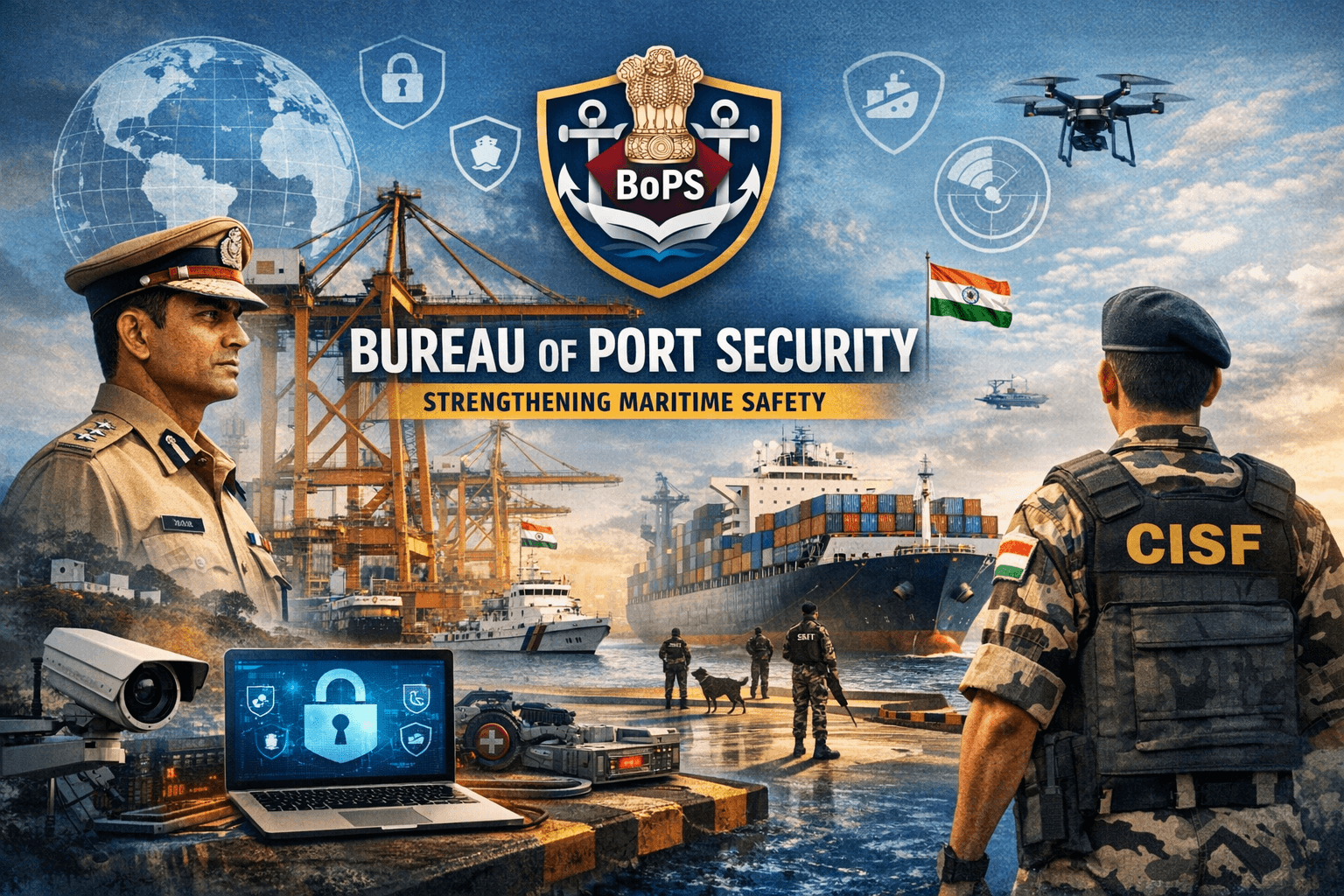
Recently on 19th December 2025, Indian government announced the creation of a dedicated Bureau of Port Security (BoPS) — a statutory authority aimed at strengthening the oversight, coordination, and resilience of port and vessel security across the nation. This will fortify India’s maritime security.

Why its needed and its importance -

  • Trade and exim business is an important share of Indian economy thus India needs to secure them for future from all type of threats including attacks/ cyber intrusion etc.

  • India’s maritime infrastructure includes coastline of approx. 7,500 km - 12 major ports and many non-major ports.

  • By creating a unified statutory body, the government aims to establish a future-ready maritime security framework which will be ready for both traditional and emerging challenges.


What will be BoPS - Bureau of Port Security

  • BoPS will come under Ministry of Ports, Shipping and Waterways.

  • It will be leaded by a Director General level Person, an IPS officer of Pay level 15.
    it will be a statutory body under Section 13 of the Merchant Shipping Act, 2025 and will have the power to formulate, enforce, and oversee port security regulations across India’s maritime infrastructure.

  • It will also have a separate cyber security division.

  • The ground level security will be taken care by CISF – Central Industrial Security Forces.

  • It will align with International standards.


This is an era of maritime trade and BoPS foundation reflects India’s commitment to securing its shores, protecting global supply chain, to be a maritime power.

(Image credit - AI)


Share on FB
Share on FB
Share on X
Share on Linkedin

Comments

Related Post

Mar 26, 2026

In Iran’s latest communication to the United Nations, Tehran has stated that “non-hostile vessels” may transit the strait only if they coordinate directly with Iranian authorities and comply with its security protocols. At the same time, vessels linked to the United States, Israel, or parties deemed hostile are explicitly excluded from safe passage. This effectively transforms a historically open international waterway into a controlled transit corridor, where access is conditional rather than guaranteed. Operational reality: “coordinate or don’t transit” Iran’s condition—coordination with its maritime authorities—is already shaping real-world shipping behavior. Evidence from recent movements shows: • Ships securing passage through direct diplomatic or operational coordination • Select vessels using identification signals or prior clearance to transit safely • Non-compliant vessels being turned back or denied access This creates a two-tier shipping system: 1. Cleared and compliant vessels (low risk, controlled passage) 2. Unaligned or non-coordinated vessels (high risk, potential denial) For operators, this shifts decision-making from purely commercial to political risk assessment. Logistics and freight impact The immediate impact is being felt across tanker and container markets: • Reduced transit volumes - tighter vessel availability • Longer alternative routing via Oman/UAE ports - increased costs • Rising insurance premiums and war risk surcharges • Operational delays due to clearance requirements Some carriers are already rerouting cargo through ports such as Sohar or Khor Fakkan, followed by overland movement—effectively bypassing Hormuz at higher cost and lower efficiency. Strategic shift: from disruption to control Unlike temporary blockades, Iran’s move signals something more structural. This is not just about restricting traffic—it is about: • Exerting sovereign control over transit conditions • Leveraging geography to influence global energy flows • Introducing the possibility of regulated or even monetized passage In effect, Hormuz is being repositioned closer to a controlled maritime corridor, rather than a neutral international strait. Market implications For global trade and energy markets, the implications are significant: • Oil supply chains become less predictable and more politicized • Freight markets see volatility driven by risk premiums, not just demand • Asian buyers (India, China) gain relative advantage through diplomatic alignment and coordination • Western-linked cargo flows face higher operational uncertainty The situation also introduces a long-term concern: if conditional access becomes normalized, it could set a precedent for other strategic chokepoints globally. Iran’s message to the UN is not a reassurance—it is a redefinition of navigation rights in one of the world’s most critical shipping lanes. For the logistics industry, the takeaway is clear: Hormuz is no longer just a passage—it is now a negotiated transit zone, where access depends as much on geopolitics as on maritime compliance. The shift from open sea lane to controlled corridor could prove to be one of the most consequential changes in global shipping in recent years.

Mar 26, 2026

In Iran’s latest communication to the United Nations, Tehran has stated that “non-hostile vessels” may transit the strait only if they coordinate directly with Iranian authorities and comply with its security protocols. At the same time, vessels linked to the United States, Israel, or parties deemed hostile are explicitly excluded from safe passage. This effectively transforms a historically open international waterway into a controlled transit corridor, where access is conditional rather than guaranteed. Operational reality: “coordinate or don’t transit” Iran’s condition—coordination with its maritime authorities—is already shaping real-world shipping behavior. Evidence from recent movements shows: • Ships securing passage through direct diplomatic or operational coordination • Select vessels using identification signals or prior clearance to transit safely • Non-compliant vessels being turned back or denied access This creates a two-tier shipping system: 1. Cleared and compliant vessels (low risk, controlled passage) 2. Unaligned or non-coordinated vessels (high risk, potential denial) For operators, this shifts decision-making from purely commercial to political risk assessment. Logistics and freight impact The immediate impact is being felt across tanker and container markets: • Reduced transit volumes - tighter vessel availability • Longer alternative routing via Oman/UAE ports - increased costs • Rising insurance premiums and war risk surcharges • Operational delays due to clearance requirements Some carriers are already rerouting cargo through ports such as Sohar or Khor Fakkan, followed by overland movement—effectively bypassing Hormuz at higher cost and lower efficiency. Strategic shift: from disruption to control Unlike temporary blockades, Iran’s move signals something more structural. This is not just about restricting traffic—it is about: • Exerting sovereign control over transit conditions • Leveraging geography to influence global energy flows • Introducing the possibility of regulated or even monetized passage In effect, Hormuz is being repositioned closer to a controlled maritime corridor, rather than a neutral international strait. Market implications For global trade and energy markets, the implications are significant: • Oil supply chains become less predictable and more politicized • Freight markets see volatility driven by risk premiums, not just demand • Asian buyers (India, China) gain relative advantage through diplomatic alignment and coordination • Western-linked cargo flows face higher operational uncertainty The situation also introduces a long-term concern: if conditional access becomes normalized, it could set a precedent for other strategic chokepoints globally. Iran’s message to the UN is not a reassurance—it is a redefinition of navigation rights in one of the world’s most critical shipping lanes. For the logistics industry, the takeaway is clear: Hormuz is no longer just a passage—it is now a negotiated transit zone, where access depends as much on geopolitics as on maritime compliance. The shift from open sea lane to controlled corridor could prove to be one of the most consequential changes in global shipping in recent years.

Your source for the latest logistics news, ocean freight updates, and incident reports. Stay informed, stay ahead in the world of supply chain.

© 2025 Logisticswall. Designed by

Your source for the latest logistics news, ocean freight updates, and incident reports. Stay informed, stay ahead in the world of supply chain.

© 2025 Logisticswall. Designed by

Your source for the latest logistics news, ocean freight updates, and incident reports. Stay informed, stay ahead in the world of supply chain.

© 2025 Logisticswall. Designed by