
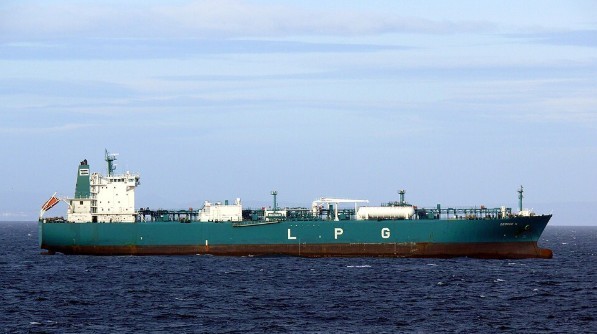
Two Indian-flagged LPG carriers have successfully secured passage through the Strait of Hormuz, highlighting a growing shift toward coordinated navigation in one of the world’s most sensitive maritime corridors.
The vessels—Jag Vasant and Pine Gas—departed the UAE on 23 March 2026 and are transiting close to the Iranian coastline under approved routing. Both tankers are moving through the designated corridor between Larak Island and Qeshm Island, a passage currently used for vessels cleared by Iranian authorities.
Cargo, routing and timelines
Operational details indicate a tightly managed movement:
Jag Vasant
Cargo: ~47,600 MT LPG
Charterer: Bharat Petroleum Corporation Limited
Destination: Kandla Port
ETA: 26 March
Pine Gas
Cargo: ~45,000 MT LPG
Charterer: Indian Oil Corporation Limited
Destination: New Mangalore Port
ETA: 27 March
Both shipments are critical for India’s LPG supply chain, particularly as domestic demand remains structurally high.
Impact on India’s energy logistics
India imports a significant share of its LPG requirements, and Hormuz remains a critical artery. Any disruption directly impacts:
Domestic cylinder supply chains
Refinery-linked LPG distribution
Coastal import terminal operations
The successful movement of these cargoes demonstrates India’s ability to maintain energy flows through diplomatic and operational alignment, even under elevated geopolitical risk.
Freight and risk dynamics
The broader shipping environment around Hormuz continues to reflect heightened caution:
War risk premiums remain elevated
Tanker routing decisions are increasingly politically influenced
Operators without clearance face delays or rerouting
In this context, Indian-flagged vessels securing passage signals a relative advantage in risk-managed logistics execution.
The transit of Jag Vasant and Pine Gas underscores a deeper structural change:
Hormuz is no longer functioning purely as a transit corridor—it is evolving into a controlled maritime zone where access depends on coordination and geopolitical positioning.
For India, the immediate priority is continuity of supply. But for global shipping, the implication is broader—energy logistics through key chokepoints is becoming conditional, not guaranteed.
The movement of these two LPG cargoes is a small but significant indicator of how global trade is adapting to new realities.
In a constrained and politically sensitive maritime environment, coordination is now as critical as cargo, and successful transit depends as much on alignment as on navigation.
Popular Posts

Explore Topics



Comments