Mar 25, 2026

Ukraine strikes hit Russia’s oil export ports Primorsk oil terminal

Ukraine’s latest long-range drone strikes have significantly disrupted Russia’s oil export logistics, targeting key Baltic and Black Sea terminals that form the backbone of its seaborne crude trade.

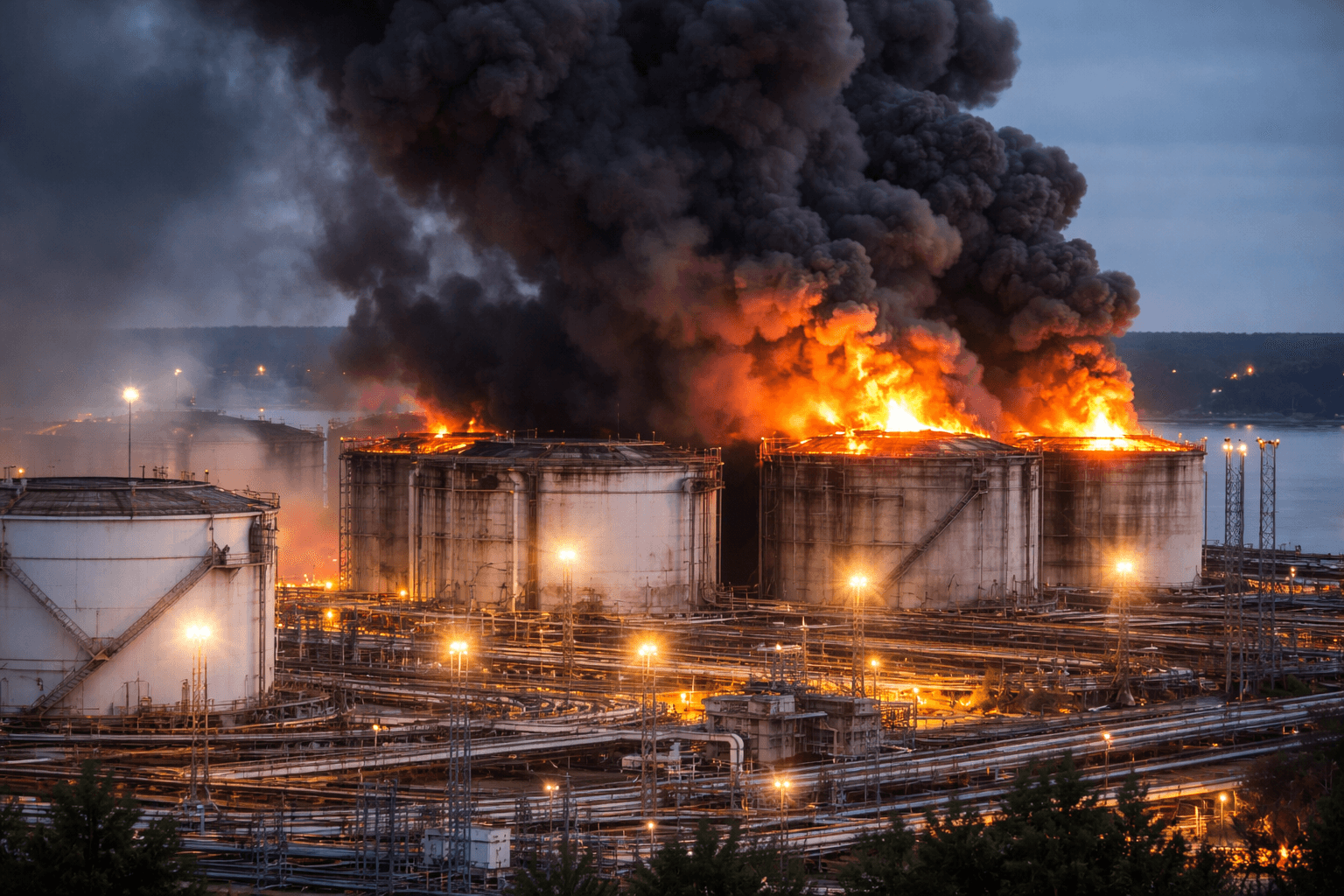
The most critical impact has been reported at the Primorsk oil terminal, Russia’s largest Baltic export hub operated by Transneft. The strike, carried out around 23 March 2026, damaged storage infrastructure, including fuel tanks, and triggered fires that forced partial suspension of operations. Primorsk typically handles close to 1 million barrels per day (bpd) of crude oil, along with substantial diesel exports, making it a high-value logistics target.

Additional strikes were reported at the Ust-Luga port and the Novorossiysk port, alongside attacks on inland refineries and pipeline nodes. This multi-point targeting has created a cascading disruption across Russia’s export network rather than an isolated port shutdown.

Extent of damage and operational disruption

Current estimates suggest that up to 40% of Russia’s oil export capacity—approximately 2 million bpd—has been temporarily knocked offline due to the combined impact of these strikes.

The damage profile is concentrated in:

  • Tank farms, where fires have compromised storage capacity

  • Loading systems, including pumping stations and marine loading arms

  • Pipeline inflows, affected by upstream infrastructure hits

While some components, such as pumping systems, can be restored within days to weeks, storage tank repairs typically require several weeks to months, depending on the extent of structural damage and fire exposure.

However, the primary constraint is not engineering—it is security risk. Repeated strikes on the same assets could delay full restoration indefinitely, effectively extending disruption timelines beyond standard repair cycles.

Rebuild timelines and logistical adjustments

In stable conditions, partial operations at affected ports could resume within 1–3 weeks using bypass systems and reduced capacity handling. Full recovery, particularly for heavily damaged tank farms, may take 1–3 months or longer.

In response, Russia is already adjusting logistics flows:

  • Diversion of cargoes toward Far East terminals such as Kozmino

  • Increased reliance on longer-haul routes to Asian buyers

  • Reallocation of tanker fleets, including non-Western “shadow fleet” vessels

These adjustments, while mitigating export losses, come at the cost of higher freight rates, longer voyage cycles, and reduced overall system efficiency.

Impact on global oil trade

The disruption is beginning to reflect in global markets. Reduced Russian export availability is tightening supply, contributing to upward pressure on crude prices, with benchmarks trending toward the $100 per barrel range.

For the shipping and logistics sector, the implications are immediate:

  • Longer tonne-mile demand, supporting tanker earnings

  • Increased congestion at alternative export terminals

  • Higher insurance and risk premiums in affected regions

Additionally, disruption at primary loading ports complicates Russia’s ability to maintain consistent export volumes under existing sanction-evasion mechanisms.

This wave of attacks marks a clear shift toward targeting energy logistics infrastructure as a strategic objective. By focusing on ports, storage, and pipelines simultaneously, Ukraine is not just reducing output—it is disrupting the entire export chain from wellhead to vessel loading.

Unlike refinery strikes, which primarily affect product output, port disruptions directly impact international trade flows, making them more consequential for global supply chains.

The strikes on Primorsk, Ust-Luga, and Novorossiysk highlight a growing vulnerability in Russia’s oil export system. With a significant share of capacity offline and repairs constrained by ongoing security threats, the situation represents more than a temporary outage.

It is an evolving energy logistics disruption with global trade implications, where recovery timelines will depend as much on military developments as on technical repairs.


Share on FB
Share on FB
Share on X
Share on Linkedin

Comments

Related Post

Mar 26, 2026

In Iran’s latest communication to the United Nations, Tehran has stated that “non-hostile vessels” may transit the strait only if they coordinate directly with Iranian authorities and comply with its security protocols. At the same time, vessels linked to the United States, Israel, or parties deemed hostile are explicitly excluded from safe passage. This effectively transforms a historically open international waterway into a controlled transit corridor, where access is conditional rather than guaranteed. Operational reality: “coordinate or don’t transit” Iran’s condition—coordination with its maritime authorities—is already shaping real-world shipping behavior. Evidence from recent movements shows: • Ships securing passage through direct diplomatic or operational coordination • Select vessels using identification signals or prior clearance to transit safely • Non-compliant vessels being turned back or denied access This creates a two-tier shipping system: 1. Cleared and compliant vessels (low risk, controlled passage) 2. Unaligned or non-coordinated vessels (high risk, potential denial) For operators, this shifts decision-making from purely commercial to political risk assessment. Logistics and freight impact The immediate impact is being felt across tanker and container markets: • Reduced transit volumes - tighter vessel availability • Longer alternative routing via Oman/UAE ports - increased costs • Rising insurance premiums and war risk surcharges • Operational delays due to clearance requirements Some carriers are already rerouting cargo through ports such as Sohar or Khor Fakkan, followed by overland movement—effectively bypassing Hormuz at higher cost and lower efficiency. Strategic shift: from disruption to control Unlike temporary blockades, Iran’s move signals something more structural. This is not just about restricting traffic—it is about: • Exerting sovereign control over transit conditions • Leveraging geography to influence global energy flows • Introducing the possibility of regulated or even monetized passage In effect, Hormuz is being repositioned closer to a controlled maritime corridor, rather than a neutral international strait. Market implications For global trade and energy markets, the implications are significant: • Oil supply chains become less predictable and more politicized • Freight markets see volatility driven by risk premiums, not just demand • Asian buyers (India, China) gain relative advantage through diplomatic alignment and coordination • Western-linked cargo flows face higher operational uncertainty The situation also introduces a long-term concern: if conditional access becomes normalized, it could set a precedent for other strategic chokepoints globally. Iran’s message to the UN is not a reassurance—it is a redefinition of navigation rights in one of the world’s most critical shipping lanes. For the logistics industry, the takeaway is clear: Hormuz is no longer just a passage—it is now a negotiated transit zone, where access depends as much on geopolitics as on maritime compliance. The shift from open sea lane to controlled corridor could prove to be one of the most consequential changes in global shipping in recent years.

Mar 26, 2026

In Iran’s latest communication to the United Nations, Tehran has stated that “non-hostile vessels” may transit the strait only if they coordinate directly with Iranian authorities and comply with its security protocols. At the same time, vessels linked to the United States, Israel, or parties deemed hostile are explicitly excluded from safe passage. This effectively transforms a historically open international waterway into a controlled transit corridor, where access is conditional rather than guaranteed. Operational reality: “coordinate or don’t transit” Iran’s condition—coordination with its maritime authorities—is already shaping real-world shipping behavior. Evidence from recent movements shows: • Ships securing passage through direct diplomatic or operational coordination • Select vessels using identification signals or prior clearance to transit safely • Non-compliant vessels being turned back or denied access This creates a two-tier shipping system: 1. Cleared and compliant vessels (low risk, controlled passage) 2. Unaligned or non-coordinated vessels (high risk, potential denial) For operators, this shifts decision-making from purely commercial to political risk assessment. Logistics and freight impact The immediate impact is being felt across tanker and container markets: • Reduced transit volumes - tighter vessel availability • Longer alternative routing via Oman/UAE ports - increased costs • Rising insurance premiums and war risk surcharges • Operational delays due to clearance requirements Some carriers are already rerouting cargo through ports such as Sohar or Khor Fakkan, followed by overland movement—effectively bypassing Hormuz at higher cost and lower efficiency. Strategic shift: from disruption to control Unlike temporary blockades, Iran’s move signals something more structural. This is not just about restricting traffic—it is about: • Exerting sovereign control over transit conditions • Leveraging geography to influence global energy flows • Introducing the possibility of regulated or even monetized passage In effect, Hormuz is being repositioned closer to a controlled maritime corridor, rather than a neutral international strait. Market implications For global trade and energy markets, the implications are significant: • Oil supply chains become less predictable and more politicized • Freight markets see volatility driven by risk premiums, not just demand • Asian buyers (India, China) gain relative advantage through diplomatic alignment and coordination • Western-linked cargo flows face higher operational uncertainty The situation also introduces a long-term concern: if conditional access becomes normalized, it could set a precedent for other strategic chokepoints globally. Iran’s message to the UN is not a reassurance—it is a redefinition of navigation rights in one of the world’s most critical shipping lanes. For the logistics industry, the takeaway is clear: Hormuz is no longer just a passage—it is now a negotiated transit zone, where access depends as much on geopolitics as on maritime compliance. The shift from open sea lane to controlled corridor could prove to be one of the most consequential changes in global shipping in recent years.

Your source for the latest logistics news, ocean freight updates, and incident reports. Stay informed, stay ahead in the world of supply chain.

© 2025 Logisticswall. Designed by

Your source for the latest logistics news, ocean freight updates, and incident reports. Stay informed, stay ahead in the world of supply chain.

© 2025 Logisticswall. Designed by

Your source for the latest logistics news, ocean freight updates, and incident reports. Stay informed, stay ahead in the world of supply chain.

© 2025 Logisticswall. Designed by