
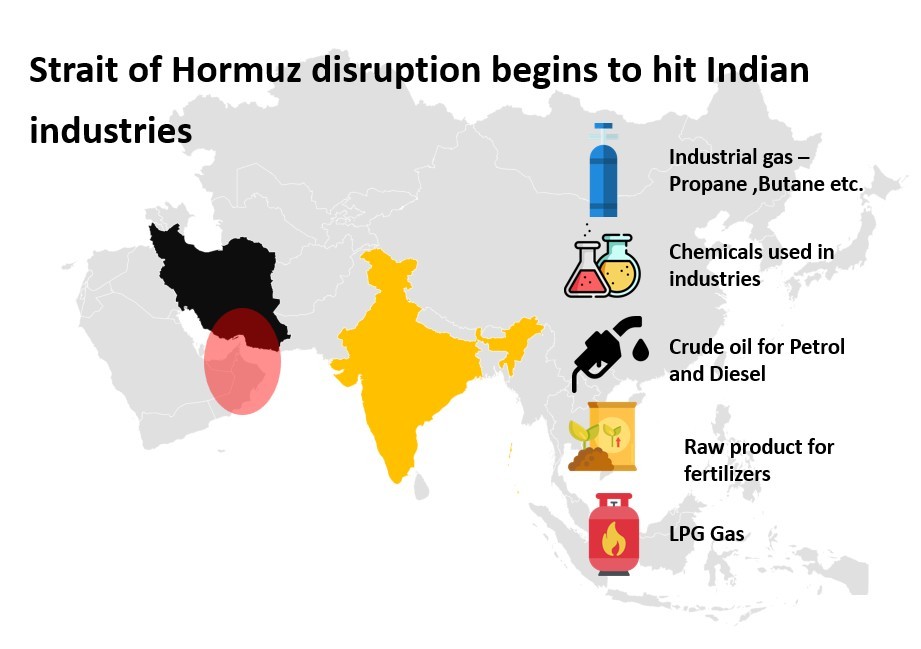
The disruption in the Strait of Hormuz has started to ripple through several Indian industries, exposing how dependent the country’s trade and energy flows remain on the Gulf corridor.
The situation intensified after rising tensions between Iran and the United States threatened shipping traffic across the narrow waterway that connects major Gulf energy exporters to global markets. Nearly a fifth of India’s imports pass through this route, including a large share of crude oil and liquefied natural gas.
The first signs of disruption appeared in energy-intensive sectors. Chemical units in Gujarat reported operating with sharply reduced gas supplies, forcing production cuts and pushing raw material costs higher. Fertilizer manufacturers have also warned of limited gas availability, with some plants indicating only a few weeks of feedstock cover. Since natural gas is a critical input for urea production, any prolonged disruption could affect domestic fertilizer output.
Steel producers have begun facing similar challenges. Companies dependent on industrial gases such as LPG, propane, and natural gas have reported operational constraints as shipments slow and fuel costs rise. Shipping delays have also started affecting exporters. Mango pulp shipments from Tamil Nadu, a major export hub, have been held up as vessels avoid risky routes in the Gulf. In addition, exporters of basmati rice and metal alloys have reported cargo delays and higher freight costs.
The Strait of Hormuz remains one of the world’s most critical maritime chokepoints. Any instability in the region quickly translates into higher energy prices, shipping disruptions, and supply shortages for countries like India that rely heavily on Gulf trade routes.
Industry groups are now closely monitoring developments, warning that a prolonged disruption could raise input costs across manufacturing and affect export schedules in several sectors.
Below are few facts on imports for below critical commodities imported via Arabian Gulf
LPG (cooking gas)
India is experiencing the most visible shortage in LPG.
Imports slowed because many LPG tankers pass through the Gulf route.
India imports around 85–90% of LPG from Middle East suppliers such as Saudi Arabia and Qatar.
Panic booking of cylinders increased from 5.5 million to 7.6 million daily requests.
Impact
Restaurants and industries asked to switch fuels.
Some households switching to kerosene or coal temporarily.
Natural gas / LNG
This is the biggest industrial shortage right now.
Gas supplies to industries have been curtailed.
55–65% of India’s LNG imports pass through Hormuz.
Industries affected
petrochemicals / glass / tiles / fertilizer plants / steel
Factories are already cutting production in some cases.
Industrial gases (propane, LPG, natural gas)
Industries are facing shortage of industrial fuel gases.
Example:
Steel maker Jindal Stainless reported production disruption because of shortage of propane, LPG, and natural gas.
Affected sectors
Steel / fabrication / metal processing / ceramics
Petrochemical feedstock (naphtha and gas)
Petrochemical plants are facing shortage of feedstock materials.
Key feedstocks affected:
naphtha / natural gas / petrochemical derivatives
These are used to produce:
plastics / synthetic fibers / chemicals
Supply curbs have already been imposed on some facilities.
Fertilizer raw materials
India imports a significant portion of fertilizer inputs from West Asia.
Problems:
LNG shortage affects urea production
imports of fertilizer inputs may tighten
India imports around 30% of fertilizer requirements, with a large portion coming from West Asia.
Sulphur and chemical inputs
Sulphur used in fertilizers and chemicals is largely imported from the Gulf.
Around 65% of India’s sulphur imports come from West Asia.
Shortages may affect:
fertilizer production / chemical manufacturing
Industrial raw materials for cement
Construction sector may face shortage of limestone imports.
India imported $483 million worth of limestone from West Asia, around 68% of total imports.
If shipping delays continue, cement prices could rise.
Popular Posts


Explore Topics



Comments