
In early January 2026, an otherwise ordinary Chinese feeder container ship, the
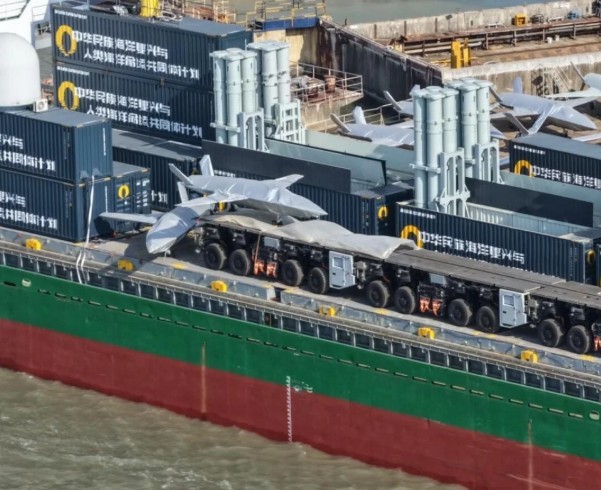
, attracted global attention after satellite and social-media images showed something highly unusual, the vessel’s deck transformed from a simple transport platform into a makeshift launch site for advanced combat drones.
Unlike traditional warships built for specific maritime missions, this transformation wasn’t achieved through years of design and construction. Instead, what emerged was a modular, truck-mounted electromagnetic launch system placed directly onto the ship’s deck, suggesting a bold new approach in naval warfare strategy.
A Container ship with a military twist
What makes this transformation noteworthy is the method. The Zhong Da 79, a standard container feeder vessel, first made headlines when it was spotted laden with nearly 60 vertical missile launch cells fitted in container modules. That in itself demonstrated China’s capability to quickly convert commercial vessels into improvised arsenal ships.
Then came the next surprise, in late December images showed the bulk of those missile launchers removed, replaced by a truck-link catapult train capable of launching fixed-wing drone fighters. The system consists of high-mobility truck units joined end-to-end, forming a compact electromagnetic rail launch track, a crude but functional equivalent of a carrier catapult.
Mounted on this makeshift rail was at least one combat drone, poised for launch, a striking image that blurred the line between civilian and combat vessels.
This development reflects several broader trends and possibilities:
1. Modular and low-cost force projection
Rather than relying solely on expensive aircraft carriers or combatants, modular systems allow cheap merchant hulls to be converted quickly into mission-specific platforms. They can serve in air-defense, surveillance, or offensive roles depending on the modules installed.
2. Drones become sea-based weapons
China, like several major powers, has been rapidly expanding its family of combat UAVs. Some are designed specifically for naval operations. By integrating drone launch capability onto ships, naval planners effectively expand the reach of air assets without the need for traditional carriers or large helipads.
3. Electromagnetic launch systems at sea
The use of electromagnetic rail launchers, a technology similar to that developed for modern carrier catapults, signals a willingness to experiment with advanced launch tech on unconventional platforms. While short, the track aboard Zhong Da 79 is not as capable as those on purpose-built carriers, but it could still support short-take-off drones.
Strategic implications
Warfare at lower cost:
Maritime threat perception: Converting civilian vessels into war tools challenges existing rules of engagement and maritime law, especially in tense areas like the South China Sea or Taiwan Strait.
The transformation of Zhong Da 79 from a feeder ship to a floating drone launch platform is more than a viral image, it’s a hint of how future naval engagements might evolve. In an age where unmanned systems, modular technologies, and electromagnetic launchers are increasingly accessible, the traditional maritime order could undergo significant transformation.
Image source - X
Popular Posts

Explore Topics




Comments