
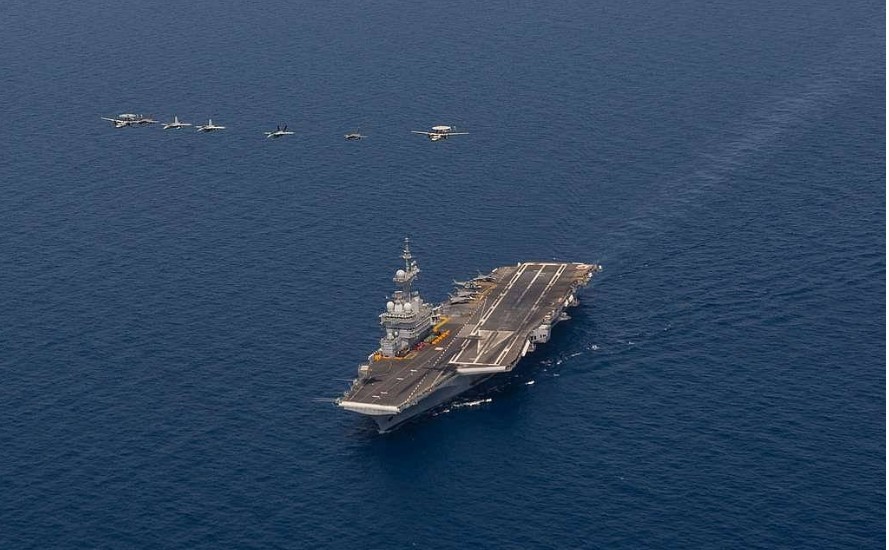
French aircraft carrier Charles de Gaulle has been deployed toward the eastern Mediterranean and Gulf region as tensions escalate around Iran and the Strait of Hormuz. France is also deploying several escort warships and expanding naval missions to protect maritime routes and allied Gulf states.
The carrier leads a French carrier strike group, which typically includes frigates, destroyers, submarines, and logistics vessels.
Core specifications of aircraft carrier Charles de Gaulle
Displacement: ≈42,500 tonnes
Length: 261 m
Propulsion: Two K15 nuclear reactors
Speed: ≈27 knots
Crew: ≈1,900 personnel (ship crew + air wing)
Endurance: ≈45 days without resupply
Air power
The carrier can operate up to 30–40 aircraft, including:
Rafale M multirole fighter jets
E-2C Hawkeye airborne early-warning aircraft
Dauphin and NH90 helicopters
These aircraft provide:
air-defence patrols
long-range strike capability
radar surveillance and targeting
The carrier also carries around 500 tonnes of ammunition and up to 800 commandos for amphibious or special-operations missions.
U.S. aircraft carriers already in the region
Two major U.S. Navy carrier strike groups are already operating near the Gulf.
1. USS Gerald R. Ford
World’s largest aircraft carrier
Nuclear powered
Deploys 70–80 aircraft including F-35C and F/A-18 fighters
Operating in the Red Sea and Middle East theatre
2. USS Abraham Lincoln
Nimitz-class carrier
Crew about 5,500 personnel
Participating in U.S. strike operations in the region.
Each U.S. carrier strike group normally includes:
1 aircraft carrier
1–2 cruisers
2–4 destroyers
submarines
supply ships
The concentration of three carrier groups (two U.S. + one French) dramatically increases Western air-strike and surveillance capability around the Gulf.
Combined carrier capacity in the region could exceed:
150–200 combat aircraft
thousands of sailors and pilots
dozens of escort warships
The objective is primarily:
protect shipping routes
deter Iranian naval attacks
maintain air superiority in case of escalation.
Drone and missile threat
Iran and its regional allies possess large inventories of:
attack drones
anti-ship missiles
ballistic missiles
These weapons have already been used in the region against military targets and commercial shipping, raising the risk of drone or missile attacks against naval vessels.
However, carrier groups deploy extensive defences including:
radar early-warning aircraft
Aegis missile defence destroyers
electronic warfare systems
China is unlikely to intervene militarily but could provide satellite intelligence or surveillance data to Iran.
China operates:
military satellites
ocean-tracking systems
space-based radar monitoring
Such systems could theoretically help identify carrier positions, although carrier strike groups constantly maneuver to avoid tracking.
Reaction from other countries
European and Gulf states have supported increased naval presence to protect commercial shipping and oil routes, while also calling for de-escalation to avoid a wider regional conflict.
For shipping and logistics markets, the buildup signals continued risk around the Strait of Hormuz, which carries a major share of global energy shipments.
Popular Posts


Explore Topics



Comments