
Digital Jurisdiction at Sea: China’s First Starlink Penalty and What It Means for Global Shipping
Incidence
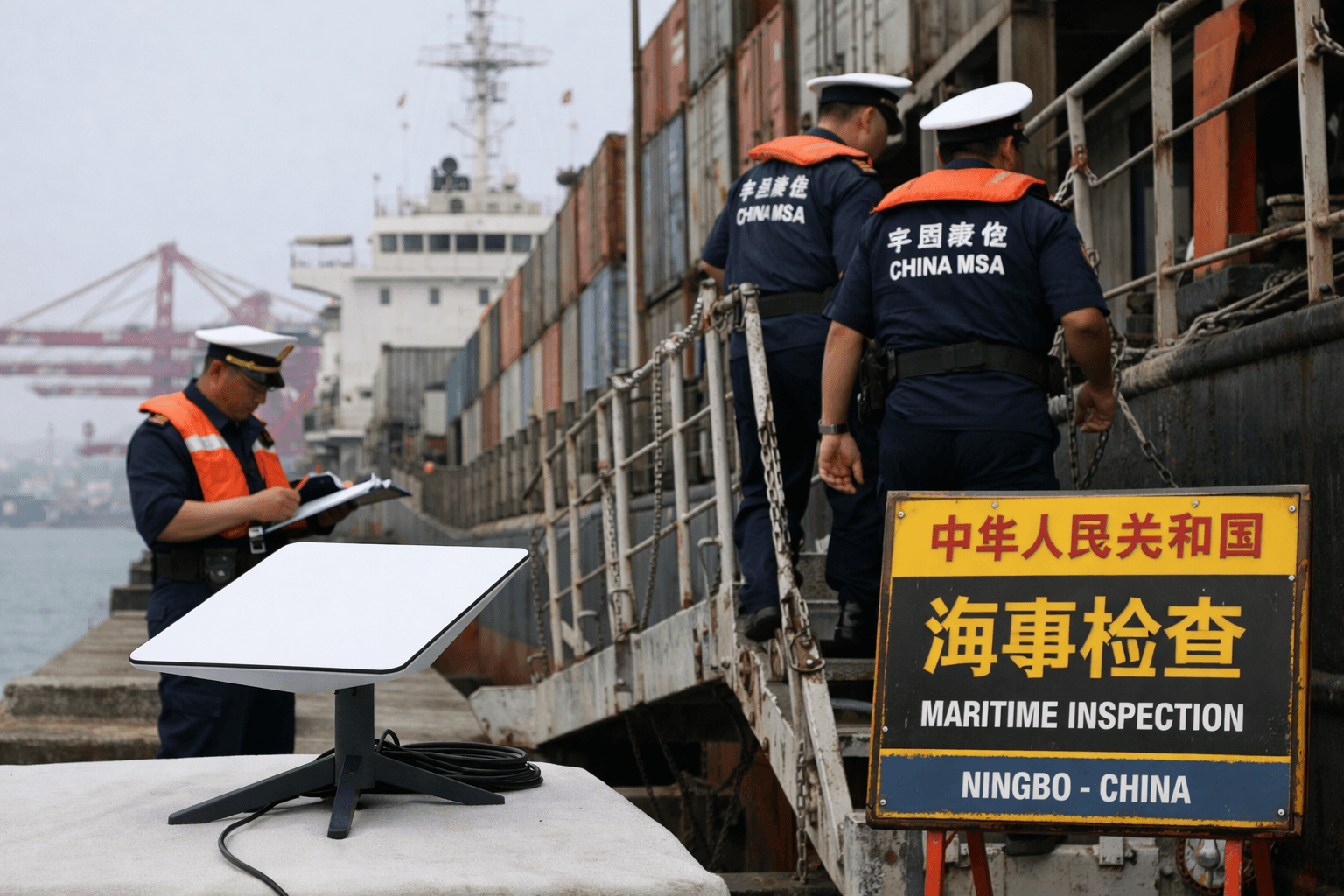
Recently in December 2025, for the first time in history any country penalised a ship for charges of using a different countries internet service.
China took the first ever regulatory penaliizng action against a foreign ship for using SpaceX’s Starlink satellite internet service within China’s territorial waters — this action is disputed by international maritime law.
Detail of the Incidence
During a routine inspection at Ningbo Port in Zhejiang province of China, the Chinese maritime safety officers identified a foreign vessel equipped with a specific “micro rectangular antenna” which was a terminal for low-Earth orbit (LEO) satellite for communications and data modulation, in-short the foreign vessel was using internet through Starlink (an American service provider).
As per China this was a breach of Chinese telecommunications and radio laws, which require:
All network traffic within Chinese territory to be routed through China managed domestic gateways only.
Prior intimation and China approval for any radio devices or frequency use.
Starlink has never received an approval in China and is thus banned under the rule.
Till now the penalty amount has not been declared officially.
How will it impact the maritime industry
Starlink and other Lower Earth Orbit services have much to offer to maritime industry including high and reliable speed which gives many other benefits.
Dispute created by China and few other countries
Even though the international water till 12 nautical miles to Chinese coast is subject to full jurisdiction under international maritime law still China is disputing its digital sovereignty. In June 2025, China introduced new regulations on direct-to-device satellite services.
This type of dispute has been raised few other countries also, example – Iran and Russia.
The impact of non-compliance risks for the ships includes fines, equipment confiscation, vessel detention, and operational delays, these are costly outcome as most of vessels have tight schedules and less window for port operations.
Data Sovereignty dispute by maritime industry
Understanding Chinese benefits and infrastructure planned
China is investing in domestic satellite internet:
China SatNet’s Guowang constellation targets 13,000 satellites;
Also, Qianfan’s project aims for up to 15,000 satellites — both designed, planned and are being implemented to give sovereign command over its digital infrastructure.
As per news since 2024, China has invested 1.25 billion USD in satellite internet sector and is expected to invest approx. 3 billion USD by 2030.
The first penalty for unauthorized Starlink usage in China represents much more than a maritime enforcement action — it encapsulates a turning point in how nations regulate digital connectivity at global platform. The maritime industry might also face security challenge of control of vessels system and privacy later by using Chinese internet. From - Maritime operators, technology providers, and international policymakers, the message is clear “Connectivity does not transcend borders without consequences. Sovereignty matters — even at sea”.
Popular Posts


Explore Topics



Comments