
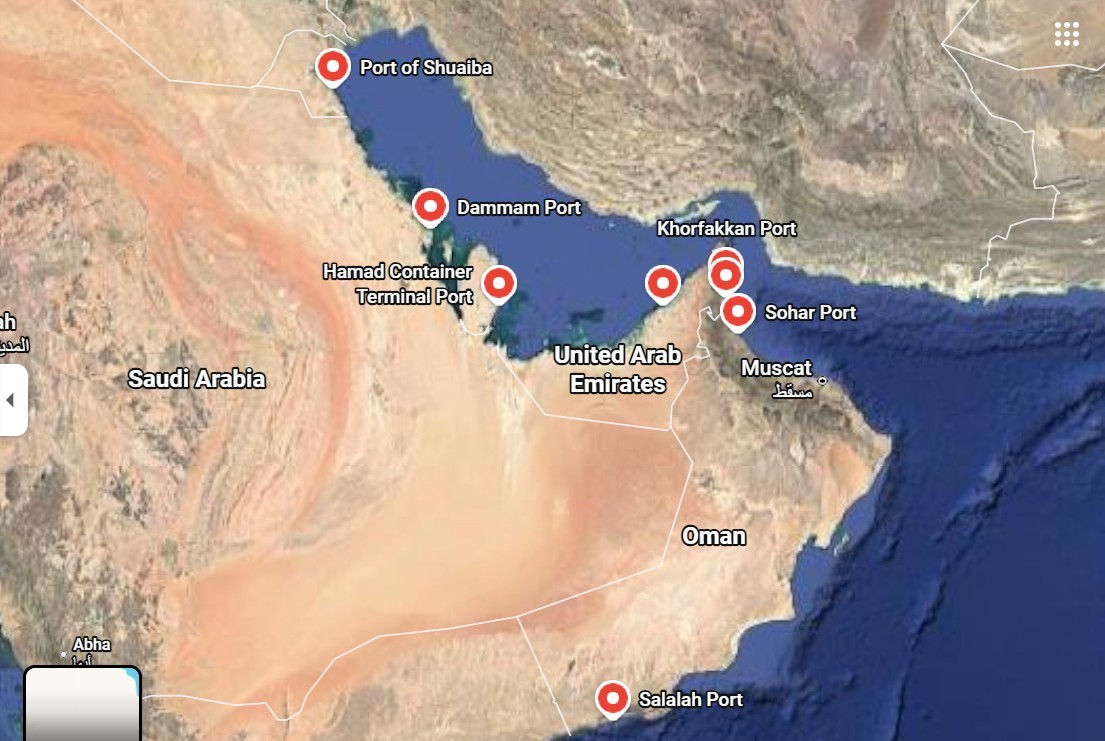
Following security concerns around the Strait of Hormuz, several shipping lines have started diverting or terminating voyages before entering the Gulf, creating major disruptions for cargo bound to ports such as Jebel Ali, Khalifa Port, Dammam, Doha, and Kuwait.
1. DP World feeder strategy – Offloading in Indian ports
According to DP World / Unifeeder operational advisory (March 2026), containers originally bound for Jebel Ali are being discharged at nearby Indian ports.
Shippers are given two options:
Return cargo back to origin after destuffing containers
Pay an Emergency Surcharge of USD 2000 per container to move cargo via alternative routing.
The alternative routing involves sending containers to Khor Fakkan (UAE)/Sohar (Oman), which lies outside the Strait of Hormuz, allowing vessels to avoid entering the Gulf.
2. Similar strategy by major carriers
Other carriers are implementing comparable measures.
MSC advisory – Gulf service disruption (March 2026)
MSC has introduced additional freight exceeding USD 3000 per container to cover diversion costs and alternative routing. Earlier as per their advisory they charged only 800 USD extra and after seeing the gravity of the situation they are about to increase the charges for transhipment.
CMA CGM advisory – Middle East operational update (March 2026)
CMA is offering alternative routing with additional freight around USD 2000 per container.
These surcharges reflect the extra sailing distance, feeder connections, and terminal handling costs associated with diversion.
Its also in the news that CMA CGM is starting a new service to Khor Fakkan port from mid of March 2026.
3. Khor Fakkan becoming a temporary gateway
Many carriers are considering Khor Fakkan Container Terminal (KCT) as the primary alternative gateway because it sits before the Strait of Hormuz on the Gulf of Oman side.
Key terminal details:
Operator: Gulftainer
Annual capacity: ~5 million TEU
Quay length: 1,880 meters
Draft: 16 meters
Container yard: 450,000 m²
Cranes: 18 quay cranes
Although Khor Fakkan is a major transshipment hub, it was not designed to replace the entire capacity of Gulf gateway ports like Jebel Ali.
Jebel Ali alone handles nearly 19 million TEU annually, far exceeding Khor Fakkan’s practical capacity.
Because of this, the terminal is reportedly:
restricting new cargo acceptance
prioritizing reefer and perishable cargo
limiting full container discharge.
4. Sohar as another alternative – but customs complications
Some carriers are also evaluating Sohar Port in Oman.
However, routing cargo through Sohar creates logistical complications:
Cargo destined for UAE must undergo Oman customs clearance
Containers then require cross-border trucking into the UAE
Additional documentation and transit procedures increase delays.
This makes Sohar a temporary solution rather than a scalable alternative.
5. Growing option: Return cargo to port of loading
Because of capacity constraints at alternative ports, many carriers are also considering a Back-to-Origin option.
This means:
Cargo may be returned to the Port of Loading (POL).
The shipment is treated as End of Voyage / Voyage Terminated.
Shippers must decide whether to store cargo, redirect to another destination, or rebook later.
Some shipping lines have already issued “End of Voyage” notices for Gulf-bound cargo (like MSC), effectively suspending delivery obligations until the situation stabilizes.
Key challenge for Gulf supply chains
The major issue is structural:
Most Gulf container ports lie inside the Strait of Hormuz.
If vessels avoid the strait, only a few ports remain accessible, including:
Khor Fakkan
Fujairah
Sohar/Salalah.
These ports cannot absorb the entire cargo volume destined for the Arabian Gulf, which explains the sudden rise in - emergency surcharges / rerouting charges / cargo return options.
Replying to major queries asked in present situation :-
Can all shipping lines transport containers between Indian ports for complete journey from India to India?
No – As per the Merchant Shipping Act, 1958 (Sections 406 and 407) - These sections constitute the core cabotage laws in India, which dictate that "coasting trade" (moving cargo between Indian ports) is primarily reserved for Indian-flagged ships.
How to get Customs clearance for “Back to Town (BTT)” cargo in India?
As per the JNCH (Jawaharlal Nehru Customs House) Public Notice (06 March 2026), Public notice number 31/2026 f exporters can obtain Back to Town (BTT) permission for export cargo where EGM has not been filed by following a simple process:
Submit a request to the concerned Assistant/Deputy Commissioner (AC/DC) at the respective CFS or CPP through the exporter or their Customs Broker.
Customs will verify the seal on the container (e-seal for self-sealed containers or customs bottle seal for dock-stuffed containers) and match it with the Shipping Bill and stuffing records.
If the seal is intact, BTT permission is granted.
No physical examination is required for containers in CPP; for CFS cargo, only destuffing and visual inspection of lots is done.
BTT penalties/fees are waived under the current relaxation to facilitate trade.
Why are shipping lines charging Emergency Risk Surcharge (ERS)?
Emergency Risk Surcharge is introduced to cover additional operational costs, insurance premiums, and security risks when vessels sail through or avoid conflict zones. Have mentioned the details in our earlier blog with example of BL clauses from MSC - On what basis can shipping lines reroute cargo and charge extra? .
Can shipping lines legally change the route of a vessel?
Yes. Under the Bill of Lading clauses such as Methods and Routes of Carriage and Carrier’s Options, shipping lines have the right to change the route, transship cargo, or discharge cargo at alternative ports if required for safety or operational reasons. Have mentioned the details in our earlier blog with example of BL clauses from MSC - On what basis can shipping lines reroute cargo and charge extra? .
Popular Posts

Explore Topics


Comments