
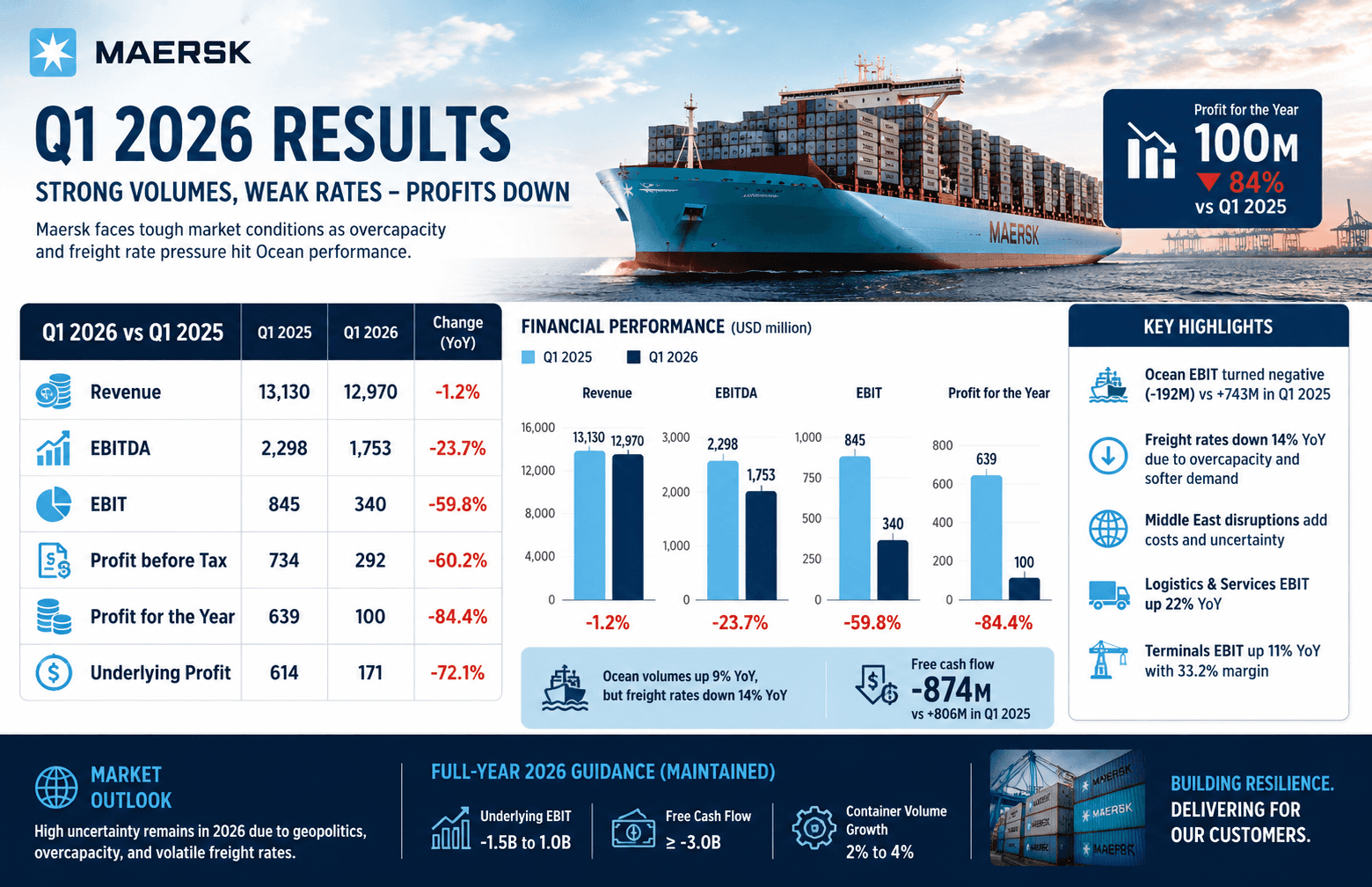
The first quarter of 2026 exposed the new reality of global container shipping: cargo demand is holding up, but profitability is evaporating. A.P. Moller - Maersk reported revenue of USD 12.97 billion in Q1 2026, slightly below USD 13.13 billion a year earlier. But the real shock came in earnings. Profit before tax dropped from USD 734 million to just USD 292 million, while profit for the period collapsed from USD 639 million to only USD 100 million.
The numbers show a company caught between strong operational execution and a weak freight market.
Q1 2026 vs Q1 2025
Metric | Q1 2025 | Q1 2026 | Change |
Revenue | 13,130 | 12,970 | -1.2% |
EBITDA | 2,298 | 1,753 | -23.7% |
EBIT | 845 | 340 | -59.8% |
Profit before tax | 734 | 292 | -60.2% |
Profit for the year | 639 | 100 | -84.4% |
Underlying profit | 614 | 171 | -72.1% |
Profit fell sharply even though cargo volumes grew
One of the most important signals from the quarter is that Maersk actually moved more containers. Ocean volumes increased 9% year-on-year, supported mainly by Asian exports and strong utilisation levels near 96%.
Normally, rising volumes should support earnings. But 2026 is different.
The global container market is facing severe overcapacity. Too many new vessels ordered during the pandemic boom are now entering service. As supply expands faster than demand, freight rates are under pressure across major trade lanes. Maersk disclosed that average loaded freight rates fell 14% year-on-year in Q1 2026.
That single factor destroyed profitability.
Ocean business became the weak spot
Maersk’s Ocean division generated USD 8.18 billion in revenue compared with USD 8.91 billion last year. EBIT turned negative at USD -192 million versus a positive USD 743 million in Q1 2025.
The company highlighted three major reasons:
Freight rates dropped sharply
Excess vessel supply continued across the industry
Middle East disruptions increased operational complexity
The Red Sea and Strait of Hormuz situation added uncertainty to routing and fuel planning. However, Maersk said the direct financial impact during Q1 remained limited because higher bunker costs were partially recovered through surcharges and spot rate adjustments.
Still, the market environment remains fragile.
The shipping market has changed completely since last year
In Q1 2025, shipping lines were still benefiting from elevated freight conditions caused by rerouting around the Red Sea crisis. Vessel diversions tightened effective capacity and supported freight rates.
By Q1 2026, the situation shifted.
Several structural changes hit the industry simultaneously:
1. Massive fleet expansion
New vessel deliveries accelerated globally, creating excess capacity. Even with decent cargo demand, supply outpaced utilisation growth.
2. Freight rates normalized
Pandemic-era pricing power disappeared. Spot rates weakened across Asia-Europe and transpacific routes.
3. Customers became more price-sensitive
Importers and exporters shifted toward shorter contracts and flexible sourcing, reducing carriers’ pricing leverage.
4. Geopolitical risks became operational costs
Middle East instability forced carriers to maintain contingency routing, higher fuel reserves, and operational flexibility.
5. Cash flow weakened across the sector
Maersk posted negative free cash flow of USD 874 million compared with positive USD 806 million last year.
6. Logistics and terminals saved the quarter
While Ocean struggled, Maersk’s non-shipping businesses performed relatively well.
The Logistics & Services division increased revenue by 8.7% and EBIT by 22%, supported by stronger air freight and middle-mile operations.
Meanwhile, the Terminals business delivered:
Revenue growth of 6.7%
EBIT growth of 11%
EBIT margin of 33.2%
This reinforces Maersk’s long-term strategy of becoming an integrated logistics company rather than depending purely on container freight cycles.
Cost control remains impressive
Despite the earnings collapse, Maersk did manage one operational victory.
Ocean unit costs at fixed energy prices fell 7% year-on-year due to network optimisation and the Gemini Cooperation model.
That means the company is operating more efficiently even during a difficult freight environment.
Without those cost reductions, losses would likely have been significantly worse.
What the market looks like now
The container shipping market in mid-2026 is highly volatile.
Current conditions include:
Weak freight pricing
Overcapacity from vessel deliveries
Geopolitical uncertainty in the Middle East
Stable but not explosive cargo demand
Heavy competition among carriers
Maersk itself maintained cautious full-year guidance, expecting underlying EBIT between negative USD 1.5 billion and positive USD 1.0 billion.
That unusually wide range shows how uncertain the market remains.
The company also warned that future performance depends heavily on:
Red Sea reopening conditions
Strait of Hormuz stability
Oil and bunker prices
Congestion levels if trade routes normalize suddenly
Writers view
The Q1 2026 results are less about operational weakness and more about the end of an abnormal shipping cycle.
During 2021–2024, carriers enjoyed extraordinary profitability because capacity was constrained and supply chains were disrupted. That phase is now over.
Maersk is entering a lower-margin era where:
scale alone is not enough,
freight pricing is unstable,
and logistics diversification matters more than ever.
The company still has strong balance sheet liquidity with USD 18.4 billion in cash and deposits. But investors are no longer rewarding shipping companies simply for moving large cargo volumes. Profitability now depends on network efficiency, logistics integration, and the ability to survive prolonged pricing pressure.
For the broader shipping industry, Q1 2026 may be remembered as the quarter when operational strength stopped translating into strong profits.
Popular Posts

Explore Topics


Comments