
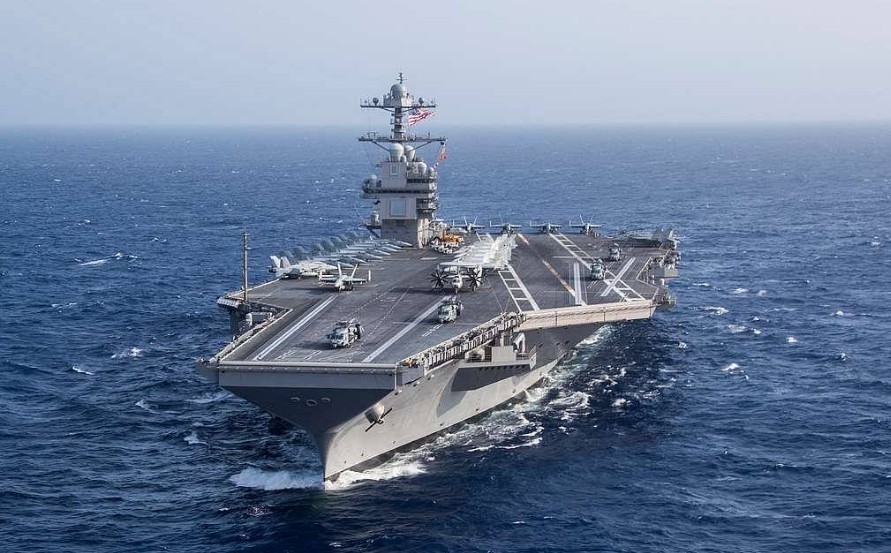
The United States has significantly increased its naval presence in the Middle East after the nuclear-powered aircraft carrier USS Gerald R. Ford transited the Suez Canal and entered the Red Sea. The move signals a major escalation in military readiness in one of the world’s most strategically important maritime regions.
The deployment comes amid rising tensions in the Middle East and growing security concerns around key shipping routes such as the Red Sea, Bab-el-Mandeb, and the Strait of Hormuz, which are critical corridors for global energy and container trade.
USS Gerald R. Ford crosses the Suez Canal
The USS Gerald R. Ford (CVN-78), the newest and largest aircraft carrier in the U.S. Navy, recently transited the Suez Canal with its strike group while moving from the Mediterranean Sea into the Red Sea.
Satellite images and photos released by the U.S. military confirmed the passage of the carrier along with escort vessels, including the guided-missile destroyer USS Bainbridge (DDG-96).
The Ford strike group’s arrival places one of the most powerful naval formations in the region. Aircraft carriers like the Ford can carry more than 70–80 combat aircraft, making them a mobile airbase capable of conducting large-scale military operations.
Multiple U.S. carriers now positioned near the Middle East
With the Ford now operating in the Red Sea, the United States already has another aircraft carrier in nearby waters.
USS Abraham Lincoln is currently deployed in the Arabian Sea.
USS Gerald R. Ford has entered the Red Sea after crossing the Suez Canal.
Reports also suggest that a third aircraft carrier, USS George H. W. Bush, could soon deploy toward the region after completing its pre-deployment exercises.
If this deployment happens, it would create a rare situation where three U.S. carrier strike groups operate simultaneously around the Middle East, representing one of the largest naval concentrations in the region in decades.
What it means for the maritime industry
For the shipping and logistics sector, these developments highlight how quickly geopolitical tensions can influence maritime operations.
Potential impacts include:
Higher war-risk insurance premiums
Increased naval escorts for merchant vessels
Shipping route adjustments
Rising freight costs and delays
The presence of multiple U.S. carrier strike groups suggests that maritime security will remain a major focus in the coming weeks.
The transit of USS Gerald R. Ford through the Suez Canal and the possible deployment of USS George H. W. Bush underline the strategic importance of the Middle East’s maritime corridors.
For global trade and shipping companies, the situation serves as another reminder that naval power, geopolitics, and commercial shipping remain deeply interconnected.
Popular Posts

Explore Topics



Comments