For years, “2030” has been repeated like a coordinated deadline.
Governments invoke it.
The United Nations frames global goals around it.
Central banks speak of transition timelines.
The World Economic Forum ties economic restructuring to it.
Climate transition, clean energy, digital infrastructure, supply-chain resilience — all converging toward the same horizon.
But beneath the public narrative lies another transformation that is far less discussed: the restructuring of global trade geography itself.
The real story of 2030 may not only be about carbon emissions or renewable energy. It may be about routes, chokepoints, logistics corridors, and the redistribution of strategic power.
The Arctic is becoming an economic frontier
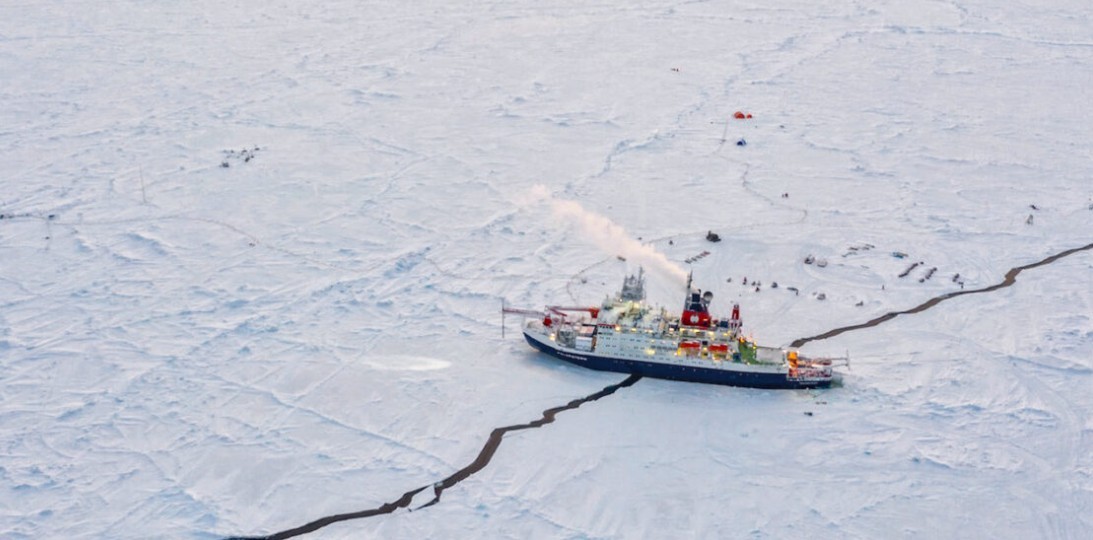
As Arctic ice coverage declines, the Northern Sea Route (NSR) along Russia’s northern coastline is becoming commercially viable for longer periods each year.
For global shipping, this changes the equation dramatically.
A voyage from East Asia to Northern Europe through the Arctic can reduce transit time by nearly two weeks compared with the traditional Suez Canal route, depending on season and conditions. For container operators, energy traders, and bulk cargo carriers, that means:
Lower fuel costs
Faster cargo turnaround
Reduced insurance exposure in conflict-prone regions
Greater flexibility in Eurasian trade flows
Fifteen days saved on a single voyage is not merely a logistical advantage. Across thousands of annual shipments, it reshapes freight economics, inventory cycles, and geopolitical leverage.
The implications are enormous.
Traditional maritime chokepoints — the Suez Canal, Strait of Malacca, Bab el-Mandeb, and Strait of Hormuz — have long defined global trade security. Any alternative that bypasses them reduces the strategic dominance associated with those corridors.
Russia and China are accelerating Arctic cooperation
Russia possesses the geography. China possesses capital, manufacturing depth, and long-term strategic patience.
Over the past decade, both countries have steadily expanded cooperation on Arctic infrastructure, energy projects, icebreaker fleets, and shipping logistics. Beijing’s “Polar Silk Road” initiative reflects its ambition to become a major stakeholder in Arctic commerce despite not being an Arctic nation.
Russia, facing Western sanctions and seeking alternative trade architecture, increasingly views the Arctic as both an economic lifeline and a geopolitical hedge.
The convergence is strategic:
Russia develops infrastructure and route control
China expands financing, cargo participation, and industrial integration
Both reduce dependence on Western-controlled maritime systems
This is not temporary alignment. It is structural.
India’s quieter but highly significant positioning
While global attention remains focused on conflicts and sanctions, India has been steadily increasing its participation in Eurasian connectivity projects.
Two corridors deserve particular attention.
Chennai–Vladivostok maritime corridor
The proposed maritime corridor connecting Chennai to Vladivostok aims to deepen India–Russia trade integration across the Far East and Arctic-linked supply systems.
For India, the corridor offers:
Faster access to Russian energy and mineral resources
Strategic diversification beyond western shipping lanes
Entry into future Arctic-linked logistics networks
Indian participation in Arctic shipping capability, polar navigation training, and maritime cooperation signals that New Delhi is thinking decades ahead rather than news cycles ahead.
The INSTC changes Eurasian trade logic
The International North-South Transport Corridor (INSTC) may ultimately become one of the most important logistics projects of the decade.
Stretching roughly 7,200 km through sea, rail, and road networks, the corridor connects India with Russia and Europe through Iran and the Caspian region.
If fully optimized, it could:
Reduce cargo transit time significantly
Lower freight costs versus traditional European routes
Create a sanctions-resistant trade channel
Strengthen Eurasian commercial integration outside traditional Western systems
For logistics professionals, this is where geopolitics becomes operational reality.
Trade corridors determine:
Port investments
Energy pricing
Freight flows
Currency settlements
Manufacturing migration
Strategic alliances
The map shapes the market.
Why today’s conflicts matter to trade architecture
The Russia–Ukraine war, Red Sea disruptions, Middle East instability, and energy sanctions are often analyzed as separate crises.
But from a supply-chain and strategic trade perspective, they are deeply interconnected.
Every conflict near a maritime corridor affects:
Insurance premiums
Vessel routing
Commodity pricing
Food security
Energy flows
Supply-chain reliability
The Red Sea crisis alone forced major carriers to reroute around the Cape of Good Hope, adding time and cost to global shipping operations.
What businesses now seek is resilience.
And resilience increasingly means diversification away from single chokepoints.
That is precisely why Arctic routes, Eurasian rail corridors, and multimodal alternatives are attracting long-term strategic investment.
The emerging multipolar trade order
The next decade may witness the transition from a Western-dominated maritime framework toward a more fragmented, multipolar logistics ecosystem.
Instead of one dominant global corridor, multiple parallel systems may emerge:
Arctic shipping lanes
Eurasian rail networks
INSTC connectivity
Indo-Pacific maritime corridors
Regional currency settlement systems
Energy trade outside dollar-centric frameworks
No single country may fully dominate this transition.
But some nations are positioning themselves more intelligently than others.
India’s advantage lies in geography, demographics, industrial scale, and strategic flexibility. It maintains relationships across competing power blocs while simultaneously expanding its own infrastructure and manufacturing ambitions.
That balancing capability may prove decisive by 2030.
The real question is not “what is happening?”
The real question is:
Who is building the next system while the world is distracted by the current one?
Because history shows that major geopolitical transitions are rarely announced openly. They emerge quietly through ports, railways, shipping lanes, energy pipelines, and financial corridors.
The countries studying tomorrow’s trade map today will shape tomorrow’s economy.
And by 2030, the world may discover that the most important battles were never only military.
They were logistical.
Popular Posts

Explore Topics



Comments