
The Invisible Chinese wall of 200 miles: How 1,500 Chinese fishing boats quietly rewrote sea power
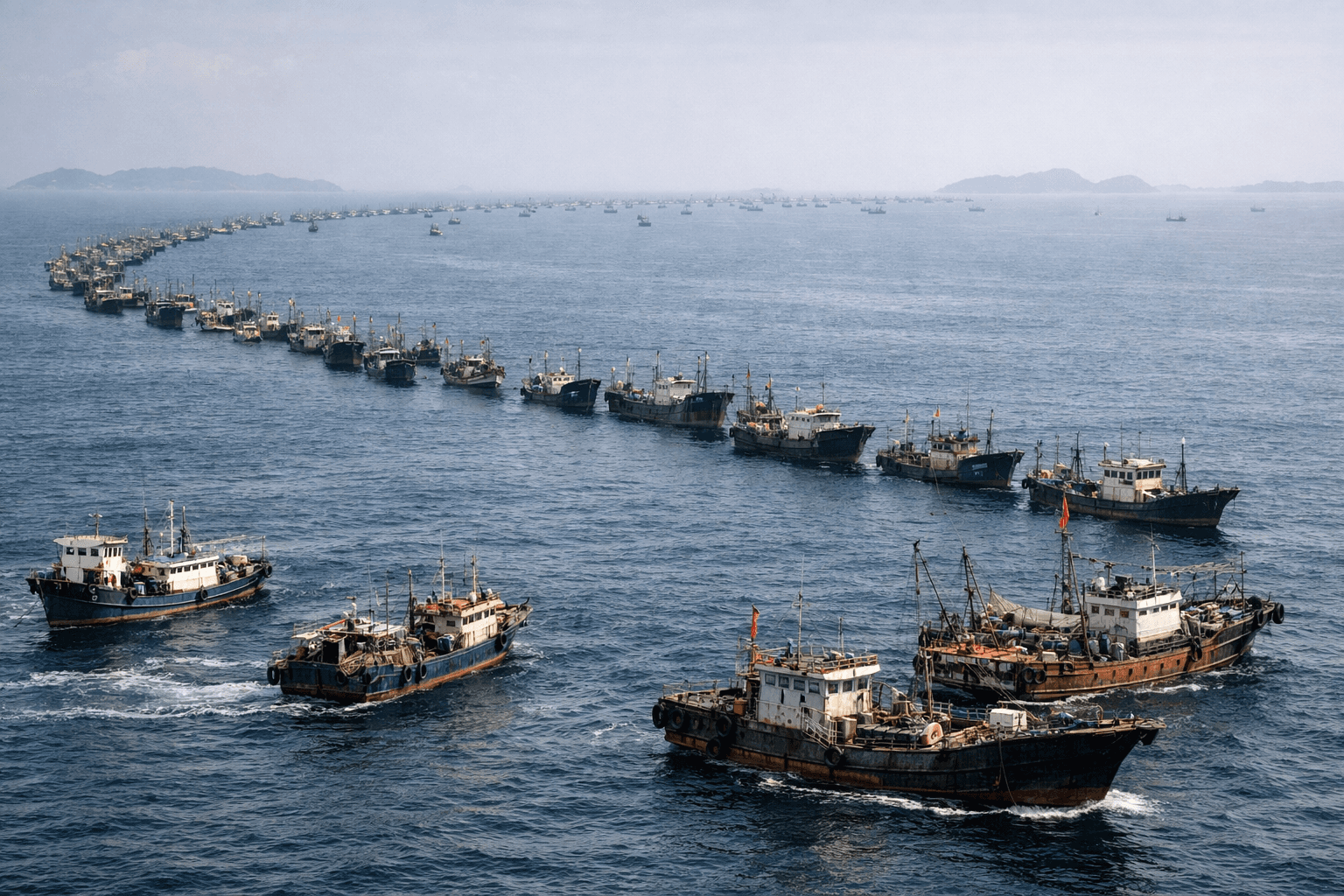
Recently, in January, something remarkable happened in the South China Sea — something almost no one noticed at first. It wasn’t warships. It wasn’t warplanes. It was approx. 1,500 ordinary fishing boats.
From satellite images, what should have looked like scattered vessels soon formed a nearly 200-mile arc of hulls, engines and nets, stretching across contested waters in a way that looked almost intentional. No government declaration. No national flag unfurled. Just a slow, methodical shift — one boat after another — until a new line of presence had emerged.
Not War. Not Peace. But Something New
Strategists call this “grey-zone tactics.” It’s not open conflict, and it’s not routine fishing either. By turning a fleet of civilian-looking boats into a de facto maritime wall, one power managed to assert physical influence without triggering a headline-grabbing crisis.
This is modern geopolitics at its most subtle:
No missiles fired
No treaties broken
No official military deployment
And yet, the message is clear: control doesn’t always need guns. Sometimes it only needs presence.
Grey-Zone influence: what it means
International maritime law doesn’t explicitly ban masses of fishing vessels in open water. That legal ambiguity is exactly what makes this tactic so powerful. Civilian boats operating in a contested zone are a lot harder to challenge than a warship sailing in.
For neighbouring countries, this change isn’t just symbolic. Coast guard officers now face a situation where:
Approaching one vessel draws ten more
Every move can be framed as “provocation”
Navigation becomes a complex negotiation
Why the world didn’t see it coming
Most global news coverage focuses on:
Naval drills
State visits
Diplomatic statements
But this strategy happened quietly — below the radar and outside the headlines. Most of the world still thinks of maritime influence as aircraft carriers and warships. What happened here challenges that assumption.
Popular Posts

Explore Topics


Comments