
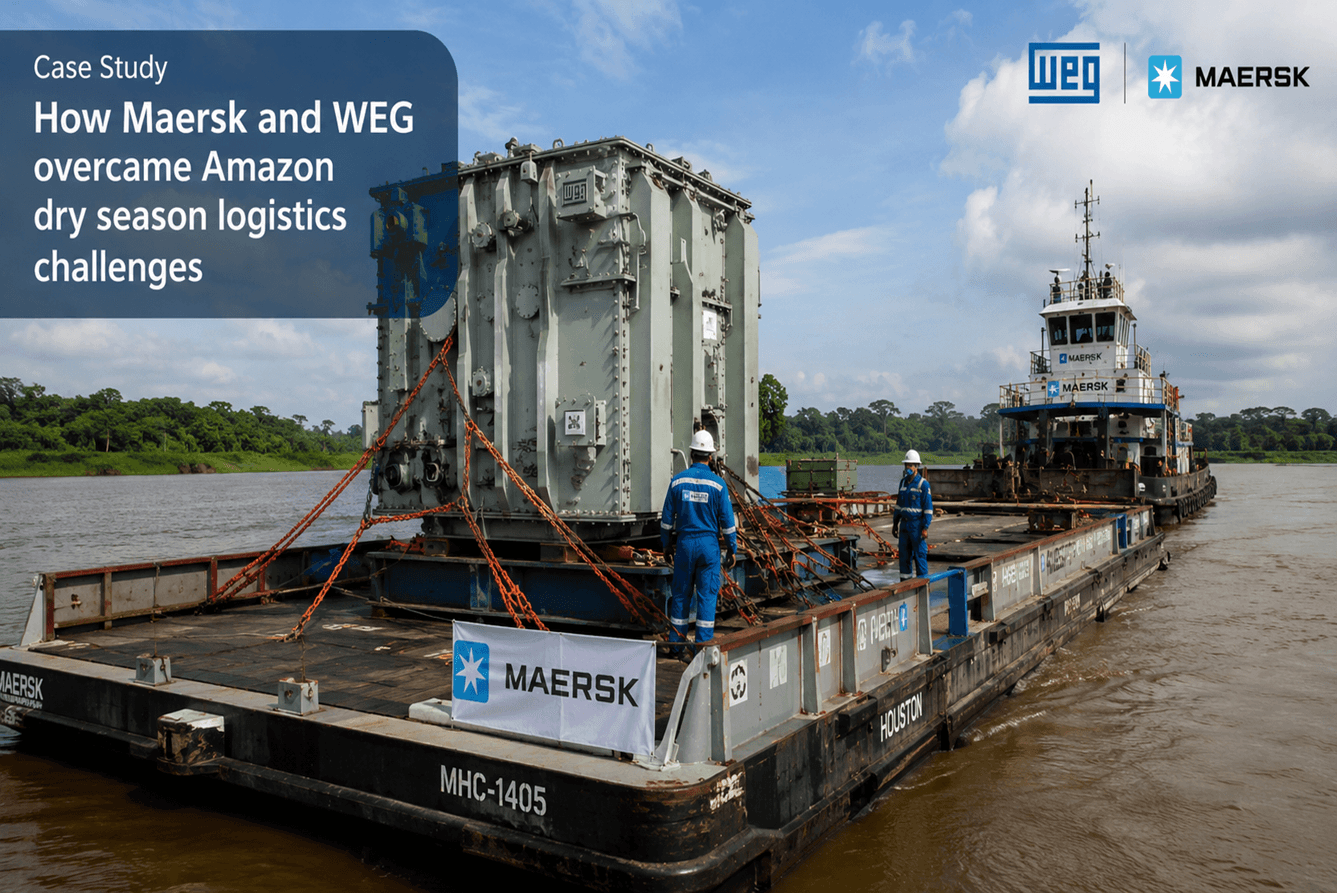
Moving oversized industrial cargo through the Amazon rainforest is already one of the most difficult logistics operations in the world. Doing it during the Amazon dry season — when river levels fall sharply and navigation becomes unpredictable — adds another layer of operational risk.
In 2025, A.P. Moller - Maersk and WEG executed a complex multimodal transport project involving three massive transformers destined for Silves in the Brazilian Amazon. The project became a strong example of how integrated logistics planning, real-time monitoring, and multimodal coordination can overcome geographical and environmental limitations.
Background of the project
WEG, one of Brazil’s leading electrical engineering and industrial equipment manufacturers, needed to transport three oversized transformers from Betim, Minas Gerais, to Silves in Amazonas state. The cargo was linked to regional power infrastructure development and required highly controlled handling throughout the journey.
The cargo dimensions highlighted the scale of the challenge:
Two transformers measured approximately 965 cm × 469 cm × 510 cm
One transformer measured 945 cm × 469 cm × 464 cm
Total cargo weight reached around 635 tonnes
The route involved road, ocean, and inland river transportation through environmentally sensitive and infrastructure-constrained regions of Brazil.
The challenge
1. Amazon dry season restrictions
The biggest operational challenge was the Amazon dry season. Water levels in regional rivers fall significantly during this period, reducing navigability for barges and increasing the risk of grounding. Certain river sections become too shallow for heavy cargo transport, forcing logistics operators to continuously reassess draft limitations and vessel movement.
2. Oversized and high-value cargo
Transformers are extremely sensitive heavy-lift cargoes. Even minor vibration, improper lifting angles, or sudden movements can damage internal components. The cargo also carried high commercial and infrastructure value, meaning delays or accidents could impact energy project timelines.
3. Remote delivery location
Silves is located deep within the Amazon region, where infrastructure connectivity is limited. Unlike major industrial corridors, the final delivery phase depended heavily on river accessibility and coordinated multimodal transfer points.
4. Coordination across multiple transport modes
The project required synchronized movement between:
Heavy-haul road transport
Port storage and consolidation
Coastal sea freight
Inland barge operations
Any delay in one stage could disrupt the entire logistics chain.
Options considered
Option 1: Direct road transport
A fully road-based solution was operationally impractical because of infrastructure limitations, route restrictions for oversized cargo, and the long distance into the Amazon interior. Road-only transport would also increase safety risks and permit complexity.
Option 2: Standard river transport without seasonal planning
Using conventional river transport without hydrological planning carried a high probability of grounding or navigation delays during low-water conditions.
Option 3: Integrated multimodal logistics strategy
The final solution combined road, ocean, and inland river transport with continuous navigability assessments and cargo consolidation planning. This became the most viable and risk-controlled option.
The solution implemented by Maersk Project Logistics
Phase 1: Heavy-haul road transport
The project started at WEG’s facility in Betim, Minas Gerais. Three specialized heavy-haul trucks transported the transformers, while 21 additional trucks carried 94 accessory cargo volumes to Itaguaí (Sepetiba Port).
Heavy-haul engineering studies, route analysis, axle-load management, and convoy coordination were conducted to ensure safe inland movement.
Phase 2: Cargo consolidation and sea transport
At Sepetiba Port, all cargo was consolidated before being shipped to Outeiro Port in Belém do Pará. Consolidation reduced handling risks and improved operational control during the coastal shipping leg.
Phase 3: Real-time river navigation planning
The inland river phase became the most critical part of the operation. Before moving the cargo toward Silves, Maersk conducted additional navigability studies to assess:
River draft availability
Water depth fluctuations
Barge loading limits
Safe transit windows
The project team relied on continuous river monitoring and precision draft management before approving barge movement.
Phase 4: Final delivery and installation readiness
After successful river transport, the transformers were delivered safely to the final project site, where WEG prepared them for installation and commissioning.
The project was completed without major cargo damage or critical delays despite the environmental challenges.
Key logistics learnings from the project
1. Multimodal logistics improves resilience
The operation demonstrated how combining road, ocean, and river transport can create flexibility when single-mode transportation becomes unreliable or economically inefficient.
2. Environmental intelligence is now critical in logistics
Hydrological monitoring, seasonal forecasting, and real-time navigability assessments are becoming essential for project cargo operations in climate-sensitive regions.
Climate variability is increasingly affecting inland waterways globally, including the Amazon, Rhine, Mississippi, and Panama Canal systems.
3. Project logistics requires engineering-level planning
Oversized cargo transport is no longer just a freight operation. It involves route engineering, structural analysis, draft calculations, and synchronized operational planning across multiple stakeholders.
4. Integrated supply chain visibility reduces operational risk
The success of the operation depended heavily on coordinated execution between ports, trucking operators, barge providers, and logistics control teams.
5. Infrastructure projects depend heavily on logistics reliability
For industries such as energy, mining, and industrial manufacturing, logistics delays can directly affect project commissioning timelines and regional infrastructure development.
Conclusion
The Maersk–WEG Amazon transformer operation became a strong example of modern project logistics under extreme environmental constraints. By combining multimodal transport, detailed feasibility analysis, and real-time river monitoring, the companies successfully navigated one of the world’s most operationally difficult cargo corridors.
The case also reflects a broader industry trend: logistics providers are increasingly expected to deliver engineering-driven, climate-adaptive, and integrated transport solutions rather than traditional freight forwarding alone.
Popular Posts

Explore Topics


Comments