
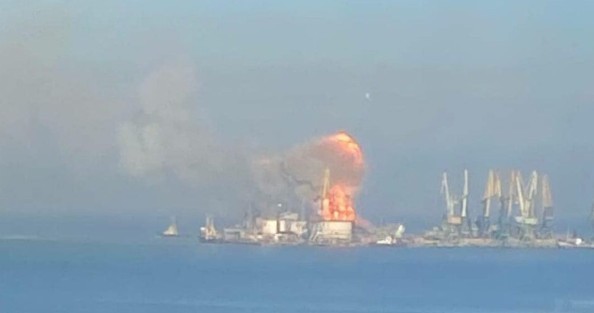
The fire at Russia’s Ust-Luga port is no longer an isolated incident. It is part of a pattern—and that pattern is getting sharper.
In the early hours of March 29, Ukrainian drones struck the Baltic Sea export hub, triggering a fire and damaging key infrastructure at one of Russia’s most critical oil terminals. Regional authorities confirmed multiple drone waves, while initial reports suggest the strike hit storage and loading facilities, forcing disruption to operations.
Ust-Luga is not just another port. It handles roughly 700,000 barrels of oil per day and serves as a major outlet for Russian crude and refined products moving into global markets. Its repeated targeting signals a deliberate shift in Ukraine’s strategy—from battlefield confrontation to economic attrition.
This was not the first hit. The port has been struck multiple times over the past week, with earlier attacks already forcing temporary shutdowns, halting crude loadings, and igniting large fires visible across the Gulf of Finland. In some cases, infrastructure damage extended to rail unloading systems and processing units, disrupting the flow of fuel oil from inland refineries to export terminals.
The cumulative effect is beginning to show. Russia’s refining system—particularly in the western corridor—relies heavily on Ust-Luga to move surplus fuel oil. With export routes constrained, refiners are now facing bottlenecks that could force production cuts or operational adjustments.
What makes this phase different is distance. These strikes are being carried out deep inside Russian territory, in some cases over 900 kilometers from Ukrainian launch zones, highlighting the growing reach of long-range drone warfare. The message is direct: geography is no longer a shield.
There is also a broader market dimension. The attacks on Ust-Luga, along with similar strikes on Primorsk and Novorossiysk, are beginning to tighten Russia’s export flexibility at a time when global oil markets are already under stress from Middle East tensions. Even limited disruption at these hubs feeds directly into price volatility, as traders factor in not just supply loss, but uncertainty.
For Ukraine, the objective is clear—undermine the revenue streams that sustain Russia’s war effort. For Russia, the challenge is more complex. Defending vast energy infrastructure spread across thousands of kilometers is fundamentally different from defending a front line.
What emerges is a new phase of the war, where ports, pipelines and terminals carry as much strategic weight as cities and trenches.
And in that equation, Ust-Luga is no longer just a port.
It is a pressure point.
Popular Posts


Explore Topics



Comments