
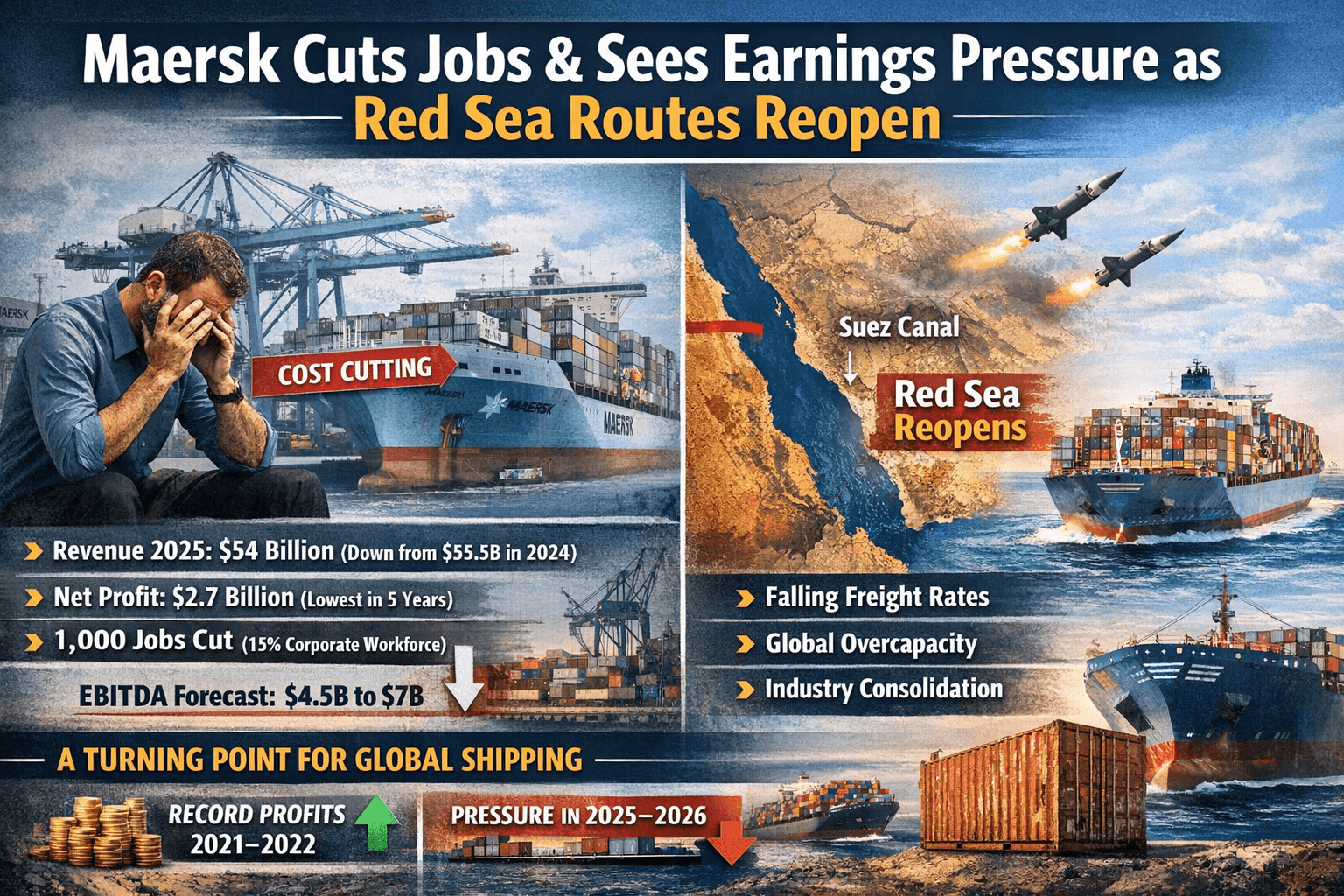
The world’s second largest container shipping company - Maersk, has announced significant steps to tighten costs and streamline operations after a challenging 2025 performance and a shifting global trade landscape. The same was the situation in Maersk in 2008, 2018. In 2008 all the employees were asked to re-apply for their position.
According to Maersk’s latest results:
Revenue for 2025 fell to about $54 billion, down from $55.5 billion in 2024, even as cargo volumes grew modestly by around 5%.
Net profit was approximately $2.7 billion, less than half of the $6.1 billion reported the year before – the lowest in about five years.
Ocean transport earnings dropped sharply, reflecting weaker freight rates and intense competition.
Looking ahead, Maersk has guided its 2026 EBITDA range to $4.5 to $7 billion, significantly below the $9.6 billion achieved in 2025, underscoring the severity of the earnings contraction in its core shipping business.
In response to these financial shifts, Maersk announced:
Cutting approximately 1,000 corporate jobs, which is about 15 % of its corporate workforce but less than 1 % of the total global headcount of ~100,000.
Expected annual cost savings of around $180 million from organizational simplification.
A renewed focus on productivity, including greater use of AI technologies and operational efficiency measures.
These cuts span headquarters, regional offices, and national units as part of broader efforts to streamline overhead and maintain profitability in a market that increasingly favours scale and technological efficiency.
The changes are done for below reason
This strategic pivot from growth and investment toward cost discipline and share returns reflects deeper structural pressures in the shipping sector:
Freight Rate Erosion – As the Red Sea route normalization increases capacity, freight rates are struggling to stabilize, squeezing margins.
Overcapacity – Carriers around the world have new vessel orders entering service, contributing to global supply overshoot.
Industry Consolidation – Maersk’s experience is part of a broader trend as global carriers reconcile pandemic-era investments with current demand realities.
A Turning Point for global shipping economics
For much of the past decade, Maersk and other major carriers benefited from robust post-pandemic demand, tight vessel capacity, and elevated freight rates - generating record profits between 2021 and 2022. However, this period of “super-normal” earnings has given way to a more volatile environment shaped by oversupply of vessels, geopolitical disruptions, and rate corrections. We have written a blog earlier on evolution of containerized international logistics , mentioning shipping line profit cycle, which can be referred for better understanding.
Red Sea – From crisis to normalization
The Red Sea, a vital conduit between Asia and Europe through the Suez Canal, was largely bypassed in 2023 and 2024 due to security threats from Yemeni Houthi attacks on commercial shipping. During that period, many carriers rerouted vessels around the Cape of Good Hope, effectively reducing global capacity by 7–8% and supporting stronger freight rates in a crowded market.
In late 2025 and early 2026, improving security conditions enabled the partial resumption of Red Sea transits, reducing voyage distances and fuel costs. While this development is positive for global supply chains, it also increases total available capacity in the market — putting downward pressure on freight rates that had buoyed profits in recent years.
Maersk’s recent job cuts and earnings warning highlight how rapid shifts in trade routes, freight rates, and macroeconomic conditions can reshape even the most dominant players in global logistics. While Red Sea route normalization is beneficial for global supply chains in the long term, its immediate impact on industry capacity and pricing dynamics has forced Maersk to refocus on cost—and cautiously recalibrate expectations for growth and profitability.
Popular Posts

Explore Topics



Comments