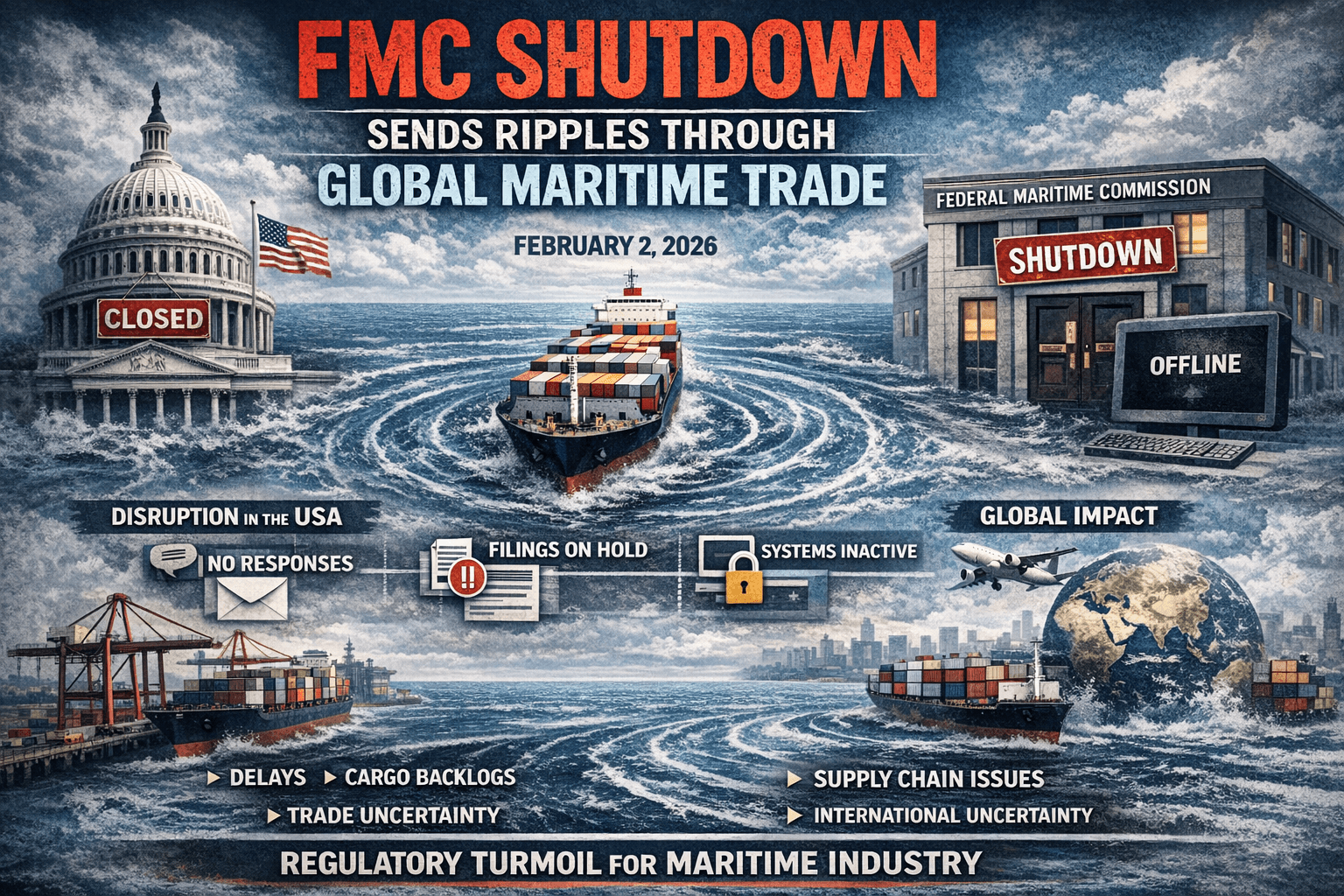
Today on 2nd Feb’ 2026, FMC has officially posted an article of Suspending its operations due to Federal government shutdown. The maritime world thrives on continuity. But when a vital regulator like the U.S. Federal Maritime Commission (FMC) halts its operations abruptly, it sends shockwaves through the global shipping ecosystem.
Why did the FMC shut down?
On January 31, 2026, the Federal Maritime Commission officially suspended its operations as part of a wider U.S. federal government shutdown caused by a lapse in appropriations. This means that, until Congress enacts new funding, the FMC is effectively closed, except for a handful of presidentially appointed commissioners who remain on duty. All other Commission employees are furloughed and legally barred from performing any work.
The shutdown isn’t a reflection of the Commission’s performance, it is a consequence of political deadlock in the U.S. budget process. But the implications are very real for businesses, shippers, carriers, intermediaries, and attorneys who rely on FMC services daily.
The Immediate impact on maritime operations of America.
No official responses: Emails and phone inquiries to the Commission are suspended until reopening.
Online systems remain open but inactive: Tools like SERVCON, used for service contract filings, stay accessible, but submissions won’t be processed.
Regulatory filings are on hold: Key functions such as Ocean Transportation Intermediary (OTI) applications, NVOCC registrations, tariff registrations, and the eAgreements/eMonitoring systems are paused.
Legal and compliance deadlines are tolled: Filing deadlines in ongoing proceedings are suspended, removing legal time pressure but creating backlog once the agency reopens.
With the FMC sidelined, industry stakeholders face a sudden pause on approvals, enforcement actions, and dispute resolution services. That can create uncertainty for importers, exporters, and carriers who rely on regulatory clarity.
Why this will impact beyond USA
It’s easy to overlook a government agency if you’re not directly engaged in maritime trade. But consider how many industries depend on a regulated and predictable maritime supply chain:
Exporters and importers rely on timely licensing and tariff updates to plan shipments.
Freight forwarders and intermediaries need FMC certifications and compliance checks to operate legally.
Shipping lines and terminal operators depend on FMC oversight for fair competition and dispute resolution.
Legal professionals count on a functioning docket to move cases forward swiftly.
When these functions stop, the entire ecosystem feels the effect - from container bookings to port call scheduling and contract enforcement.
Not the first time closure -
This isn’t the first time maritime administrations have faced pressure due to political dynamics. Federal shutdowns periodically affect U.S. maritime services, for example, the National Maritime Center and examination centers faced extended closures in the past, impacting credentialing and certifications for mariners.
But the FMC serves a unique role as the primary safety net for fair practices in ocean transport. Its absence removes a key stabilizer in an industry already navigating post-pandemic disruptions, geopolitical tensions, and supply chain volatility.
What happens after reopening?
The FMC will resume normal operations.
Backlogs in filings and compliance cases will begin clearing.
Parties will need to coordinate with the Commission to reset deadlines and reconcile suspended procedures.
But the shutdown may linger in industry memory. Supply chain planners and shipping professionals may rethink their contingency strategies, anticipating regulatory disruptions as part of broader risk management.
A maritime regulator going silent may not make headlines in the same way as a carrier’s schedule cut or a port strike, but its impacts are structural and far-reaching. The FMC shutdown is a stark reminder that regulatory certainty is a critical current beneath the global trade tides.
Popular Posts

Explore Topics


Comments