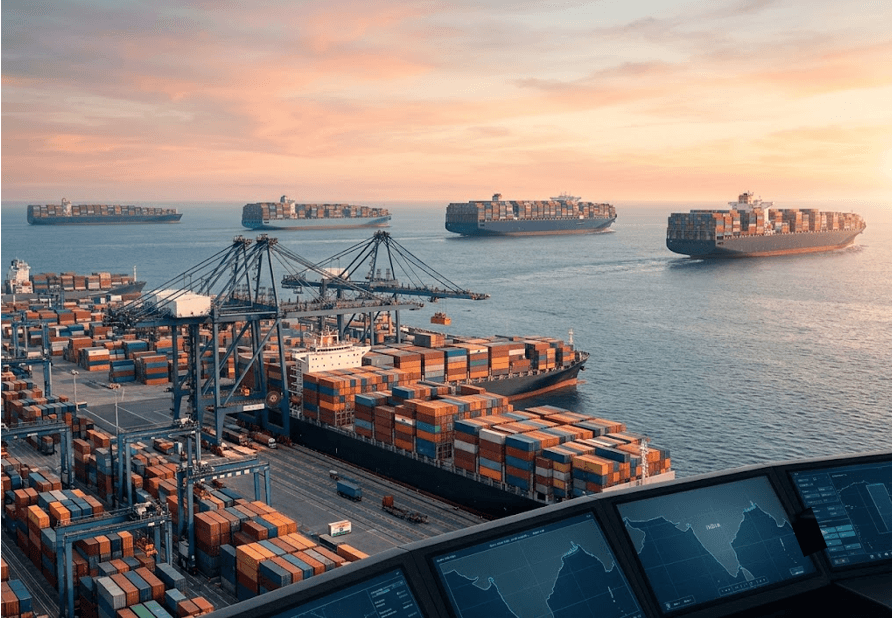
India–Gulf freight realignment: container flows shift to hybrid routes amid Hormuz disruption
Containerised freight movement from India to Gulf markets is undergoing a structural reset following disruption in the Strait of Hormuz, with operators balancing backlog clearance and redesigned routing networks.
Backlog cargo (pre-conflict sailings) is being repositioned from transshipment hubs at sharply elevated freight levels. Mundra/Nhava Sheva to Sohar/Salalah is currently quoted at USD 2,600–3,000/20’, while Nhava Sheva–Khor Fakkan via MSC is around USD 3,900/20’. East coast routing from Vizag to Sohar/Salalah is ranging between USD 3,500–4,500/20’. Parallel lanes such as Thailand–Sohar are also holding at USD 3,500–4,000/20’, indicating regional freight inflation rather than India-specific pressure.
For fresh bookings, capacity remains selective. Maersk, Hapag-Lloyd and MSC continue to offer limited services, while COSCO has restricted acceptance to legacy cargo only. CMA CGM is actively quoting ~USD 4,000/20’ from Vizag to Sohar/Fujairah, positioning east coast India as a relatively flexible origin in the current scenario.
A major operational shift is the emergence of hybrid routing models. Shipping lines are increasingly discharging containers at ports outside the Persian Gulf—particularly Sohar, Salalah, and Saudi gateways—followed by cross-border trucking into UAE, Kuwait, and Qatar. This sea–land integration is adding 5–10 days transit and additional inland costs, but ensuring continuity of supply chains.
Risk premiums, war surcharges, and insurance constraints are now key freight drivers, not just vessel availability. Schedule reliability has dropped significantly, with blank sailings, rerouting, and port congestion impacting planning cycles. Equipment imbalances are also emerging, especially for 20’ units in west India.
As highlighted earlier, Saudi ports are gaining new liner services, strengthening their position as alternative hubs. The current freight environment reflects a transition phase—higher cost structures, fragmented routing, and increased dependence on operational agility rather than fixed service networks.
Popular Posts

Explore Topics



Comments