
Container exports from India face renewed pressure as Middle East crisis disrupts global shipping
The container shipping market is once again entering a period of uncertainty, and Indian exporters are beginning to feel the impact.
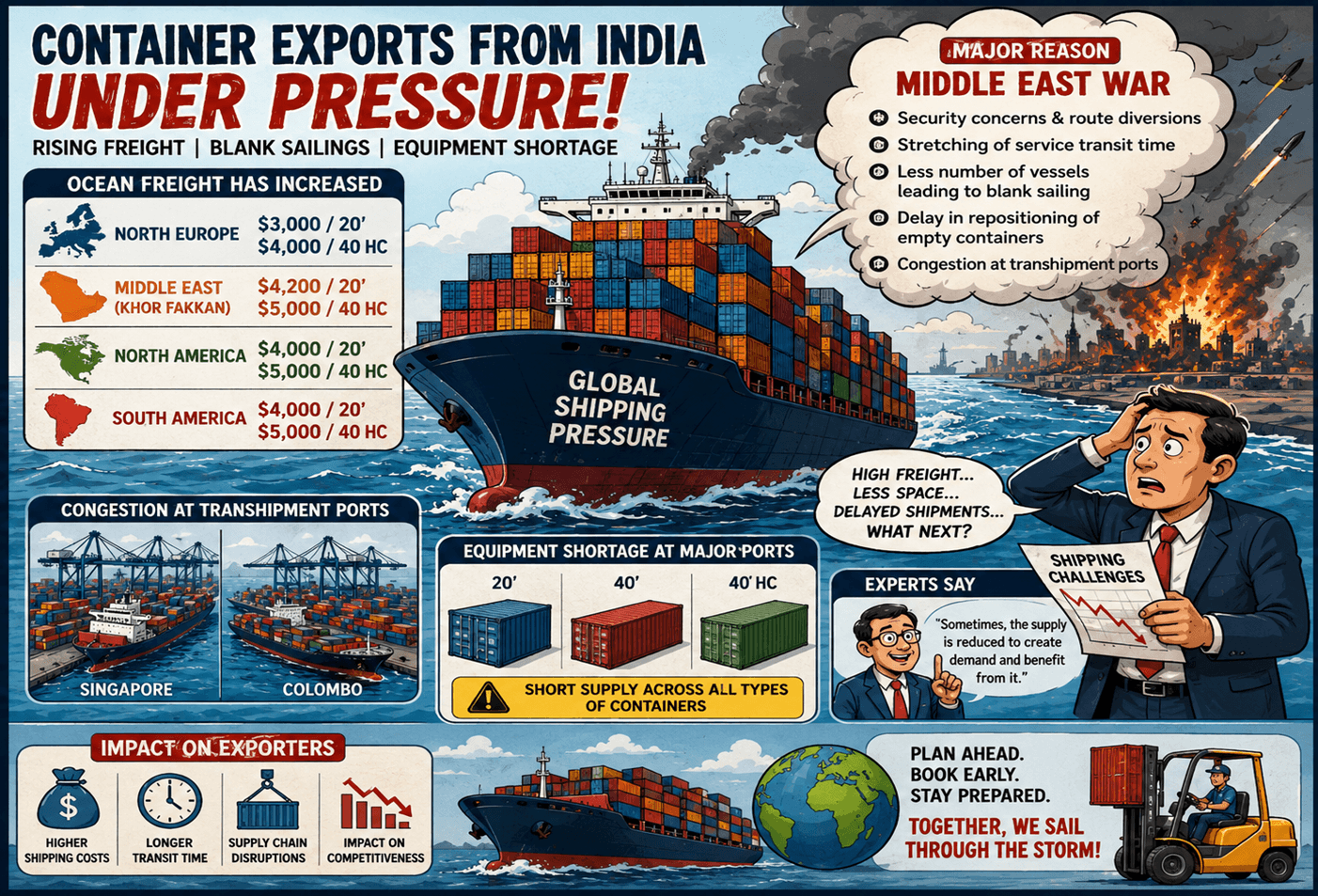
Over the past few weeks, freight rates have risen sharply across major trade lanes. Export shipments from India to North Europe are now being quoted at around USD 3,000 per 20-foot container and USD 4,000 per 40 HC container. Rates to the Middle East have increased significantly, with shipments to Khor Fakkan reaching approximately USD 4,200 per 20-foot container and USD 5,000 per 40 HC container. Freight levels to North and South America are also hovering near USD 4,000 per 20-foot container and USD 5,000 per 40 HC container.
The increase in rates is being accompanied by a growing number of blank sailings announced by major shipping lines. Reduced vessel availability, longer voyage durations, and schedule disruptions are tightening capacity across several trade routes.
A major concern for exporters is the congestion building up at key transshipment hubs such as Singapore and Colombo. Delays at these ports are affecting cargo connections, vessel schedules, and the repositioning of empty containers. As a result, exporters across India are reporting shortages of 20-foot, 40-foot, and 40 HC equipment at several major ports.
The ongoing instability in the Middle East remains the primary driver behind the disruption. Security concerns and route adjustments have extended service transit times, effectively reducing the number of vessels available for regular rotations. When ships spend more time completing a voyage, overall network capacity declines, creating pressure on freight rates.
Container availability has become another challenge. Empty equipment that would normally be repositioned back to export locations is facing delays due to vessel congestion and schedule reliability issues. This has created additional pressure on exporters trying to secure containers for time-sensitive shipments.
Many industry experts believe that the market is also being influenced by capacity management strategies adopted by shipping lines. While carriers argue that blank sailings are necessary to maintain schedule integrity and manage operational disruptions, some market participants view capacity reductions as a factor contributing to higher freight levels during periods of strong demand.
For Indian exporters, the immediate outlook suggests continued volatility. Freight costs remain elevated, equipment availability is tight, and schedule reliability is under pressure. Companies with long-term contracts, flexible inventory planning, and early booking strategies are likely to be better positioned to navigate the current market conditions.
The coming weeks will be critical. If congestion at major transshipment hubs eases and geopolitical tensions stabilize, the market could gradually return to balance. However, if disruptions persist, exporters should prepare for further pressure on freight rates, transit times, and container availability.
For now, the message from the shipping market is clear: uncertainty has returned, and supply chain planning is once again becoming a competitive advantage.
Popular Posts


Explore Topics



Comments