
Why U.S. maritime unions want a US flag shipping mandate on Venezuelan oil — and what It means for the industry
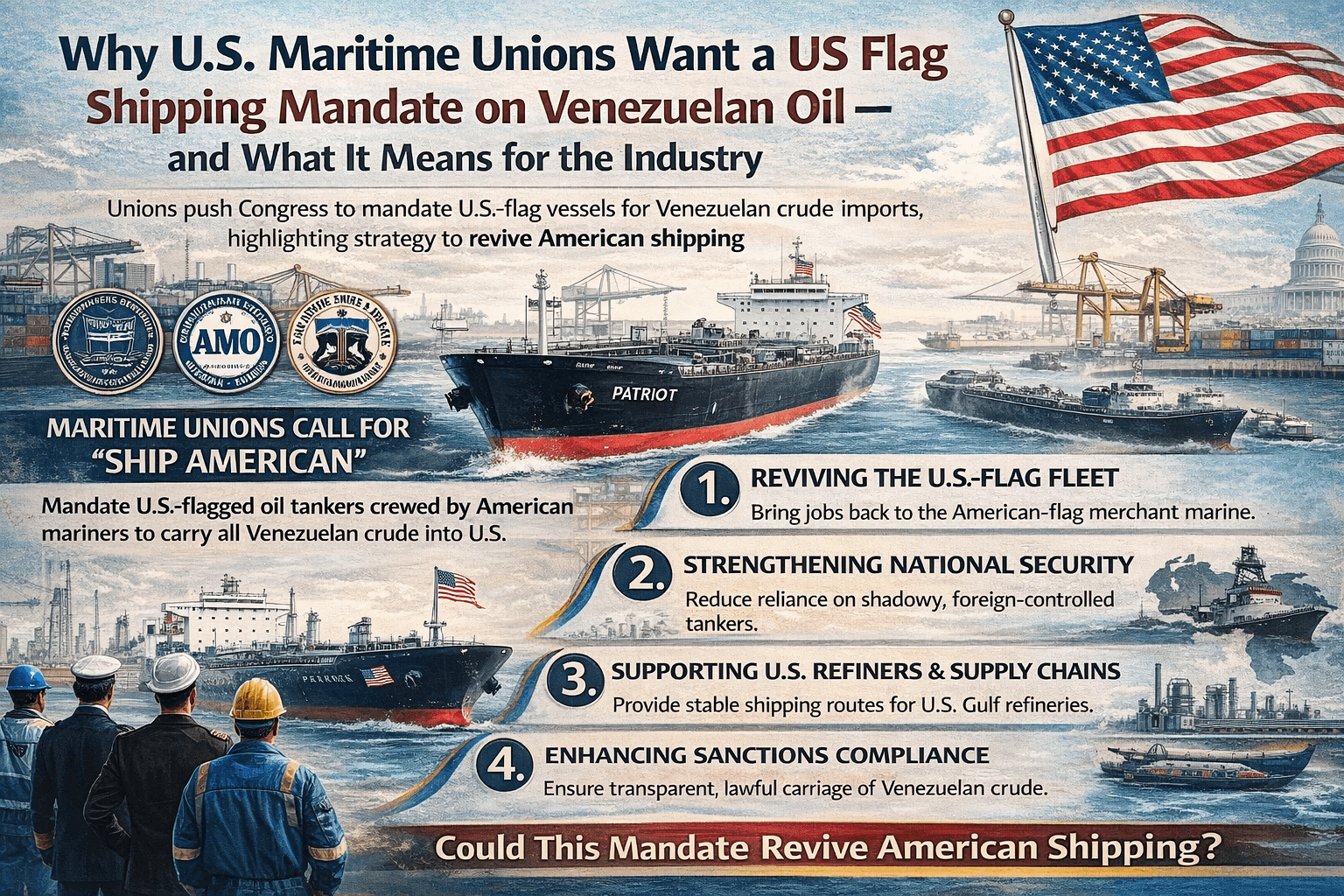
Recently in last few days, the leading maritime labour unions in the United States sent a high profile appeal to senior U.S. government officials urging a new shipping policy tied to Venezuelan crude imports. Their proposal has stirred debate in maritime and trade circles, and it underscores deeper strategic concerns about the future of the U.S. maritime industry.
The maritime union proposal
Major maritime labour unions, including
Marine Engineers’ Beneficial Association (MEBA)
American Maritime Officers (AMO)
Masters, Mates & Pilots (MM&P)
Seafarers International Union (SIU)
They want Congress and the Trump administration to mandate that all Venezuelan crude imported into the United States be carried exclusively on U.S.-flagged vessels crewed by American mariners.
In their letter, union leaders argue that aligning oil transport with U.S. shipping fleets would support the “Ship American” principles — a policy approach meant to strengthen the American maritime workforce, rebuild the domestic shipbuilding base, and reduce reliance on foreign-controlled shipping networks.
Why This Matters to the American Maritime Industry
The move, if adopted, would be significant on multiple levels:
1. Reviving the U.S.-Flag Fleet
2. Strengthening National Security
Unions contend that national energy policy should work hand-in-glove with maritime policy. They argue that requiring U.S.-flag transport for Venezuelan crude would not just protect jobs, but also reduce reliance on opaque “shadow fleets” or foreign networks that operate outside U.S. labor, safety, and transparency standards — vulnerabilities highlighted by the rise of unregistered oil tankers in sanction-dodge trades.
In recent months, examples of these so-called shadow fleets — ships that turn off tracking systems, change registrations, or sail under dubious flags to evade sanctions enforcement — have proliferated in Venezuelan oil exports. These shadow operations have complicated regulatory oversight and raised safety concerns across the maritime domain.
3. Supporting U.S. Refiners & Supply Chains
U.S. Gulf Coast refineries are well-equipped to process Venezuela’s heavy crude grades. A U.S.-flag shipping requirement could therefore provide more stable, predictable supply routes for American refineries while also creating domestic maritime jobs.
4. Enhancing Sanctions Compliance
Unions argue that mandating U.S.-flag transport helps bolster sanctions compliance by ensuring that crude moving into the U.S. is carried under legal, transparent frameworks — rather than through foreign-flag vessels that can easily slip outside regulatory purview.
Longer-Term Industry Implications
If this proposal were adopted — or even seriously considered — it could influence broader maritime policy debates in the United States:
Domestic Shipbuilding: A reliable cargo stream might motivate investment in new ship construction and retrofitting in U.S. yards.
Mariner Careers: Increased demand for U.S.-flagged cargoes would mean more jobs for American deck officers, engineers, and ratings.
Global Shipping Patterns: U.S.-flag vessels could capture a share of energy cargoes traditionally handled by foreign carriers, reshaping competitive dynamics.
Policy Precedent: This mandate could set a precedent for other cargo preference policies, similar in spirit to laws like the Cargo Preference Act that require certain government-impelled cargoes to move on U.S.-flag vessels.
Challenges and Uncertainties
It remains unclear whether the Trump administration or Congress will embrace this specific mandate. Some critics may question whether such a requirement would raise fuel costs, restrict market flexibility, or violate World Trade Organization norms. Others point out the higher cost structure of U.S.-flag operations compared to international flags of convenience.
Nonetheless, the push by maritime unions highlights a renewed focus on aligning energy policy, national security, and maritime industrial strategy, at a time when global trade patterns and geopolitical risks are in flux.
Popular Posts

Explore Topics



Comments