
Frozen ambitions: How a U.S. hospital ship mission to Greenland exposed logistical realities, Diplomatic missteps, and arctic complexities
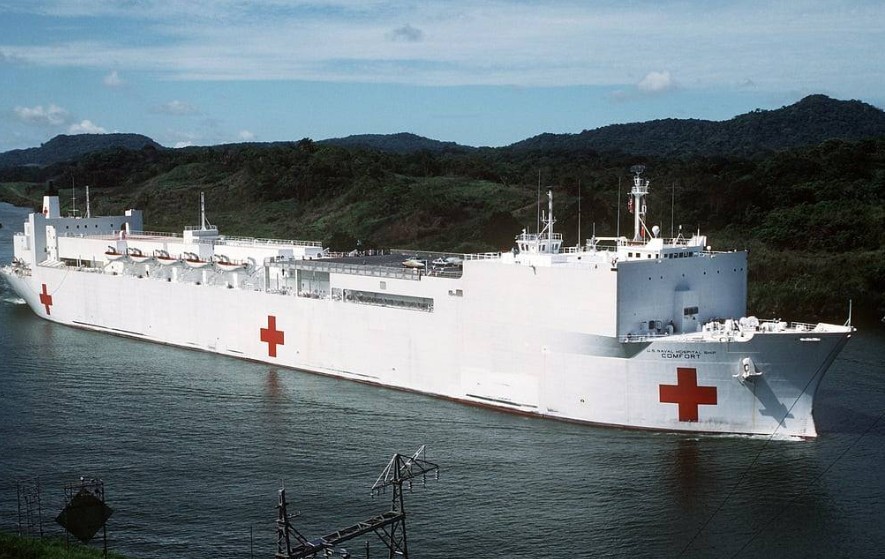
In late February 2026 a splashy social media claim from the leader of the United States set off a swirl of confusion across the international press, Arctic communities, and military watchers: a U.S. Navy hospital ship was reportedly being sent to Greenland to “take care of the many people who are sick, and not being taken care of there.”
What ensued was not a straightforward humanitarian mission, but a tangled story of political signalling, operational impracticalities, local resistance, and logistical realities — a perfect storm of Arctic geopolitics.
Day 1: The announcement that wasn’t fully anchored
On February 22, 2026, former U.S. President Donald Trump posted on social media that the U.S. would send a hospital ship — illustrated with an image of the USNS Mercy — to Greenland, claiming that many residents were not receiving the healthcare they needed.
The declaration was bold, delivered with political flair: “It’s on the way!!!” was the declaration — but here’s the twist it wasn’t backed by confirmed operational orders from the Pentagon or the U.S. Navy’s command structure.
No formal deployment orders had been issued to mobilize any U.S. hospital ship for Greenland. Officials from the U.S. Department of Defence made it clear that no such mission had been scheduled or authorised.
Day 2: The Ships — Where are they really?
The U.S. Navy operates two hospital ships — USNS Mercy and USNS Comfort — massive floating medical facilities designed for humanitarian relief and crisis response.
But at the time of the announcement:
Both vessels were undergoing scheduled maintenance at the Alabama Shipyard in Mobile, Alabama.
The Mercy had been in drydock for ballast tank repairs since July 2025.
The Comfort was also in port, engaged in routine servicing.
AIS tracking confirmed neither ship was departing for the Arctic — in fact, both remained moored.
In maritime terms, neither vessel was in a position to deploy to Greenland even if a mission were authorised.
Day 3: Arctic logistical realities hit hard
Beyond the political theatre, serious maritime challenges immediately surfaced:
Sea Ice and Draft Limits
Arctic waters around Greenland are covered with heavy pack ice and floating icebergs in late winter — conditions few non-ice-strengthened vessels are built to navigate.
Neither Mercy nor Comfort have reinforced hulls for ice operations — a critical vulnerability in icy seas.
Harbor Depth Constraints
Greenland’s main port in Nuuk has a depth of about 10.5 meters, barely enough for an enormous ship with a draft near 10 meters.
This means the ships couldn’t dock directly — they’d have to anchor offshore in freezing, highly unpredictable waters, complicating any effort to deliver medical care or personnel.
Lack of Escort Icebreakers
Even if the ships could transit north, trusted icebreaker escorts — like those operated by the U.S. Coast Guard — were unavailable or deployed elsewhere, reducing safe navigation options.
In short: the mission, as publicly articulated, wasn’t just unclear — it was logistically implausible.
Day 4: Greenland says “No Thanks”
Perhaps the most telling twist came from Greenland’s own leadership.
Greenland officials made it clear they did not request the hospital ship and did not want it:
Greenland’s Prime Minister, Jens-Frederik Nielsen, publicly declined the offer, noting that the island has a public healthcare system that provides broadly accessible treatment for its residents — contrasting it with uneven U.S. healthcare access.
Denmark, which has sovereignty over Greenland’s foreign affairs, deeply rebuffed the idea of an unsolicited military-linked mission, underscoring that such cooperation should be pursued through formal diplomatic channels, not social media.
This diplomatic rejection underscored that Greenland wasn’t a neglected health care crisis in need of U.S. rescue, challenging the very premise of the announcement.
What really happened in the Arctic?
The unusual backdrop to all of this was a medical evacuation that did occur near Greenland — but not because of local healthcare failure.
A U.S. Navy submarine crew member operating in Arctic waters was medically evacuated by Danish forces to receive treatment ashore — a routine safety operation, not a sign of systemic medical crisis.
That isolated incident, while real, did not justify or necessitate a hospital ship deployment.
A major public announcement hit social media before any orders or planning were secured.
The Arctics are harsh, unforgiving, and demanding environments. Hospital ships aren’t built for ice navigation naturally — and this mission would have faced massive physical obstacles.
Local governments can — and did — push back against unsolicited aid offers, especially when they are perceived as undermining self-sufficiency or national dignity.
Greenland is strategically important — not just for health care — but for military, scientific, and resource reasons. This incident illuminates how actions framed as “humanitarian” can be interpreted as strategy or projection.
The unfolding story of the supposed hospital ship mission to Greenland is more than a maritime curiosity. It blends political spectacle, media narratives, logistical realities, and diplomatic friction into a single episode that shows how modern military, media, and public perception interact.
It’s a reminder that announcements sometimes move faster than plans, and that real world operations — especially in extreme environments like the Arctic — require meticulous planning, multilateral cooperation, and strategic foresight, not just compelling social media images.
Popular Posts

Explore Topics



Comments