
What is Maritime Amrit Kaal Vision 2047: India’s blueprint to become a global maritime power
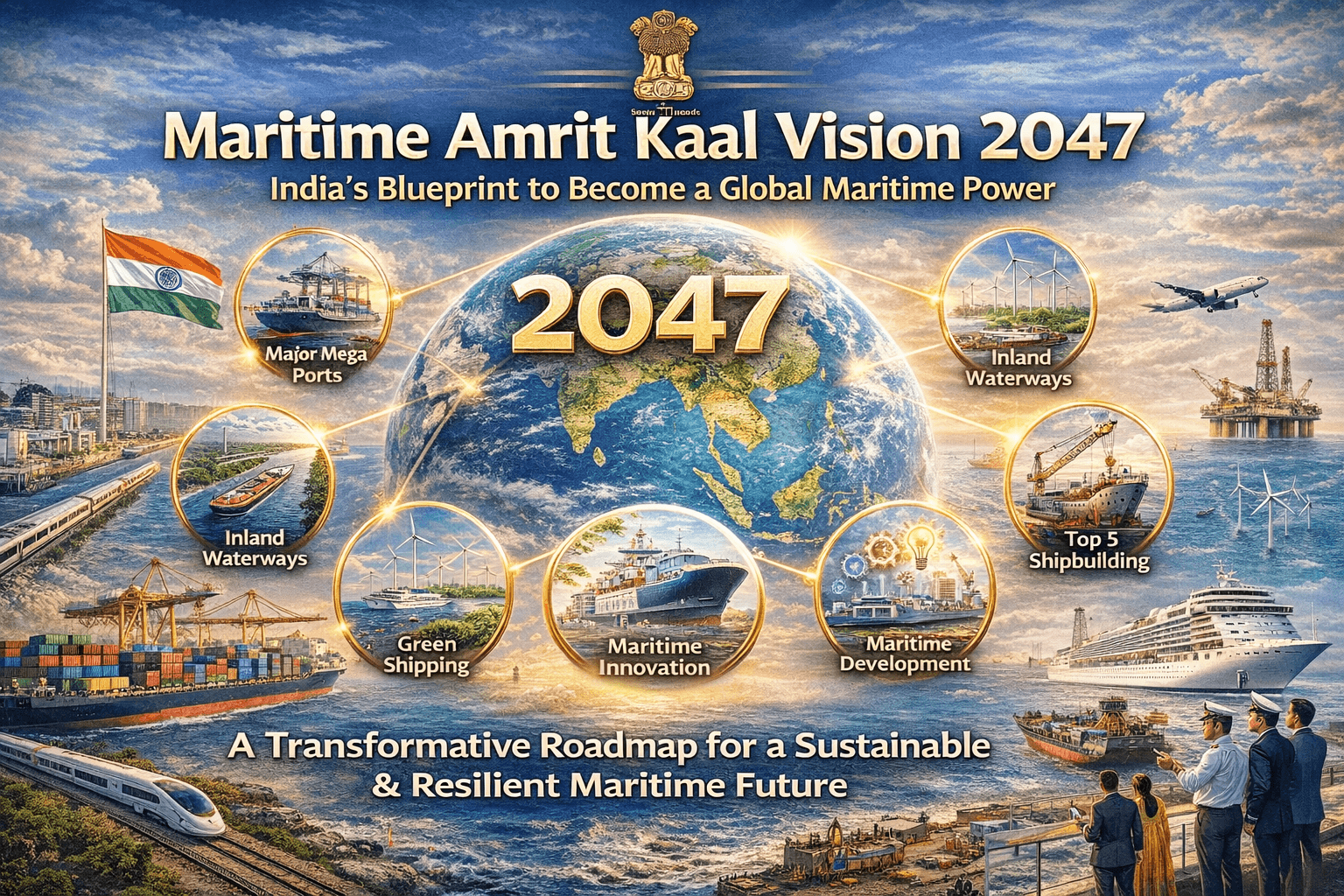
The Maritime Amrit Kaal Vision 2047 (MAKV 2047) is a comprehensive long-term strategic roadmap planed by the Government of India through the Ministry of Ports, Shipping and Waterways (MoPSW). It builds upon earlier initiatives such as the Maritime India Vision 2030, charting a transformative path for the Indian maritime and blue economy over the next two decades to coincide with India’s 100 years of Independence at 2047.
What is Maritime Amrit Kaal Vision 2047
The Maritime Amrit Kaal Vision 2047 is the umbrella roadmap and policy framework designed to:
Transform India into a global maritime leader by 2047.
Harness the country’s 7,500 km coastline, extensive inland waterways, and coastal districts to boost the Blue Economy.
Ensure sustainable, technology-driven growth across ports, shipping, logistics, tourism, cruise, shipbuilding, skills and innovation.
Vision & Mission of Maritime Amrit Kaal Vision 2047
Vision
The vision is to make India globally recognized as a highly efficient, responsible and progressive maritime nation — competitive in ports, shipping, logistics, cruise tourism, shipbuilding, inland waterways, maritime services, and innovation ecosystems.
Mission objectives
The mission includes:
Ensuring safe, efficient, environmentally sound shipping and port operations.
Promoting modern merchant fleets under the Indian flag and competitive shipbuilding and ship repair.
Building skilled human resources qualified for global maritime requirements.
Strengthening governance, technology adoption, and international best practices.
Key Strategic themes & initiatives
The MAKV 2047 document outlines 300+ initiatives across ~11 core themes (port infrastructure, shipping, inland waterways, sustainability, innovation, clusters, human resources and more).
1. Transforming port infrastructure
India plans to develop multiple mega port clusters with high cargo capacity — for example, Cochin-Vizhinjam, Chennai-Kamarajar, Paradip, Deendayal-Tuna Tekra and JNPT-Vadhavan — aiming to handle thousands of MTPA of cargo.
Ports will be modernised for speed, automation (e-gates, robotics, drones) and higher throughput.
2. Growth of inland & coastal shipping
Inland waterways and coastal shipping will see logistical upgrades to reduce road congestion and cost, potentially shifting large freight volumes to waterways, easing environmental stress and boosting connectivity.
3. Sustainability & green shipping
MAKV 2047 adopts carbon-neutral and low-emission goals, including alternative fuels like LNG, hydrogen, ammonia, shore power for ports and green corridors — in line with global commitments like IMO GHG reductions.
Cruise tourism is also targeted with improved terminals and support systems to expand coastal and river cruising.
4. Shipbuilding & recycling
India aims to be among the top five global shipbuilding nations by 2047, with expanded clusters, financing incentives, extended aid, and modern facilities. Subsidies and support schemes are being extended to attract investment and scale domestic yards.
5. Maritime clusters & blue economy
Industrial and maritime clusters near port cities will drive ancillary industry development, employment and manufacturing linkages.
6. Human resource & skill development
Training programe, certification facilities, modern maritime universities and career mobility schemes are part of the roadmap to build globally competitive maritime professionals.
Economic Impact & Investment Numbers
According to government estimates:
The vision could unlock ₹20,000+ crore in annual port revenue and attract ₹75–80 lakh crore in investment by 2047.
Port cargo handling capacity is envisaged to quadruple to over 10,000 MTPA.
The plan anticipates creation of millions of jobs directly and indirectly through infrastructure, logistics, shipbuilding and maritime services.
Around 840 Sagarmala projects (worth over ₹5.8 lakh crore) are being implemented to support this vision.
National significance: Nearly 95% of India’s trade by volume and 70% by value moves via maritime routes — making the maritime sector a vital backbone of the economy.
How it is performing on ground at practical level
Huge investment boost: India plans to invest ~₹80 lakh crore into ports, shipping, inland waterways, and logistics through 2047 to transform infrastructure and trade connectivity.
Green transport innovation: The recent launch of India’s first hydrogen-fuelled passenger vessel on the Ganga aligns with the sustainability thrust of the Amrit Kaal vision.
Maritime skill hubs & training centres — projects like a ₹188-crore maritime skills hub in Dibrugarh show the vision’s emphasis on human resource development.
Port infrastructure funding deals: MoUs worth over ₹1 lakh crore were signed to support port projects in Kolkata, Visakhapatnam, Paradip and Jawaharlal Nehru ports, aligning with national maritime goals.
Popular Posts
Explore Topics


Comments