
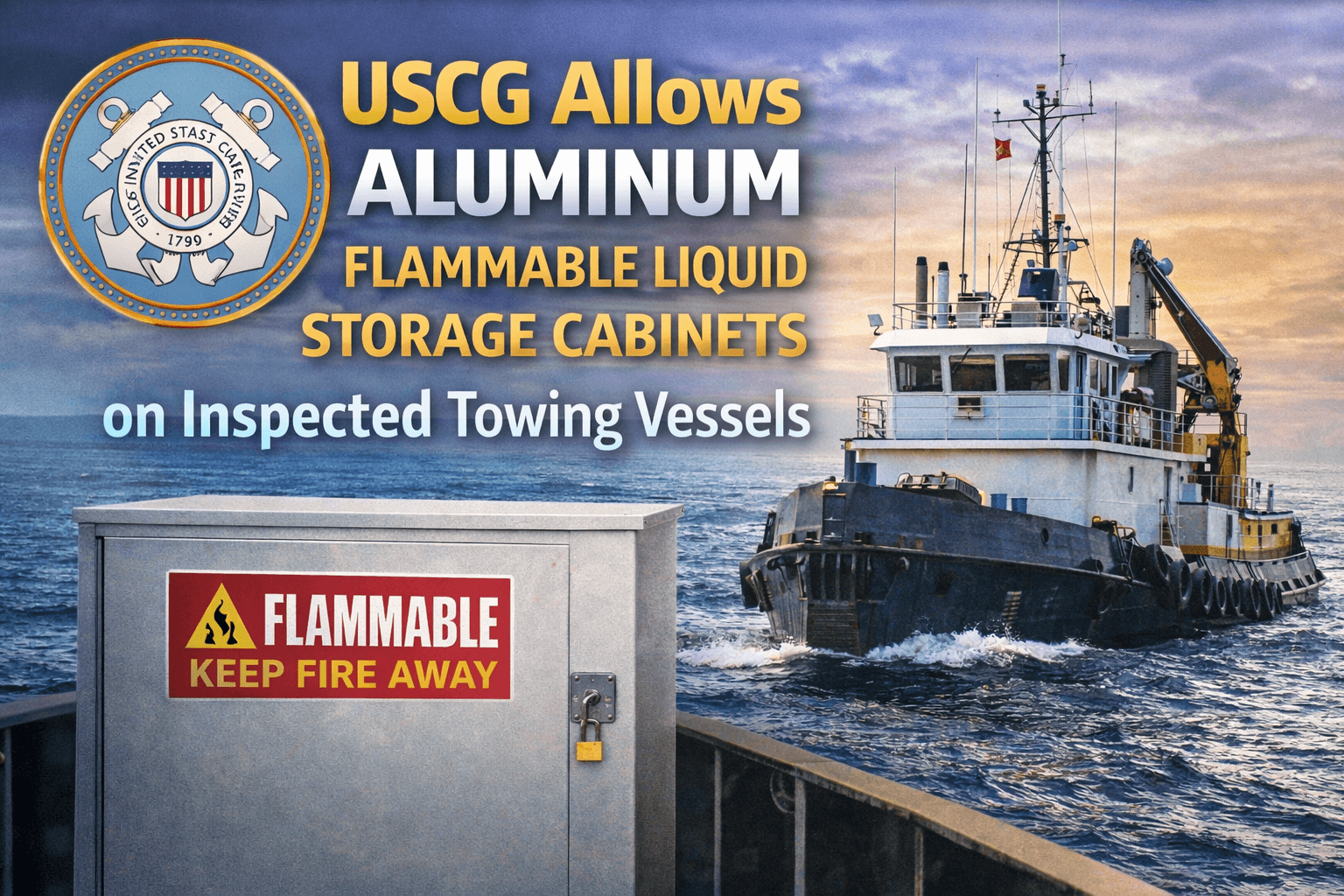
Recently on 2nd January 2026, the United States Coast Guard (USCG) has issued a new policy letter that provides updated guidance on the use of aluminum flammable liquid storage cabinets aboard inspected towing vessels. This change clarifies when and how these lighter cabinets may be accepted in place of traditional steel units under existing safety regulations, while ensuring fire risk remains controlled.
Importance of this policy
Conventionally, towing vessels — including tugboats and similar commercial craft — have been required to use heavy steel flammable liquid storage cabinets to store paints, solvents, and other flammable materials safely in compliance with the Code of Federal Regulations (46 CFR 142.225). These regulations aim to minimize onboard fire hazards by ensuring hazardous liquids are secured in approved containers.
However, the Coast Guard’s Policy Letter 05-25 — issued by the Office of Design and Engineering Standards (CG-ENG) — now formally allows aluminum cabinets to be accepted as equivalent alternatives when installed on the weather deck of inspected towing vessels, provided they meet specific criteria and local marine inspectors agree.
This shift recognizes that aluminum cabinets can offer sufficient protection in certain use-cases, especially when they are located on deck where ventilation and emergency access are generally better than in enclosed engine or storage spaces. At the same time, steel cabinets remain the preferred standard and are still mandated in spaces subject to higher fire risk.
Under Policy Letter 05-25, the use of aluminum flammable liquid storage cabinets is permitted:
Only for domestic voyages of inspected towing vessels.
When cabinets are placed on the weather deck — the open, exposed deck of the vessel.
If they meet all criteria outlined by the Coast Guard and are approved by the local Officer in Charge, Marine Inspection (OCMI).
If a vessel currently operates with a special consideration that allowed a non-standard flammable locker, those certificates and notations must be updated to reflect the new policy’s equivalency criteria at the next Coast Guard attendance review.
Requests for cabinet types or installations that fall outside the criteria specified in the policy must be submitted to CG-ENG for approval, ensuring that safety equivalency is reviewed at the national level.
Balancing Safety and Practicality
Fire safety is a critical concern on all commercial vessels. Storing flammable liquids in dedicated cabinets limits the potential for fuel, solvents, or other liquids to ignite and spread fire rapidly. Standards such as UL 1275 or similar consensus test protocols typically govern cabinet design to ensure adequate fire resistance.
By acknowledging aluminum cabinets as an acceptable option in specific circumstances, the Coast Guard is providing vessel operators with more flexibility — particularly for equipment stowage on decks where exposure to the environment may reduce certain risks.
Popular Posts

Explore Topics



Comments