
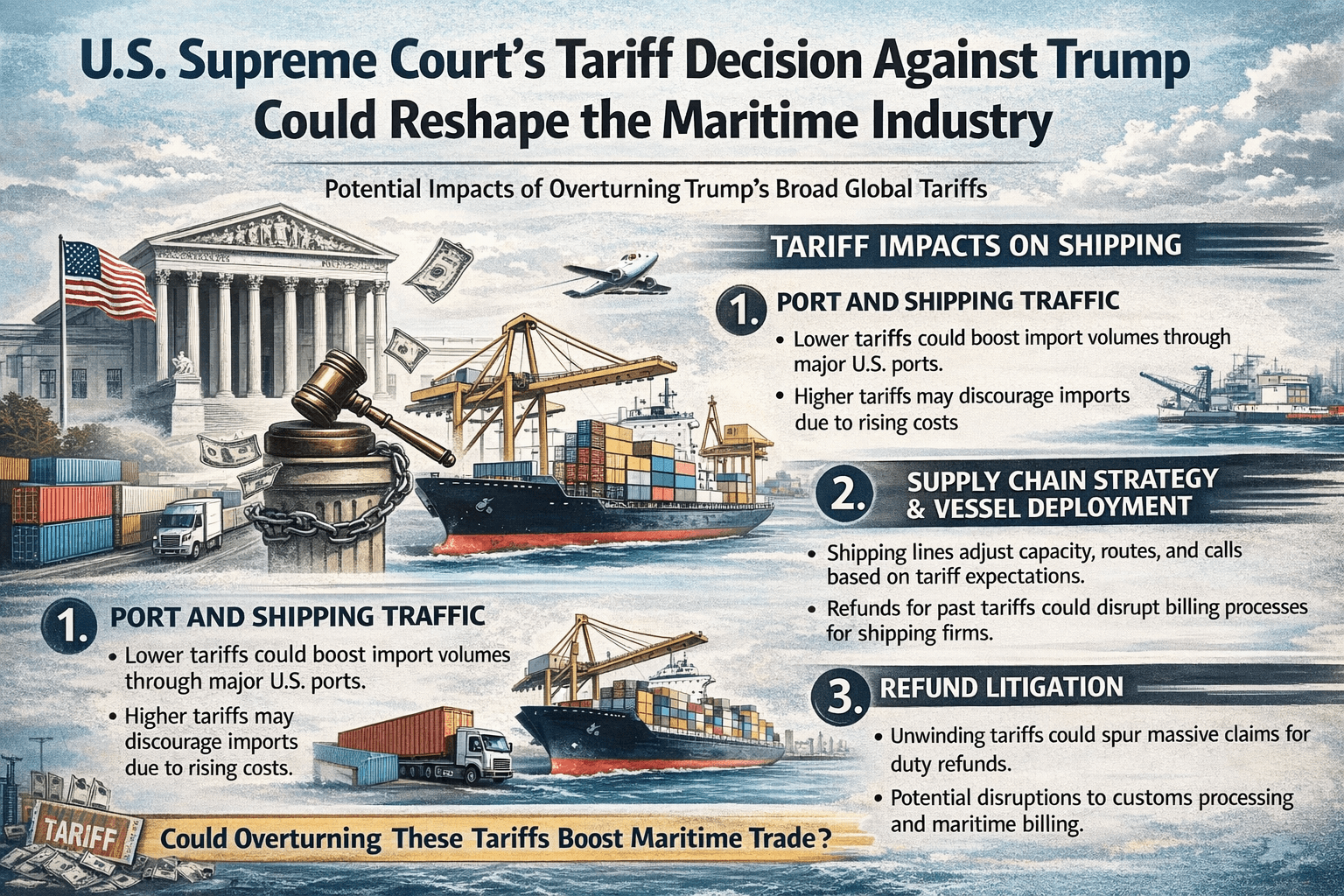
The U.S. Supreme Court may soon rule on the legality of President Donald Trump’s sweeping global tariffs, a high-stakes legal battle that could have profound implications for the maritime and global trade ecosystem. At its core, the case challenges whether Trump had the authority to impose wide-reaching tariffs under the International Emergency Economic Powers Act (IEEPA) — a law originally designed for sanctions, not trade policy.
How this decision can impact the maritime industry
Tariffs, essentially taxes on imported goods, influence how much companies pay to move products across borders. Elevated tariffs increase the cost of goods entering the U.S., which historically triggers changes in shipping demand, port utilizations, and container flows.
Historical example - In late 2025, U.S. container imports dropped nearly 6%, in part due to tariff pressures and global trade tensions.
If the Supreme Court invalidates Trump’s emergency tariffs, some tariff lines could be rolled back or reshaped, potentially lowering trade costs and reviving import demand, which would benefit shipping lines, ports, and logistics operators.
The case focuses on whether the president can use the IEEPA to impose broad tariff measures without explicit congressional authorization. The law was originally intended for emergency sanctions against foreign adversaries, not sweeping trade duties.
Lower courts already ruled that Trump exceeded his legal authority — but the Supreme Court has delayed a decision, meaning uncertainty persists.
Maritime Industry Impacts
1. Port and Shipping Traffic
If tariffs are overturned or scaled back, importers may see lower costs, encouraging higher import volumes through major U.S. ports leading to volume boost in cargo throughput - good for terminal operators, trucking, rail partners, and carriers.
Conversely, if tariffs are upheld or replaced by similar levies, ongoing trade costs may discourage imports, shifting cargo to alternative markets or pushing buyers to regionalize supply chains - a trend already seen when tariffs were first introduced.
2. Supply Chain Strategy and Vessel Deployment
Freight forwarders and shipping lines adjust strategies based on tariff expectations. High tariffs often lead to inventory stockpiling before new duties take effect — a phenomenon seen with early 2025 tariff ramps.
A Supreme Court ruling in favour of the tariffs could cement structural changes in trade flows, compelling carriers to modify vessel rotation, capacity planning, and even port calls as companies hedge against tariff costs.
3. Refund Litigation Could Ripple Through Maritime Billing
If the Court strikes down tariffs as unlawful, importers may seek refunds for duties already paid — a massive exercise involving billions of dollars.
This legal storm could slow customs clearance and cargo release as courts sort through claims, affecting port dwell times and adding administrative headaches for carriers and terminal operators.
Popular Posts

Explore Topics



Comments