
The Ships India does not own: The quiet maritime vulnerability behind a $4 trillion economy
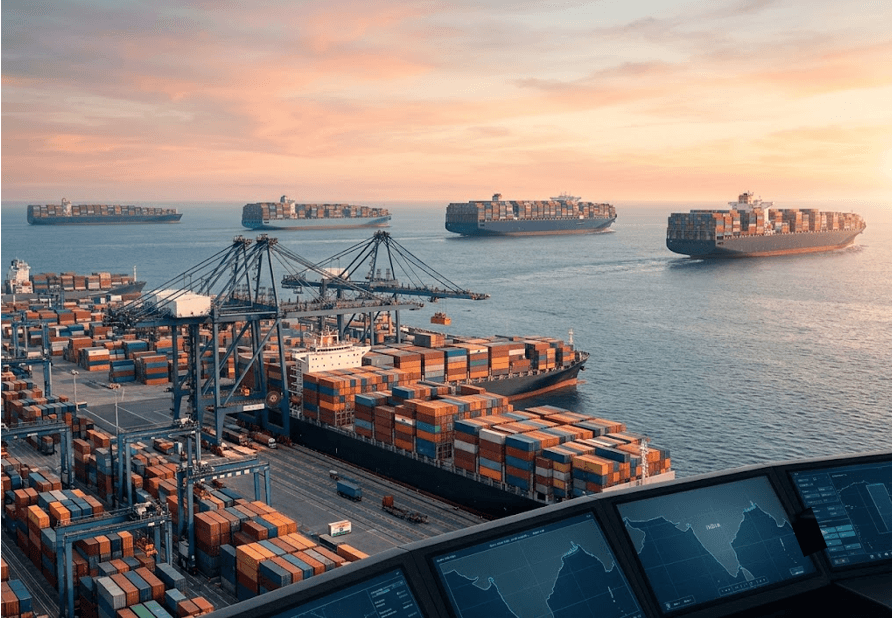
India has ports, a long coastline and one of the world's fastest-growing economies. But much of the machinery that connects India to the global economy is still controlled outside the country. That could become an important strategic vulnerability.
Some vulnerabilities arrive with missiles, sanctions or blockades.
Others arrive quietly.
A shipping line cancels a service. A vessel is delayed. Freight rates rise. A container misses its sailing. An important route suddenly becomes more expensive or less reliable.
No port needs to be attacked. No war needs to be declared.
Yet trade can begin to slow.
This is the concern behind a recent warning from Sanjeev Sanyal, a member of India's Economic Advisory Council to the Prime Minister. Speaking on September 24, Sanyal said India could face serious difficulties if three or four major global shipping lines decided to restrict access to the country.
His point is bigger than shipping.
India's economy is becoming increasingly global, but a large part of the machinery physically moving India's trade is not Indian.
India is connected—but does it have control?
Around 95% of India's trade by volume and 75% by value moves by sea, according to Sanyal. He also pointed to India's relatively small ocean-going merchant fleet and argued that the country needs to strengthen shipbuilding, ship ownership and its maritime capabilities.
Moneycontrol's report on Sanyal's remarks
India has, of course, made significant progress.
UNCTAD's 2025 maritime review placed India among the world's ten most connected countries for liner shipping. India's connectivity score increased 18% between June 2024 and June 2025, helped by growing capacity at ports such as Mundra, Nhava Sheva and Vizhinjam.
UNCTAD Review of Maritime Transport 2025
But there is an important distinction:
Having a port is not the same as controlling the ships that serve it.
A modern port can load a container in minutes. But someone still has to own the vessel, provide the capacity, operate the route and decide where that vessel sails.
Why concentration matters
Global container shipping is dominated by a relatively small number of major companies.
MSC alone accounted for roughly 21.5% of global container capacity in June 2026, while Maersk accounted for around 13.7%, according to industry data.
Seatrade Maritime's shipping-market analysis
This does not mean a few companies could simply switch off India's trade. India is a huge and increasingly important market, and shipping companies have strong commercial reasons to serve it.
In fact, the opposite is happening in some areas.
MSC's terminal arm agreed in 2026 to invest about $1.4 billion for a 49% stake connected to the development of Vizhinjam port, whose planned capacity is expected to rise dramatically.
That tells us something important: global shipping companies increasingly see India as strategically important.
But commercial dependence can still become strategic dependence during a crisis.
India is beginning to respond
New Delhi appears increasingly conscious of this vulnerability.
The government has approved a ₹69,725 crore package covering shipbuilding, maritime financing and capacity development. It includes a ₹25,000 crore Maritime Development Fund and significant financial support for shipbuilding.
Government of India's maritime and shipbuilding announcement
India has also introduced a series of new maritime laws covering shipping, ports, coastal shipping and carriage of goods.
But building a maritime ecosystem takes time.
A shipyard alone is not enough.
India needs ship owners, marine engineers, financing, insurance, equipment manufacturers, skilled seafarers and companies capable of operating globally competitive shipping networks.
The goal is not self-sufficiency
India does not need to carry every container on Indian-owned ships.
That would neither be practical nor economically sensible.
The real objective should be resilience.
India should have enough domestic maritime capability that the disruption of a few international carriers does not become a national economic crisis.
That means more Indian-owned ships, stronger shipbuilding, multiple shipping routes, competitive ports, deeper maritime finance and a large pool of skilled maritime professionals.
It also means recognising that shipping is not merely a support service for the economy.
For a trading nation, shipping is part of the economy itself.
India can build world-class factories and ports. But if the system connecting those factories to customers around the world becomes unreliable or prohibitively expensive, the entire supply chain suffers.
The larger question
India's economic ambitions are measured in trillions of dollars.
As the country becomes a larger manufacturing and trading power, the value of the system moving those goods will become enormous.
That is why Sanyal's warning is worth considering—not as a prediction that shipping companies will abandon India, but as a question about economic resilience:
How much of India's economic power depends on assets and networks that India does not control?
The answer will not come from building ships alone.
It will come from building an entire maritime ecosystem.
Because in the 21st century, economic power is not only about what a country produces.
It is also about whether it can move what it produces—and keep moving when the world becomes uncertain.
Popular Posts


Explore Topics



Comments