
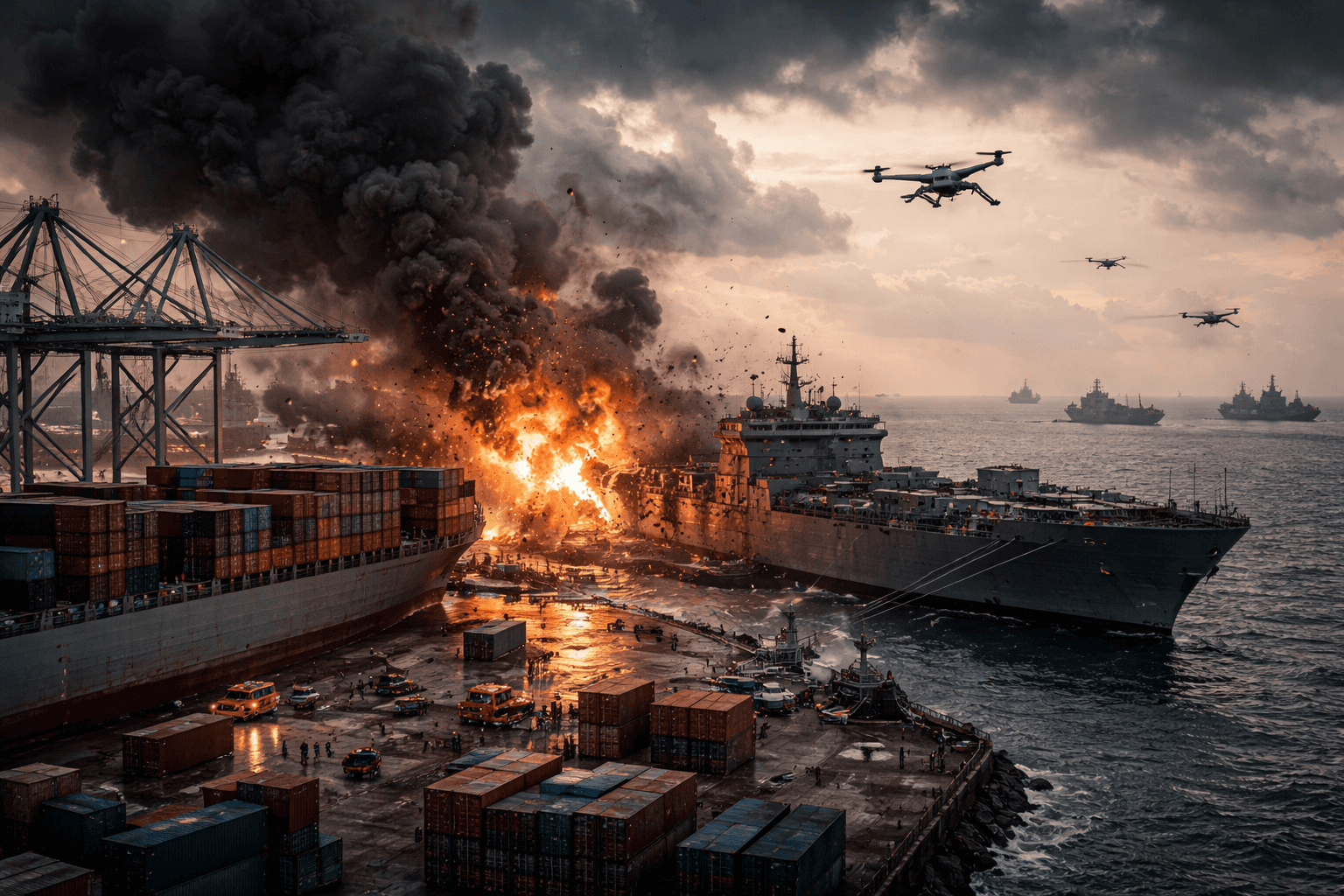
The drone strike on Oman’s Port of Salalah marks a turning point in the Iran–US–Israel conflict—not because of the damage, but because of the message.
For weeks, Oman stood apart—quiet mediator, safe logistics alternative, and neutral corridor outside the Strait of Hormuz. That illusion ended the moment drones hit Salalah.
What exactly happened
On March 28, multiple drones struck the Port of Salalah—Oman’s largest transshipment hub—damaging port infrastructure and injuring at least one worker.
Iran’s military confirmed that the intended target was an American logistics vessel operating offshore, not the port itself.
However, a critical detail stands out:
The targeted vessel’s name has not been officially disclosed
It is described only as a US-linked logistics/support vessel, likely part of military supply chains rather than a combat ship
This ambiguity is deliberate—plausible deniability remains intact.
Meanwhile, major liner operators reacted instantly:
Maersk suspended operations
Vessels like Lisbon Express were diverted out of Salalah
The port was effectively shut—without a single ship being directly hit.
Why Salalah matters more than Hormuz (for now)
The Port of Salalah is not just another Gulf port. It sits outside Hormuz, on the Arabian Sea—long considered a fallback route if the Strait collapses.
Gateway linking Asia–Europe–Africa trade
Key transshipment hub for Indian Ocean cargo flows
Alternative routing node during Hormuz disruption
By striking Salalah, the war has expanded beyond chokepoints into redundancy networks.
In simple terms:
Even the backup routes are no longer safe.
Iran’s layered strategy: deniability + proxies
Iran’s official position remains carefully worded:
Respect for Oman’s sovereignty
Claims of indirect or “independent” operations
But the broader battlefield tells a different story.
The real strategic lever lies with Houthi rebels:
Active missile and drone attacks across Red Sea routes
Expanded targeting beyond Israel into regional shipping lanes
The Oman dilemma: mediator turned battleground
Oman has historically played a balancing role—hosting US-Iran talks and maintaining neutral positioning.
Now it faces three risks:
Loss of neutrality credibility
Becoming a secondary battlefield
Collapse of its ports as “safe alternatives”
Even Oman’s own statement reflects uncertainty—no confirmed attacker publicly claimed responsibility.
This ambiguity is strategic—it keeps escalation controlled, but persistent.
What happens next: two clear scenarios
Scenario 1: escalation continues
If strikes persist:
Oman ports (Salalah, Duqm, Sohar) become active targets
Insurance costs surge → de facto closure of Arabian Sea routes
Military supply chains shift further offshore
Oil stabilizes above $110 with risk spikes
Most importantly:
The war becomes multi-node maritime warfare, not a single chokepoint crisis.
Scenario 2: controlled de-escalation
If diplomatic channels reopen:
Salalah resumes operations within days/weeks
Naval escorts increase around logistics vessels
Oman reclaims partial neutrality role
Trade resumes—but with permanent war-risk premiums
Even in peace:
The idea of “safe Gulf ports” is permanently damaged
The Salalah strike is not about a drone.
It is about geography collapsing as a shield.
For decades, trade relied on fallback routes—
Hormuz blocked? Use Oman.
Red Sea unsafe? Divert via Gulf.
That logic no longer holds.
Now, the battlefield is not a strait.
It is the entire maritime network.
And in that network, even neutral ports are no longer neutral.
Popular Posts


Explore Topics



Comments