The Panama Canal is one of the most important waterways in the world. Connecting the Atlantic and Pacific Oceans, it transformed global shipping by eliminating the need for vessels to sail around South America's Cape Horn. More than a century after its opening, the canal remains a critical artery for international trade.
1. The canal opened in 1914
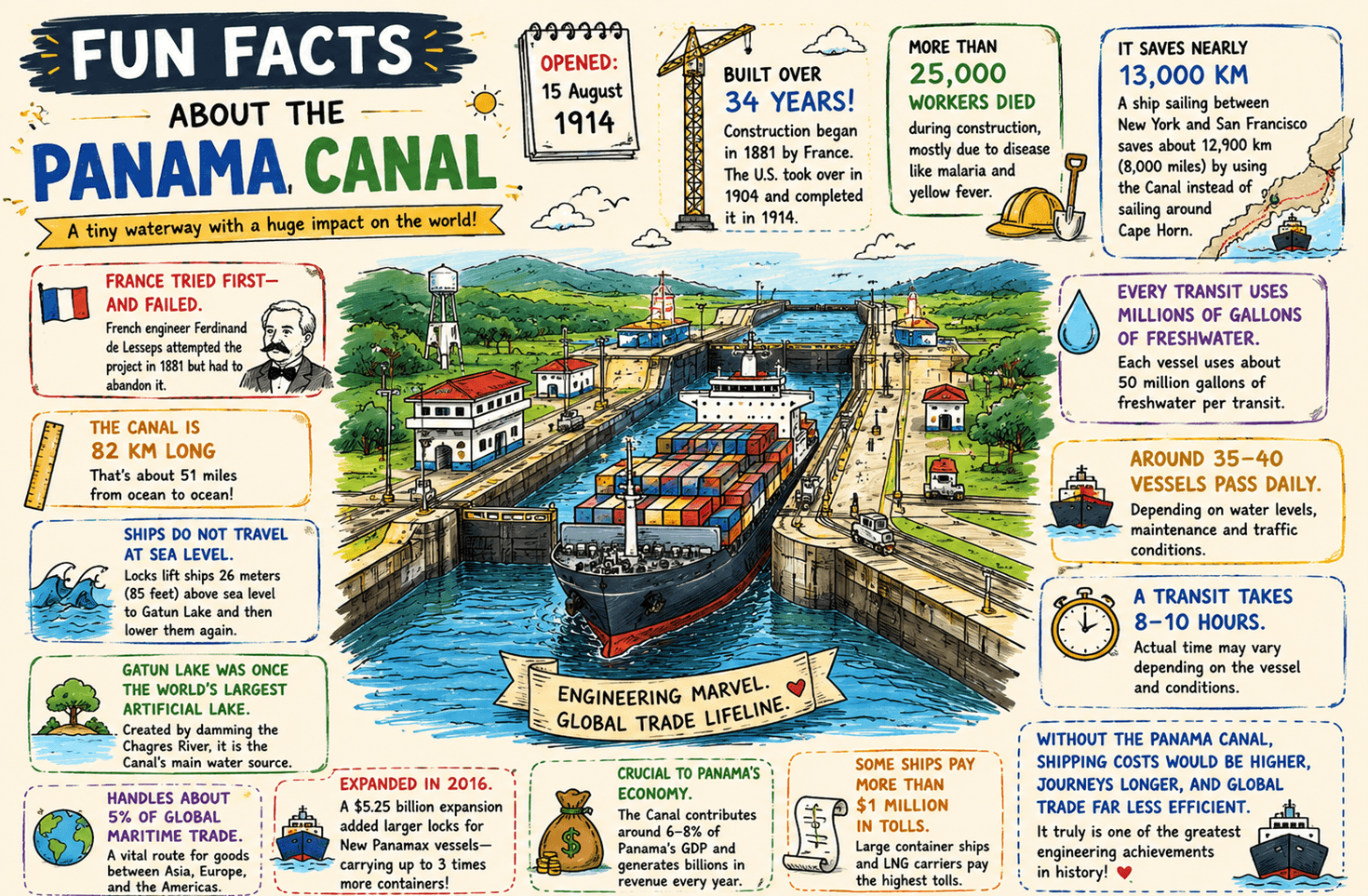
The Panama Canal officially opened on 15 August 1914, allowing ships to transit between the Atlantic and Pacific Oceans through a single route.
2. The project took 34 years to complete
Construction efforts began with the French in 1881. After the French project failed, the United States took over in 1904 and completed the canal in 1914. The entire effort spanned 34 years.
3. France tried first—and failed
French engineer Ferdinand de Lesseps, who built the Suez Canal, attempted to build a sea-level canal across Panama. Disease, landslides, and engineering challenges forced the project into bankruptcy.
4. More than 25,000 workers died during construction
Most deaths occurred during the French phase due to malaria and yellow fever. Major advances in mosquito control helped the U.S. successfully complete the project.
5. It saves nearly 13,000 km of sailing
A vessel traveling between New York and San Francisco can save approximately 12,900 km (8,000 miles) by using the canal instead of sailing around Cape Horn.
6. The canal is 82 km long
The Panama Canal stretches about 82 kilometers (51 miles) from ocean to ocean.
7. Ships do not travel at sea level
Unlike the Suez Canal, the Panama Canal uses a lock system to lift ships approximately 26 meters (85 feet) above sea level to Gatun Lake before lowering them again.
8. Gatun Lake was once the world's largest artificial lake
Created by damming the Chagres River, Gatun Lake became a key component of the canal's operation and remains its primary water source.
9. Every transit uses millions of gallons of freshwater
Each vessel passing through the original lock system requires roughly 50 million gallons of freshwater, which ultimately flows into the oceans.
10. Around 35–40 vessels pass daily
Depending on water levels, maintenance schedules, and traffic conditions, approximately 35 to 40 ships transit the canal each day.
11. A transit takes 8–10 hours
Most ships spend between 8 and 10 hours moving through the canal, though waiting times can significantly increase total voyage duration.
12. The canal handles about 5% of global maritime trade
Despite its relatively small size, the waterway carries roughly 5% of world seaborne commerce.
13. Panama expanded the canal in 2016
A $5.25 billion expansion project introduced larger locks, allowing New Panamax vessels carrying up to three times more containers than the original Panamax ships.
14. The canal is crucial to Panama's economy
The canal directly and indirectly contributes roughly 6–8% of Panama's GDP and generates billions of dollars annually through tolls and associated logistics services.
15. Some ships pay more than $1 million in tolls
Large container vessels and LNG carriers can pay tolls exceeding $1 million for a single transit, depending on vessel size and cargo.
Why the Panama Canal matters
Without the Panama Canal, global shipping costs would be significantly higher, transit times longer, and supply chains less efficient. More than 110 years after its opening, the canal remains one of the most important pieces of transport infrastructure ever built, linking markets across Asia, Europe, and the Americas.
Quick facts
Opened: 1914
Length: 82 km
Elevation of Gatun Lake: 26 m above sea level
Daily vessel transits: 35–40
Typical transit time: 8–10 hours
Expansion completed: 2016
Share of global trade: ~5%
Economic contribution to Panama: ~6–8% of GDP
The Panama Canal is not just a shortcut—it is one of the greatest engineering achievements in human history and a cornerstone of modern global trade.
Popular Posts

Explore Topics


Comments