
India’s $240 billion import dependence: Why crude oil, gold, edible oils and fertilisers are becoming a strategic concern
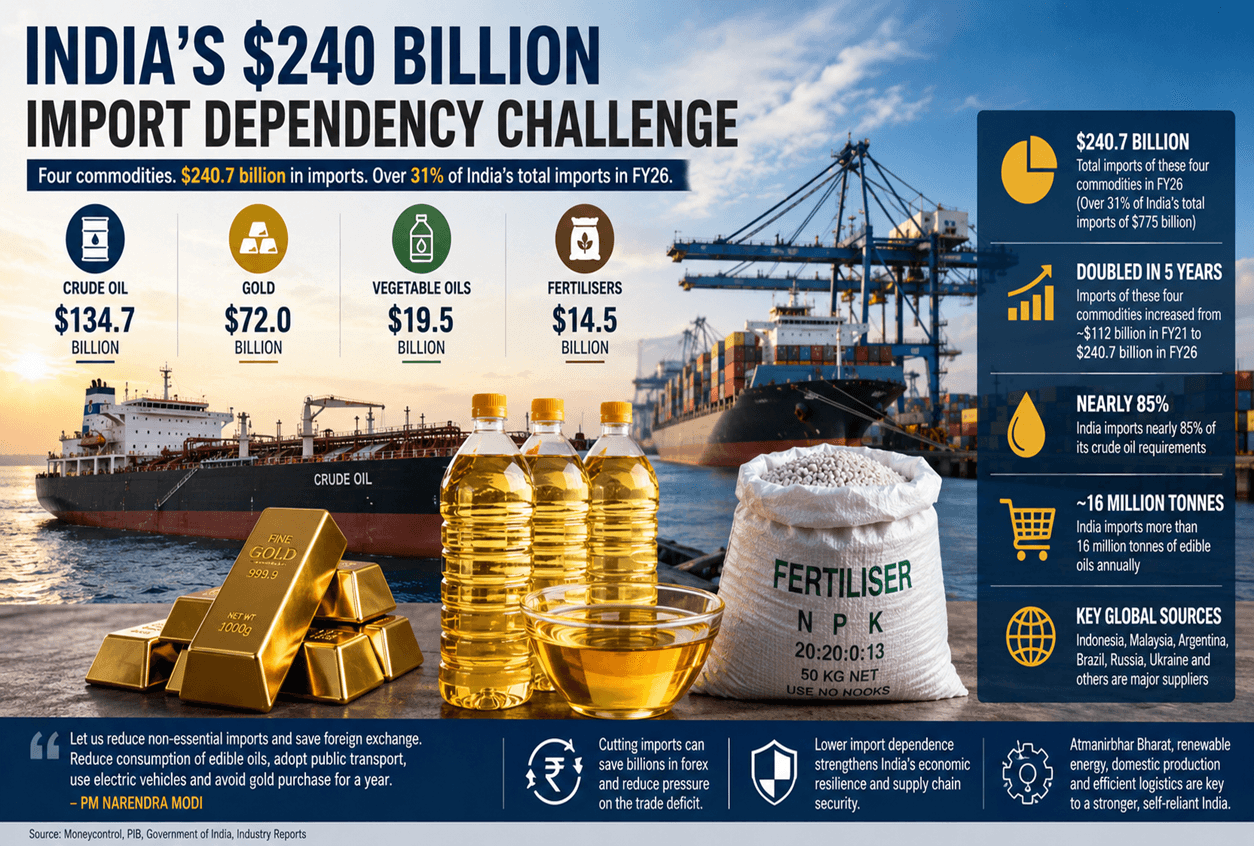
India’s growing dependence on four critical commodities—crude oil, gold, edible oils and fertilisers—has emerged as a major economic concern after Prime Minister Narendra Modi urged citizens to reduce unnecessary consumption and support economic self-reliance. According to a recent analysis, these four commodity groups accounted for imports worth nearly $240.7 billion in FY26, representing over 31 percent of India’s total import bill of $775 billion.
Crude petroleum remained India’s largest imported commodity at $134.7 billion, highlighting the country’s continued vulnerability to global energy shocks. Gold imports touched a record $72 billion, while vegetable oil imports stood at $19.5 billion and fertiliser imports rose sharply to $14.5 billion.
The concern has intensified due to geopolitical tensions in West Asia and volatility around the Strait of Hormuz, a critical global energy trade route through which a significant portion of India’s crude imports move. India currently imports nearly 85 percent of its crude oil requirement, making fuel prices and freight costs highly sensitive to international disruptions.
Prime Minister Modi, while addressing a public gathering in Hyderabad, called for “judicious use” of fuel, edible oils and fertilisers. He encouraged citizens to adopt electric vehicles, use public transport, reduce edible oil consumption and avoid non-essential gold purchases for a year to ease pressure on foreign exchange reserves.
The government’s concern is backed by rising import trends. India’s combined imports of these four commodities have more than doubled from around $112 billion in FY21 to over $240 billion in FY26. Gold imports alone increased nearly 24 percent year-on-year, while fertiliser imports jumped by about 77 percent due to elevated global prices and supply-side disruptions.
Edible oil dependence remains another major challenge. India fulfills nearly two-thirds of its edible oil demand through imports from countries such as Indonesia, Malaysia, Argentina, Brazil, Russia and Ukraine. The government has repeatedly highlighted the need to improve domestic oilseed production under the National Mission on Edible Oils–Oil Palm (NMEO-OP).
According to government and industry estimates, India imports more than 16 million tonnes of edible oils annually. Palm oil continues to dominate imports, though fluctuations in global prices and freight costs have recently impacted buying patterns. Reuters reported that India’s palm oil imports fell nearly 19 percent in March 2026 due to rising international prices.
The fertiliser sector also remains heavily import-dependent because India relies on overseas suppliers for key raw materials such as phosphoric acid, ammonia and potash. Any disruption in shipping lanes or energy markets directly affects fertiliser prices, subsidy burdens and agricultural costs.
India’s logistics and supply chain industry is expected to play a critical role in reducing long-term import vulnerability. Expansion of renewable energy infrastructure, ethanol blending, domestic oilseed cultivation, multimodal freight transport and solar-powered irrigation systems are being positioned as strategic measures to lower dependency on imported commodities.
Government initiatives such as Atmanirbhar Bharat, PM Gati Shakti, ethanol blending programmes and renewable energy expansion are increasingly linked not only to industrial growth but also to national trade security and forex stability. Analysts believe that even moderate reductions in imports across these four sectors could save billions of dollars annually and significantly narrow India’s trade deficit.
For India’s trade and logistics ecosystem, the message is becoming clear: reducing import dependence is no longer only an economic priority but a strategic necessity tied directly to supply chain resilience, energy security and long-term economic stability.
Popular Posts


Explore Topics



Comments