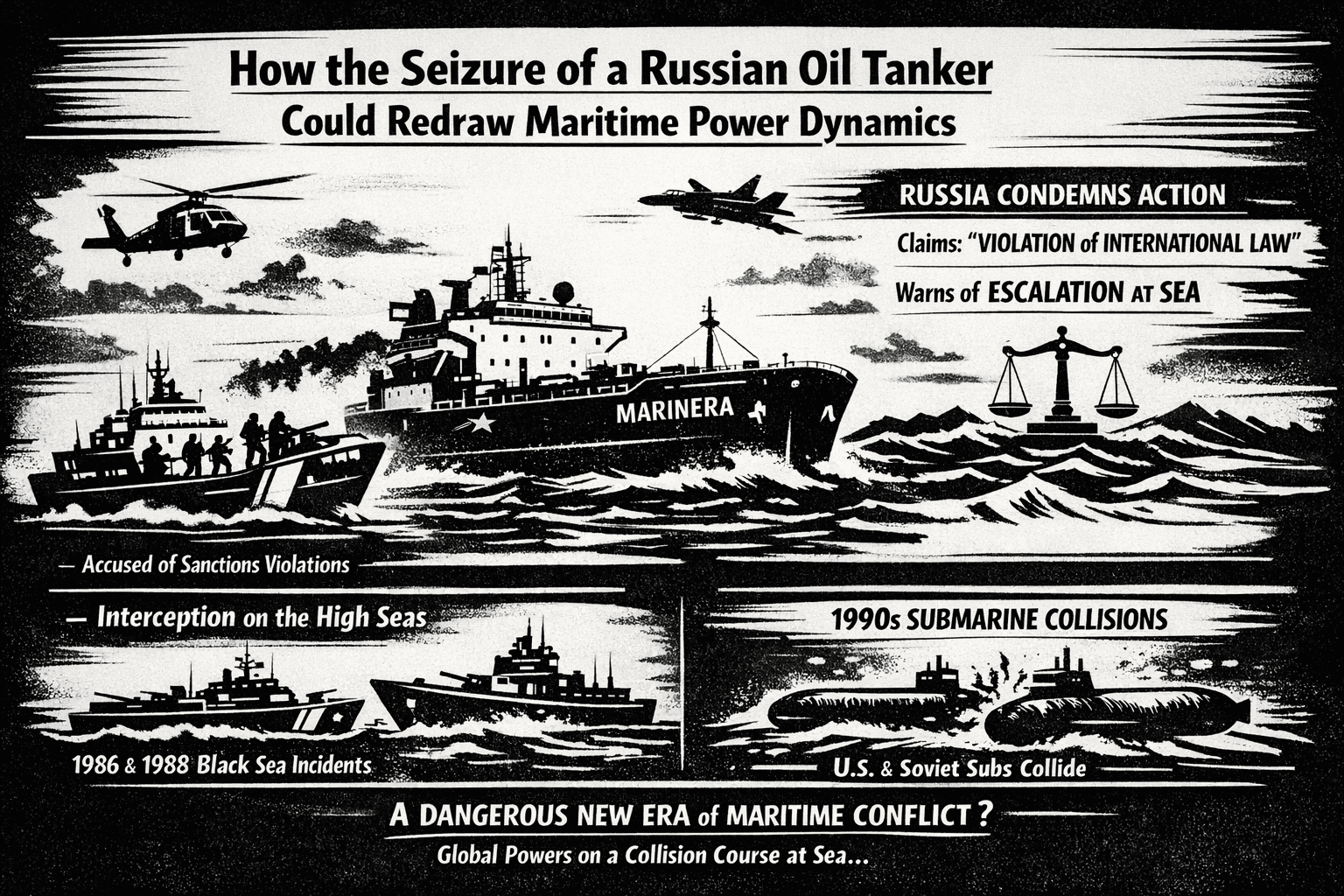
Incidence - In early January 2026 on the high seas, U.S. forces seized a Russian-flagged oil tanker, the Marinera (formerly known as - Bella 1), after a prolonged pursuit across the Atlantic Ocean. This conflict has one of the most significant maritime confrontations between Washington and Moscow in last few decades.
The Marinera — disputed by America of being part of a “dark fleet” that helped ship sanctioned oil from Venezuela, Iran or Russia — was intercepted in international waters after failing to comply with an earlier U.S. blockade and being tracked for over two weeks.
The U.S. government justified the seizure based on a U.S. federal court warrant and sanctions law, viewing the vessel as violating sanctions and being a stateless oil tanker.
Russia’s response - Moscow condemned the action as a gross violation of international maritime law, saying that stopping and forcibly boarding a civilian ship in international waters was illegal and could escalate military and political tensions.
Russian officials argued that freedom of navigation on the high seas, codified in the 1982 UN Convention on the Law of the Sea, protects vessels properly registered under a state’s flag, and that no such right exists for others to use force against them without clear legal grounds.
Why this important and what to connect from history and the situation
At face value, this might seem like an enforcement action tied to sanctions. But the stakes are much higher:
This is not just a legal fight - it symbolizes deeper geopolitical friction between the world’s two most powerful nuclear states. What once was limited engagement in hostile but stable Cold War competition has now extended into contested maritime enforcement and energy politics. Russia has warned that such actions could lower the threshold for future confrontations at sea, potentially putting military forces on a collision course where caution once prevailed.
Historical Sea Clashes Between the U.S. and Russia/Soviet Union
This isn’t the first time U.S. and Russian naval forces have clashed or nearly clashed:
1986 & 1988 Black Sea Incidents
During the Cold War, U.S. Navy ships exercised their right of innocent passage through Soviet territorial waters in the Black Sea. Soviet vessels physically bumped the U.S. ships in 1988, symbolic of Cold War brinkmanship, though both sides avoided open conflict.
Submarine Collisions After the Soviet Era
In the early 1990s, U.S. and Russian nuclear submarines collided near the Barents Sea during covert maneuvers, incidents that could have triggered crisis escalation had political conditions been more tense.
Looking Ahead
The Marinera seizure could set a precedent for future maritime enforcement actions, especially as states use economic tools like sanctions as part of geopolitical strategy. If global powers increasingly act unilaterally at sea, the risk of missteps and military escalation can grow.
Image credit - AI
Popular Posts
Explore Topics


Comments