
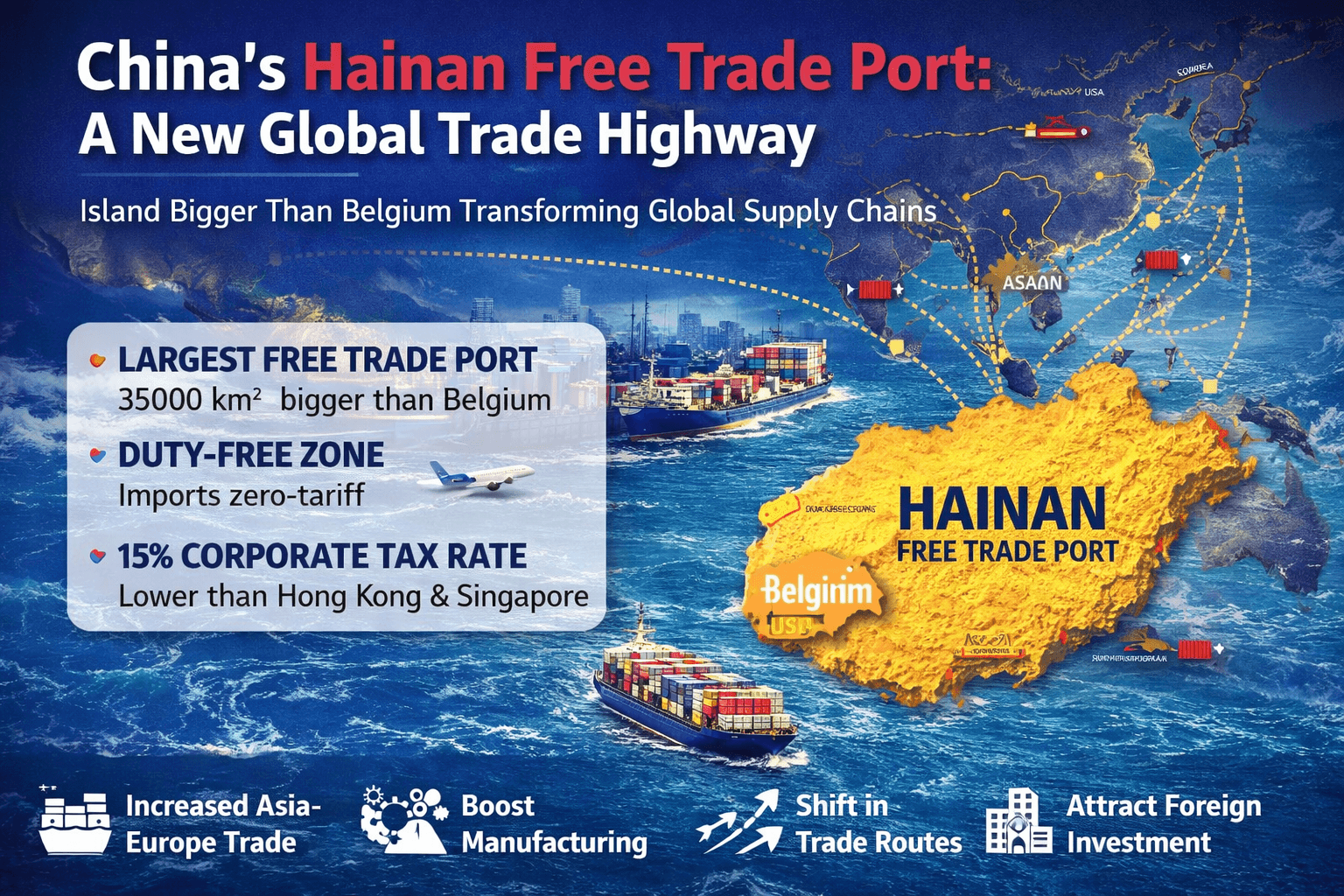
In a bold economic move that could reshape global trade flows, China has transformed its southern island province of Hainan into the world’s largest free trade port — bigger than Belgium in land area — with new laws coming into force at the end of 2025. This development is an attempt to build a mega-economic hub aimed at building a new gateway for Asian trade and supply chains.
What Is the Hainan Free Trade Port?
The Hainan Free Trade Port covers the entire island of Hainan and surrounding smaller islands, about 35,000 square kilo meters — slightly larger than the European country of Belgium and almost 50 times the size of Singapore.
Originally it was announced in 2018, confirmed in December 2025, when Hainan began operating as a separate customs zone with independent trade and investment regulations.
Under the new system:
Most goods can enter Hainan duty-free.
There will “two-line” customs system — one line linking Hainan to global markets, and another separating it from mainland China’s standard tariff regime.
Added-value incentives allow products that complete at least 30% of their value addition in Hainan to enter mainland China duty-free, encouraging manufacturing and logistics operations on the island itself.
Historical view of China’s Trade Experiments
China has a long record of using trade and investment zones as economic catalysts:
From the late 1970, China opened Special Economic Zones (SEZs) like Shenzhen, which transformed from fishing village into a global export powerhouse.
Earlier free-trade zones such as the Shanghai Free-Trade Zone helped pilot reforms in customs, finance, and regulatory flexibility.
These earlier experiments laid the groundwork for larger, more ambitious projects — with Hainan now becoming a catalyst in the same conventional way.
Chinese Incentives with comparison to competitors
China is positioning Hainan to rival traditional global trade hubs (like Singapore or Dubai) by offering:
A flat corporate tax rate of 15%, lower than Hong Kong -16.5% and Singapore - 17%.
Regulatory flexibility unlike mainland China, including broader approval for foreign products and services.
Eased visa rules for short-term business, tourism, and medical visitors (up to 30 days), only in Hainan away from Mainland China.
Hainan’s zero-tariff imports and investment incentives stand in contrast to rising protectionism elsewhere, offering companies a way to mitigate tariffs and trade barriers
Foreign companies can set up special bank accounts with fewer foreign exchange controls.
What This Means for Maritime & Logistics Sectors -
Expect increased container traffic through Hainan’s ports.
New Shipping line services to be routed through Hainan port in coming months.
Please follow us, will keep you updated
Popular Posts


Explore Topics


Comments