
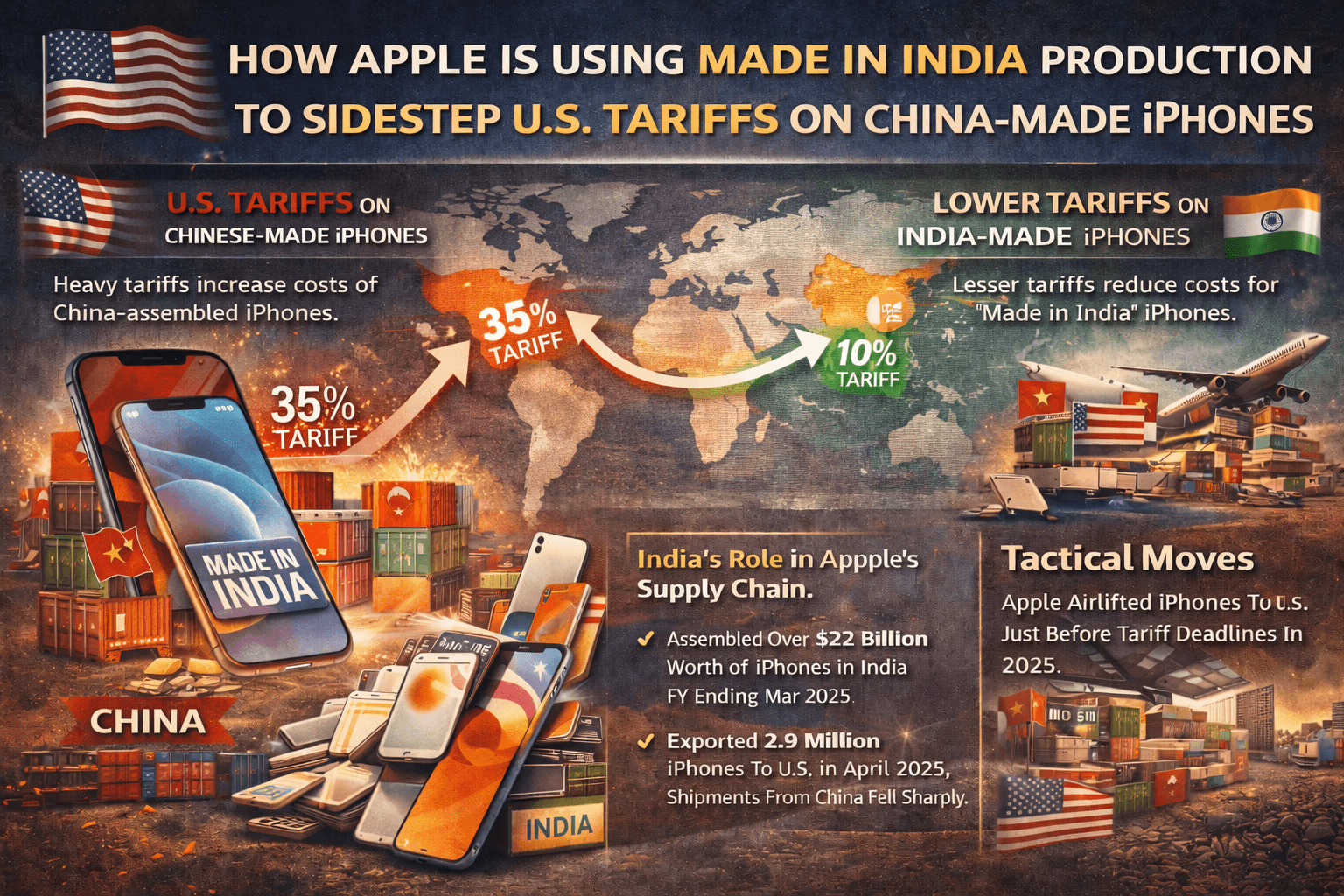
In response to rising U.S.–China trade tensions and punitive tariffs on Chinese-assembled goods, Apple Inc. has accelerated its iPhone manufacturing shift to India and positioning India as a key production hub to avoid costly U.S. tariffs on China-made devices.
Why the shift matters: U.S. tariffs on China vs India
The backdrop to this strategy is a series of U.S. tariffs imposed on imports from China as part of broader trade tensions. These levies — including a baseline tariff around 30 % on Chinese smartphone imports — would significantly increase the cost of iPhones assembled in China, squeezing margins or forcing higher prices for American consumers.
By contrast, iPhones assembled in India face a much lower tariff rate — initially around 10 % — and at times even temporarily paused. This tariff differential helps apple to get the manufacturing at a Cheaper cost.
What is India’s rising role in Apple’s global supply chain
Apple began iPhone production in India in 2017 but since then the operation has expanded rapidly. Its important to note that Apple assembled over $22 billion worth of iPhones in India in the fiscal year ending March 2025, a 60 % year-on-year increase.
Moreover, India now accounts for a growing share of U.S. iPhone imports:
India exported approximately 2.9 million iPhones to the U.S. in April 2025, a 76 % year-on-year surge, while shipments from China fell sharply.
Analysts estimate that Apple could expand Indian production capacity to meet all U.S. iPhone demand by 2026, relative to current production volumes.
This rapid increase shows how Apple is shifting its manufacturing footprint away from China to India. Also the manufacturing in India at a much lower cost than manufacturing in USA.
Tactical moves: exporting from India to the USA just before tariff implementation
In 2025, Apple reportedly went so far as to airlift large shipments of iPhones from India to the U.S. just ahead of tariff deadlines, using cargo flights to “beat” tariff cut-off dates and stockpiled the inventory in American warehouses.
Challenges in shifting completely to India
While India plays an increasingly central role, Apple still depends partly on China for a large portion of iPhone components and supply chain infrastructure. Assembly in India still uses components sourced from Chinese factories, meaning the complete shift of production may take years.
In addition, political pressure from the U.S. government — including threats of higher tariffs if production doesn’t shift wholly to American soil — underscores the geopolitical complexity.
Despite these challenges, India’s lower tariff exposure, competitive labour costs, and supportive manufacturing policies make it a compelling alternative for Apple. Analysts predict that India could eventually become a major export base for iPhones destined for the U.S. market, helping Apple avoid steep tariff costs and maintain price competitiveness.
At the end all companies works for profit and Apple has to take necessary actions to make profit and keep business running.
Popular Posts

Explore Topics



Comments