Europe’s Ports Are Under Pressure Again: 1.7 Million TEU of Global Capacity Lost to Delays
Europe’s Ports Are Under Pressure Again: 1.7 Million TEU of Global Capacity Lost to Delays
Rotterdam : 30 August 2026
The latest congestion figures are not just another warning for container shipping. They show how much vessel capacity is being lost simply because ships are spending too much time waiting.
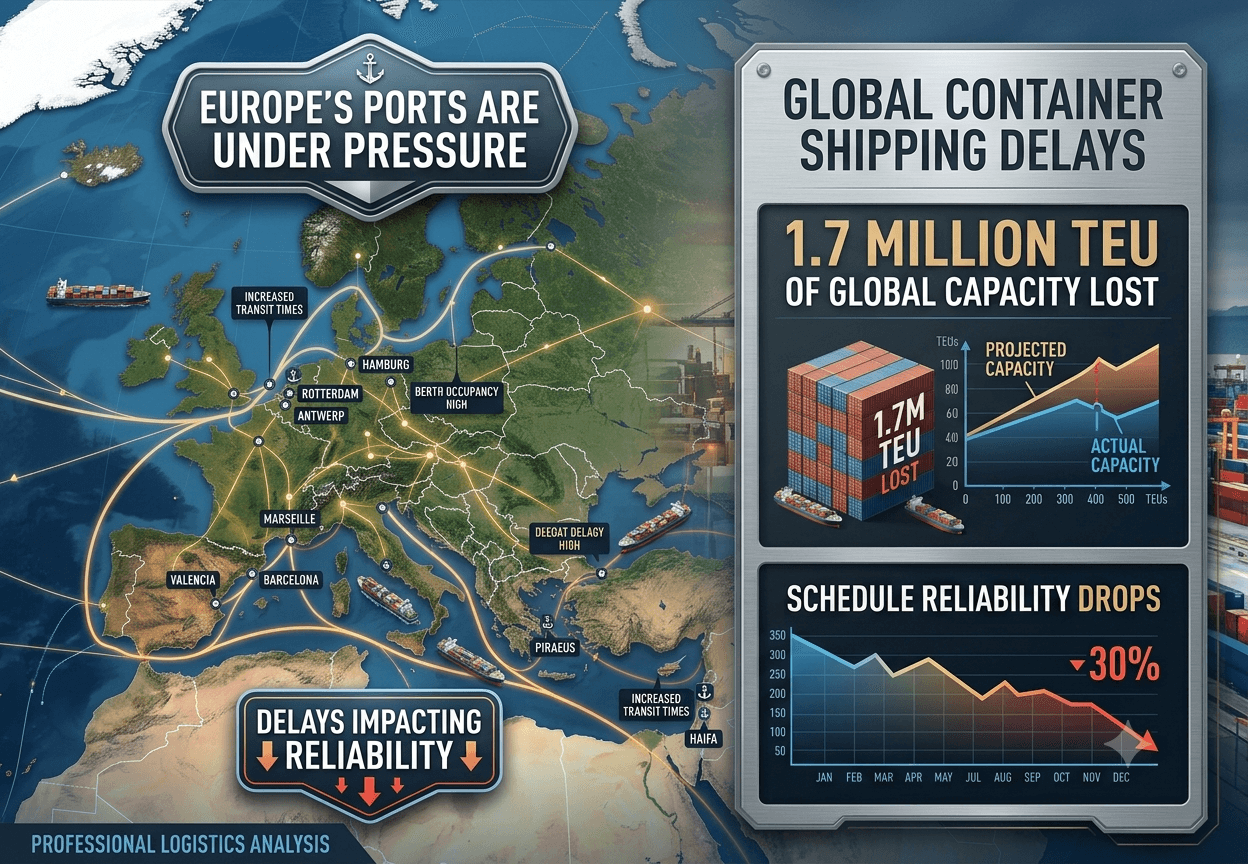
Sea-Intelligence estimates that around 5% of global deep-sea container capacity — approximately 1.7 million TEU — is currently absorbed by vessel delays. The figure is global, not 1.7 million TEU sitting outside European ports. But North Europe has become one of the industry's important pressure points, and the deterioration in schedule reliability is becoming difficult to ignore.
The latest July figures make the situation even clearer. Global container schedule reliability fell to 56.4% in July 2026, down 6.1 percentage points from June and the lowest level recorded this year. For vessels that arrived late, the average delay increased to 6.06 days, the highest since January 2024.
For European shippers, however, the problem is not simply that ships are late.
The bigger concern is what happens after those ships arrive.
The 1.7 million TEU number needs some explanation
It would be easy to read the headline and assume that 1.7 million TEU of containers are currently sitting in European ports.
That is not what the number means.
Sea-Intelligence is measuring vessel capacity effectively taken out of service by delays. At today's fleet size, 5% works out to approximately 1.7 million TEU.
Before the pandemic, between 2011 and 2019, delays typically absorbed about 2.2% of global container capacity. The difference between that old baseline and today's 5% represents roughly another 1 million TEU of capacity being lost to delays.
That distinction matters.
A container ship stuck outside Rotterdam is obviously delayed. But so is the ship that reaches Rotterdam late, misses its planned berth, leaves late and then arrives late at Hamburg or Antwerp.
The vessel may still be physically operating.
For the network, however, part of its capacity has effectively disappeared.
And that is what the 1.7 million TEU represents.
North Europe is one of the places where the problem is becoming visible
The European situation is not identical across every port, but the pressure is clear.
Rotterdam, Antwerp-Bruges, Hamburg and other North European gateways are dealing with a mixture of vessel bunching, terminal utilisation, inland transport constraints and changing service patterns.
At Rotterdam, the port itself has acknowledged that rising container traffic is putting increasing pressure on roads, terminals and logistics processes. Its June market update pointed to congestion at terminals and on roads, longer waiting times and limited capacity during peak periods.
Maersk's June market update was more specific: Rotterdam terminals were experiencing high yard utilisation, reduced crane availability and extended waiting times for barges and feeders, with some terminals asking customers to collect import containers urgently to prevent congestion from worsening.
This is the part of the story that is often missed.
A port does not become congested only when ships are waiting outside.
It can become congested when containers cannot leave quickly enough.
A vessel may discharge thousands of boxes, but if trucks, trains and barges cannot remove them at the required pace, those containers remain inside the terminal. The yard fills. Handling becomes more difficult. The next vessel arrives into a port that has less room than it had before.
The congestion then feeds itself.
Rotterdam is still handling huge volumes
There is also a useful reality check here.
Rotterdam is not collapsing.
Its total throughput actually increased 0.4% in the first half of 2026 to 212.0 million tonnes. Container throughput, however, was down 0.1% in TEU and 2.6% in tonnes.
That tells us something important.
The current European problem should not be described as ports simply running out of cargo-handling capacity.
The issue is more about how efficiently that capacity can be used when ships, terminals and inland transport are no longer moving in sync.
Rotterdam is even accelerating additional container-terminal investment. Rotterdam World Gateway is bringing forward an expansion at Maasvlakte 2, including a fourth deep-sea berth, five new quay cranes, 22 automated stacking cranes and 24 automated guided vehicles. The investment is around €500 million.
That is a sign that the industry knows the answer cannot be congestion management alone.
More efficient capacity is also needed.
Hamburg tells a different story
Hamburg's numbers show why Europe's port situation cannot be described simply as “too much cargo.”
Germany's largest seaport handled about 4.0 million TEU in the first half of 2026, down 3.8% from the same period last year.
The Port of Hamburg attributed the difficult first half to several factors, including the harsh winter at the beginning of the year and ongoing terminal modernisation. HHLA separately reported a 6.7% decline in container handling to 2.959 million TEU during the first six months, with terminal automation works, rail construction and winter weather affecting operations.
So while Rotterdam is dealing with pressure from traffic and inland logistics, Hamburg is also dealing with the temporary reduction in operational capacity caused by infrastructure work.
That is why European congestion is difficult to diagnose with one number.
The ports are facing different problems at different times.
The reliability numbers are perhaps more worrying than the queues
For the shipping lines, the most important number may not be the number of ships waiting outside a port.
It is schedule reliability.
Only 56.4% of global liner services arrived within their scheduled window in July. That was the weakest performance of 2026 so far.
And when a vessel was late, the average delay was 6.06 days.
That means a ship arriving almost a week late is no longer an exceptional event in the global liner network.
The situation is even more uncomfortable for some Europe-related trades. On the North Europe–US East Coast route, only 28% of services arrived on time in July, according to the latest industry reporting based on Sea-Intelligence data.
For a shipper planning production, warehouse labour, trucking or retail distribution, that is a serious problem.
A schedule saying “arrival on 10 September” becomes much less useful when the actual arrival could move several days in either direction.
Europe has already experienced how long congestion can take to disappear
There is a useful historical comparison sitting in Antwerp.
Port of Antwerp-Bruges said in July 2023 that operational challenges and congestion at its container terminals had finally been resolved after two difficult years, with diverted cargo beginning to return.
The port also said congestion had already been slowly declining from the third quarter of 2022.
This gives us a valuable timeline.
The severe disruption did not simply arrive one month and disappear the next.
The congestion eased gradually, and Antwerp was still talking about the return of diverted cargo in 2023.
That does not mean today's congestion will take two years to resolve.
The circumstances are different.
But it is a useful reminder that when congestion becomes embedded in the wider shipping network, recovery can be slow.
And Europe had another warning in 2025
The problems did not end with the pandemic.
By June 2025, Rotterdam, Antwerp and Hamburg were again facing severe congestion. At the time, logistics operators reported barge waiting times of around 66 hours at Antwerp and 77 hours at Rotterdam, while some vessels arriving at Antwerp were several days behind schedule.
The reasons were not the same as the COVID crisis.
Higher import flows, changes in shipping alliances, US tariff uncertainty, low Rhine water levels and disruption to vessel schedules were all contributing to the pressure.
That episode is particularly relevant because it showed that European ports can become congested without a pandemic or a single major port closure.
The network itself can become unbalanced.
2026 is showing the same vulnerability in a different form
This year's problem is again a mixture rather than one dramatic incident.
Ships are arriving in less predictable patterns. Terminals are handling large vessel calls. Inland transport has to absorb containers after they are discharged. Infrastructure work is temporarily reducing capacity at some terminals. Weather has also played a role.
And geopolitical disruption has not disappeared from the shipping equation.
The result is a European network with less room for error.
A ship arriving two days late is manageable when the next berth is available and the terminal has plenty of yard space.
The same two-day delay becomes a much bigger problem when another large vessel is already waiting, the yard is heavily occupied and the barge or rail connection is unavailable.
That is how a delay becomes congestion.
The ships themselves are getting bigger
There is another structural change that deserves attention.
The ships calling at European ports are enormous.
In July, Rotterdam received the CMA CGM Notre Dame, a vessel with capacity for 24,212 TEU, almost 400 metres long and 61 metres wide.
A ship of that size is highly efficient when the port and inland network are ready for it.
But when a mega-ship arrives late and discharges a very large number of containers at once, the terminal has to absorb a huge operational wave.
The bigger the ship, the bigger the consequence when the system is not synchronised.
This is one reason why port performance cannot be judged only by the number of cranes on the quay.
So how long could it take to recover?
This is where it is important not to make a prediction that the available data cannot support.
There is no reliable date today for when European congestion will return to normal.
If vessel schedules stabilise, terminal yards clear and inland transport catches up, the worst pressure can ease within weeks or a few months.
But if vessels continue arriving in bunches, yard utilisation remains high and inland evacuation remains constrained, the problem can persist much longer.
The Antwerp experience tells us that a prolonged congestion episode can take years to fully work through.
The 2025 European episode also lasted for months, with congestion still being discussed well into the summer.
So the sensible approach in 2026 is not to say, “Europe will be normal by October.”
It is to watch the indicators that will tell us whether the system is genuinely recovering.
Are vessel waiting times falling?
Are containers leaving terminals faster?
Are barge and rail delays coming down?
Is schedule reliability moving back above 60% and then towards the pre-pandemic range?
Those numbers will tell us much more than a single headline about ships waiting outside a port.
What does this mean for Indian exporters?
This is where the European story becomes an Indian shipping story.
A container can leave JNPA or Mundra on schedule and still arrive late at the customer's warehouse in Germany, Belgium, France or the Netherlands.
The problem may develop after the vessel has already left India.
For exporters, the consequences can include longer transit times, additional storage costs, missed delivery windows, changes in inland routing and greater uncertainty around inventory planning.
For importers, the risk is similar.
The container may technically have reached Europe, but that does not mean it has reached the warehouse.
In a congested European network, port arrival and cargo availability are two different things.
That distinction is becoming increasingly important for Indian companies planning Europe-bound supply chains.
The bigger issue is effective capacity
There is perhaps one sentence that best explains what is happening in Europe:
A port can have enough physical infrastructure and still not have enough usable capacity.
A berth may be available.
The crane may be there.
The vessel may be alongside.
But if the yard is full, the truck cannot collect the container, the barge is waiting and the rail connection is disrupted, the system is effectively operating below its theoretical capacity.
That is what makes the present situation different from a simple shortage of cranes or berths.
It is a network efficiency problem.
And that is also why adding ships to the global fleet does not automatically solve it.
If vessels spend more time waiting, part of that new capacity is consumed by delay.
Where does this lead?
For shipping lines, prolonged congestion can mean slower vessel rotations, schedule recovery measures, blank sailings or changes to port calls.
For shippers, it means that transit-time promises need more caution.
For ports, it strengthens the case for automation, additional berth and yard capacity and better coordination with road, rail and inland-waterway operators.
And for cargo owners, it is another reminder that the cheapest freight rate is not necessarily the cheapest logistics solution.
A route that is five days cheaper on paper but regularly loses another six days to congestion may not actually be the faster route.
That is the uncomfortable lesson from the latest numbers.
The number to watch now is not 1.7 million
The 1.7 million TEU figure has grabbed attention because it is enormous.
But the more important question is whether that number starts falling.
If the share of global capacity absorbed by delays moves back towards the historical 2.2% range, the industry will have clear evidence that the network is recovering.
If it remains around 5%, while late vessels continue averaging around six days behind schedule, then the industry is effectively operating with a large portion of its fleet capacity tied up in inefficiency.
Europe's ports are therefore facing a problem that cannot be solved by simply clearing a queue outside Rotterdam or Antwerp.
The real test will be whether the entire chain — ship, terminal, truck, rail, barge and warehouse — starts moving together again.
Until that happens, the 1.7 million TEU headline is more than a statistic.
It is a measure of how much capacity global container shipping is currently losing simply because the network is not moving fast enough.
Popular Posts

Explore Topics


Comments