
COSCO overtakes Hapag-Lloyd: can China's shipping giant become the world's second-largest container line?
By the LogisticsWall Editorial Team
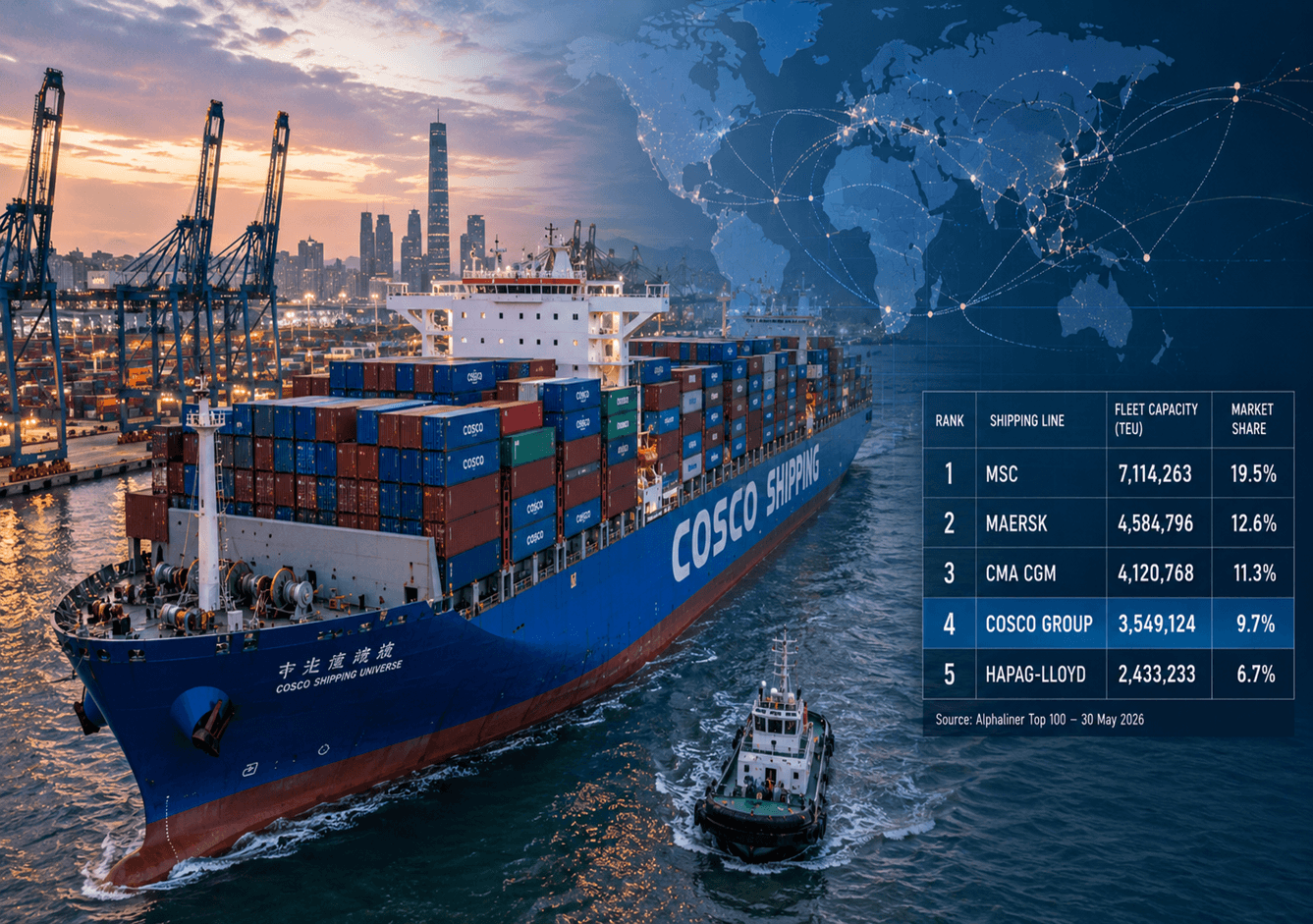
The global container shipping hierarchy has undergone another significant shift. According to the latest Alphaliner Top 100 ranking published on 30 May 2026, China's COSCO Shipping Group has strengthened its position as the world's fourth-largest container carrier, pushing Hapag-Lloyd further behind and narrowing the gap with the industry's top three operators.
For years, the industry's leadership structure appeared relatively stable. MSC, Maersk and CMA CGM dominated the market, while COSCO and Hapag-Lloyd competed for fourth position. However, aggressive fleet expansion by COSCO is changing that equation.
Top five container shipping lines in 2026
Based on fleet capacity, the world's largest container shipping companies are:
Rank | Shipping Line | Fleet Capacity (Approx.) |
1 | MSC | 7.1 million TEU |
2 | Maersk | 4.6 million TEU |
3 | CMA CGM | 4.1 million TEU |
4 | COSCO Group | 3.5-3.6 million TEU |
5 | Hapag-Lloyd | 2.4 million TEU |
The gap between COSCO and Hapag-Lloyd has widened considerably. COSCO now controls more than one million TEU of additional capacity compared with the German carrier.
Why COSCO is growing faster
Unlike most global carriers, COSCO benefits from being part of China's state-owned shipping ecosystem.
The company is supported by access to Chinese shipyards, state-backed financing, strategic cargo flows and strong domestic port infrastructure. Through subsidiaries including OOCL, COSCO has steadily expanded its global footprint across Asia-Europe, Transpacific and emerging trade routes.
One of the biggest reasons analysts are watching COSCO closely is its enormous orderbook.
Industry data shows COSCO has more than 1.1 million TEU on order, one of the largest expansion pipelines among the world's major carriers. Including vessels already ordered and under construction, the group's future capacity could approach 4.7 million TEU.
Could COSCO become number two?
Today, the gap between COSCO and Maersk remains substantial. However, the longer-term picture is becoming more interesting.
Maersk has increasingly shifted its focus toward integrated logistics, warehousing and supply-chain solutions rather than pure fleet expansion. COSCO, on the other hand, continues to invest heavily in vessels, terminals and maritime infrastructure.
If current fleet ordering trends continue, industry observers believe COSCO could eventually challenge CMA CGM for third place and potentially narrow the distance to Maersk during the next decade.
China's broader maritime strategy also supports this possibility. The country already dominates global shipbuilding, container manufacturing and port infrastructure. Having a national champion among the world's largest shipping lines aligns closely with Beijing's long-term logistics ambitions.
The strategic importance of COSCO
COSCO's rise is not merely a commercial story.
The company has become a key component of China's global trade network. Through investments in terminals, shipping services and logistics corridors, COSCO plays an important role in connecting Chinese exports with international markets.
Recent fleet expansion programs include multi-billion-dollar orders for LNG dual-fuel container vessels, positioning the company for both growth and environmental compliance requirements.
At the same time, COSCO remains one of the dominant carriers on the Asia-North America trade lane and continues to benefit from the strength of the OCEAN Alliance alongside CMA CGM and Evergreen.
What it means for shippers
For cargo owners and freight forwarders, COSCO's growth reflects a broader shift in the container shipping market.
Asian carriers are steadily increasing their influence over global trade lanes, while Chinese shipping companies are becoming more integrated with ports, terminals and logistics networks worldwide.
As new vessels enter service over the next three to five years, competition among MSC, Maersk, CMA CGM and COSCO is likely to intensify.
LogisticsWall perspective
The most important development is not that COSCO has secured fourth place. That battle is effectively over for now.
The real question is whether China's largest shipping group can leverage state-backed investment, one of the world's biggest orderbooks and access to the global shipbuilding industry to challenge the traditional dominance of Maersk and CMA CGM.
Based on current fleet growth trends, COSCO appears to be the only carrier outside the top three with a realistic path toward reshaping the industry's leadership structure during the next decade.
The world's container shipping market is no longer a race between European carriers alone. China's COSCO has entered the conversation, and its rise could become one of the defining stories of global shipping in the years ahead.
Popular Posts

Explore Topics



Comments