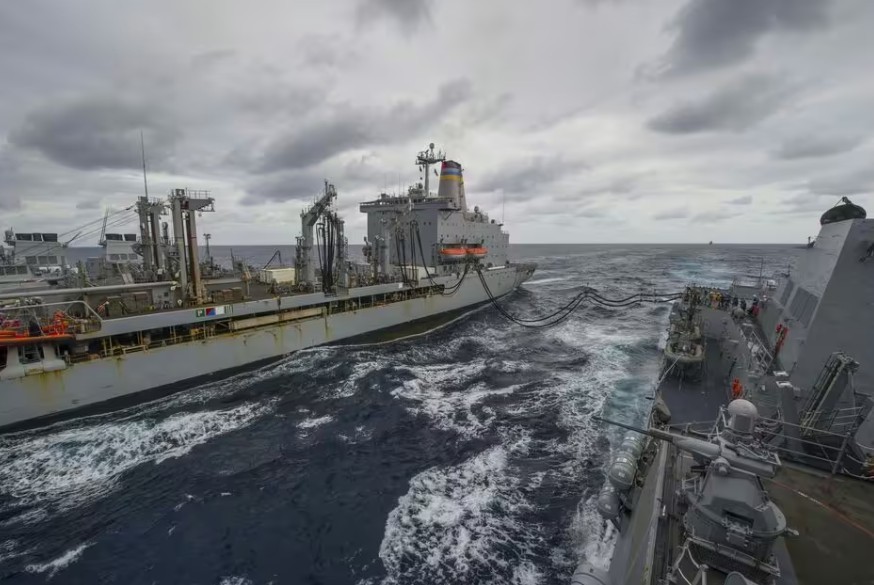
On 11 February 2026, two U.S. Navy vessels — the Arleigh Burke–class guided-missile destroyer USS Truxtun (DDG-103) and the Supply-class fast combat support ship USNS Supply (T-AOE-6) — collided at sea during a replenishment-at-sea operation in waters within the U.S. Southern Command’s (SOUTHCOM) area of responsibility, likely in the Caribbean or near South America.
The collision occurred while the ships were conducting a complex underway replenishment maneuver, a high-precision naval logistics operation in which fuel, stores and supplies are transferred between moving ships.
Involved Vessels
1. USS Truxtun (DDG-103)
Type: Arleigh Burke-class guided-missile destroyer
Role: Multi-mission warship capable of anti-air, anti-surface and anti-submarine warfare
Home Port: Naval Station Norfolk, Virginia
Deployment: Recently departed its home port on 6 February 2026 for deployment to SOUTHCOM region, supporting naval presence operations.
2. USNS Supply (T-AOE-6)
Type: Supply-class fast combat support ship
Role: Provides underway replenishment of fuel, ordnance, and supplies to Navy surface combatants
Operational Note: One of only a few remaining fast combat support ships in U.S. Naval inventory.
The two ships were performing an underway replenishment (UNREP) — a maneuver where vessels sail in close parallel formation (often within hundreds of feet) while developing rigging between them to move fuel and supplies.
During this evolution on Wednesday afternoon, the vessels made physical contact. Although the exact tactical movements leading to the collision remain under ongoing investigation by SOUTHCOM, both ships have since reported that they are continuing to sail safely.
Impact
Two personnel sustained minor injuries and were treated; both are in stable condition.
No major structural damage has been publicly confirmed, and neither vessel reported critical casualties or loss of propulsion immediately after the collision.
1. Replenishment-At-Sea (UNREP) Complexity
Underway replenishment is one of modern naval operations’ most demanding evolutions. Ships must:
Maintain precise station-keeping while underway
Balance hydrodynamic interactions between hulls
Coordinate bridge, engineering, and deck teams, any deviation can cause contact or rigging failure.
Importance of At-Sea logistics
UNREP capability allows naval forces to sustain presence without returning to port — critical in extended operations like:
Security in strategic waters
Extended patrols
High-tempo deployments
This incident underscores how crucial — yet challenging — these operations remain.
2. Rare but High-Risk Event
U.S. Navy ship-to-ship collisions are rare but highlight operational risk. The last widely reported collision involving U.S. warships occurred in 2025 between USS Harry S. Truman and a commercial vessel near the Suez Canal.
While this event did not escalate to major damage or loss of life, it reminds naval planners that even routine logistics tasks can produce serious incidents if executed even slightly off standard parameters.
Popular Posts


Explore Topics



Comments