
The Strait of Hormuz dominates headlines whenever geopolitical tensions rise in the Middle East. The waterway handles approximately 20.9 million barrels of oil per day and more than 11 billion cubic feet of LNG daily, making it one of the world's most important energy corridors. However, if the focus shifts beyond Hormuz, another chokepoint presents an even greater risk to global trade: the Strait of Malacca.
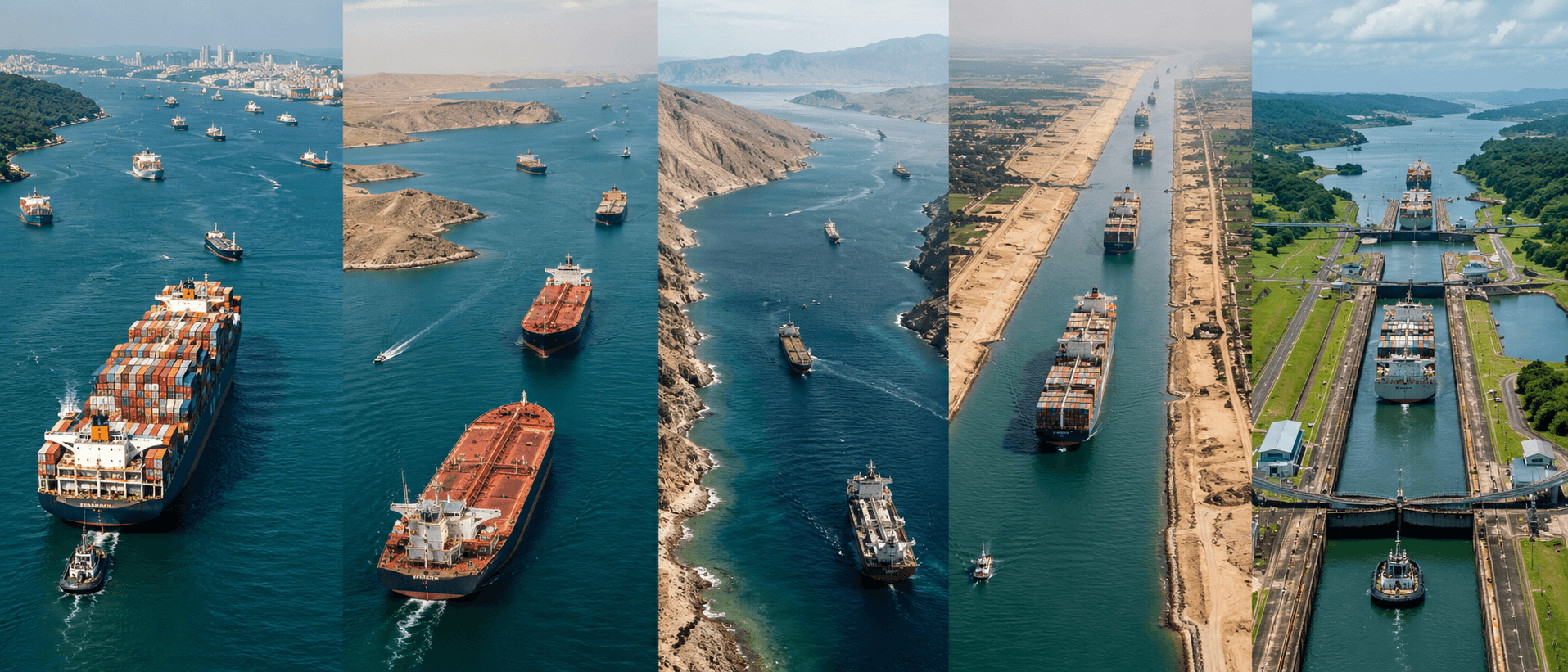
1. Strait of Malacca: The world's most critical trade chokepoint
Stretching between Malaysia, Singapore and Indonesia, the Strait of Malacca is the busiest maritime corridor in the world.
More than 102,500 vessels transited the strait during 2025, equivalent to around 280 ships per day. The waterway carried approximately 23.2 million barrels of oil per day during the first half of 2025, exceeding the volume transported through Hormuz. Nearly 29% of global seaborne oil trade passes through Malacca.
The strait is particularly critical for China, Japan, South Korea and other Asian economies. Around 75% of China's crude oil imports move through this route. The corridor also handles significant containerized cargo flows connecting Asia with Europe, the Middle East and Africa.
Impact of closure
Severe disruption to Chinese energy imports.
Major delays for Asia-Europe container trade.
Increased reliance on longer routes through Indonesia.
Higher freight costs and fuel consumption.
Significant impact on Singapore's transshipment business.
Among all global chokepoints, Malacca has the highest dependency from Asian manufacturing supply chains and energy markets.
2. Bab el-Mandeb: The most vulnerable chokepoint
Located between Yemen and the Horn of Africa, Bab el-Mandeb connects the Red Sea with the Gulf of Aden.
The route handled approximately 4.2 million barrels of oil per day during the first half of 2025. Before the Red Sea security crisis, volumes exceeded 9 million barrels per day.
The chokepoint serves as the gateway to the Suez Canal. Any disruption immediately affects trade between Asia and Europe.
Impact of closure
Ships forced around the Cape of Good Hope.
Additional transit time of 10 to 15 days.
Increased bunker consumption.
Reduced vessel availability.
Higher freight rates and schedule disruption.
The Red Sea crisis demonstrated that Bab el-Mandeb can disrupt global container shipping even without a formal closure.
3. Suez Canal: The world's most important container shortcut
The Suez Canal links the Mediterranean Sea with the Red Sea and remains one of the most strategically important waterways for container shipping.
Approximately 4.9 million barrels of oil per day and significant containerized cargo volumes move through the canal. Before the Red Sea security crisis, more than 20,000 vessels used the canal annually.
The 2021 Ever Given grounding demonstrated how a single vessel can disrupt billions of dollars in trade.
Impact of closure
Asia-Europe trade faces major delays.
Container carriers reroute via the Cape of Good Hope.
Additional voyage distance of approximately 3,500 to 4,000 nautical miles.
Increased freight rates and equipment shortages.
Europe is the region most exposed to prolonged Suez disruptions.
4. Panama Canal: The most important gateway for the Americas
The Panama Canal connects the Atlantic and Pacific Oceans and remains critical for trade between North America, Latin America and Asia.
The canal transported approximately 2.3 million barrels of oil per day during the first half of 2025 and handles thousands of container, dry bulk and LNG vessel transits annually.
Unlike other chokepoints, its biggest risk is climate-related. Drought conditions have repeatedly reduced transit capacity by limiting water availability.
Impact of closure
Longer voyages around South America.
Reduced competitiveness for U.S. exporters.
Increased costs for agricultural and container cargo.
Significant disruption to East Coast supply chains.
The United States remains the most exposed economy to Panama Canal disruptions.
5. Strait of Hormuz: Still the most dangerous energy chokepoint
Hormuz remains the most sensitive geopolitical chokepoint in the world.
Approximately 20.9 million barrels of oil per day and 11.4 billion cubic feet of LNG transit the waterway. Nearly one-fifth of global oil consumption depends on uninterrupted flows through the strait.
Unlike Malacca, practical alternatives are limited. Existing pipeline bypasses can replace only a fraction of normal volumes.
Impact of closure
Immediate increase in oil prices.
LNG supply disruptions.
Higher tanker earnings.
Rising war-risk insurance premiums.
Significant impact on India, China, Japan and South Korea.
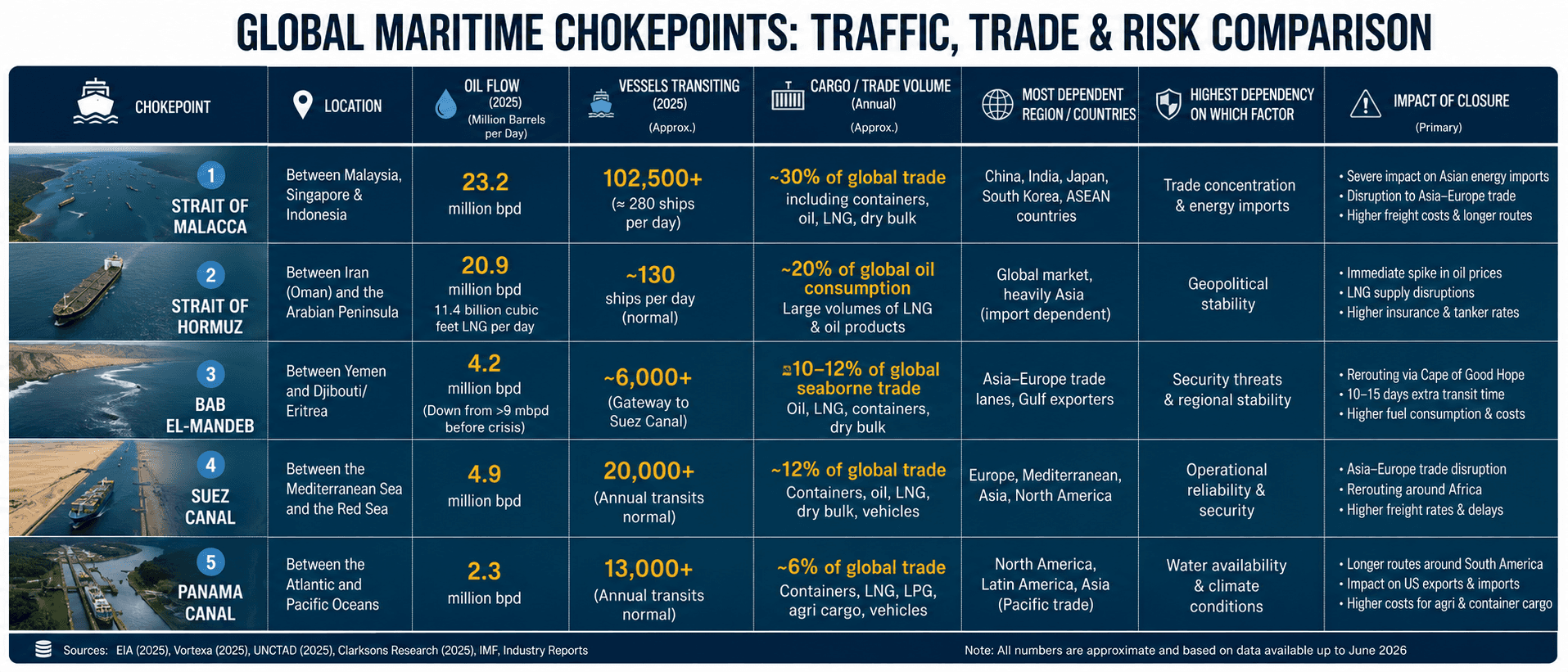
Ranking the world's riskiest maritime chokepoints
Rank | Chokepoint | Main Dependency | Primary Risk |
1 | Strait of Malacca | Asian manufacturing and energy imports | Trade concentration |
2 | Strait of Hormuz | Global oil and LNG markets | Geopolitical conflict |
3 | Bab el-Mandeb | Asia-Europe shipping | Security threats |
4 | Suez Canal | Container shipping | Operational disruption |
5 | Panama Canal | Americas trade | Climate and water shortages |
The Logistics Wall view
While Hormuz remains the most politically sensitive maritime chokepoint, the Strait of Malacca represents the greatest systemic risk to global trade. More oil passes through Malacca than Hormuz, vessel traffic is significantly higher and Asia's manufacturing economy depends heavily on uninterrupted operations.
A closure of Hormuz would primarily trigger an energy crisis. A prolonged disruption in Malacca would affect energy markets, container shipping, manufacturing supply chains and global trade simultaneously.
For shipping lines, cargo owners and logistics professionals, the future challenge is no longer a single chokepoint. Increasing geopolitical tensions, climate-related disruptions and congestion mean that resilience across multiple maritime corridors is becoming a critical part of global supply chain strategy.
Popular Posts


Explore Topics

Comments