

The global container shipping hierarchy: who is winning the fleet race in 2026?
The global container shipping industry has continued its expansion despite repeated predictions of a freight market collapse. Comparison of December 2024 data with current fleet figures shows that most major carriers have added significant capacity while maintaining large orderbooks.
Below is the detail of present share of top 10 shipping lines as on 18th June 2026
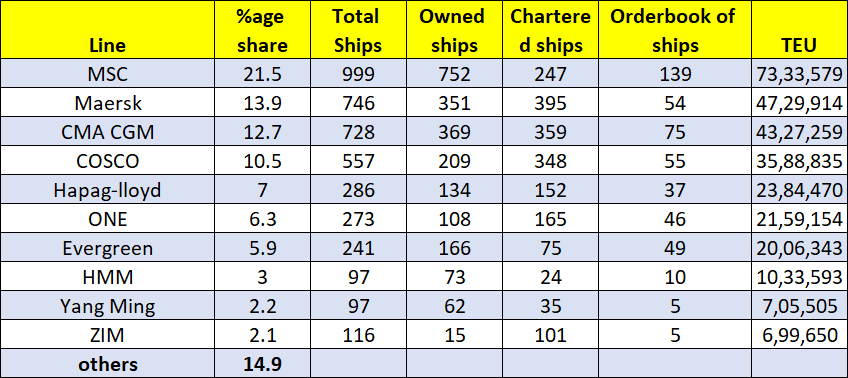
MSC has strengthened its position as the world's largest container shipping line. The carrier increased its fleet from 879 vessels to 999 vessels while expanding capacity from 6.34 million TEU to 7.33 million TEU. Its market share also rose from 20.2% to 21.5%, further widening the gap with competitors.
Maersk increased its fleet from 714 ships to 746 ships and capacity from 4.43 million TEU to 4.73 million TEU. While the fleet grew, market share slightly declined from 14.1% to 13.9%, indicating that competitors expanded faster.
CMA CGM recorded one of the strongest growth performances. Fleet size increased from 655 vessels to 728 vessels while capacity expanded from 3.84 million TEU to 4.33 million TEU. Market share improved from 12.3% to 12.7%.
COSCO maintained steady growth with fleet size increasing from 512 ships to 557 ships and capacity reaching 3.59 million TEU. Its market share remained relatively stable around 10.5%.
ONE expanded from 253 vessels to 273 vessels and crossed the 2 million TEU mark, increasing capacity to 2.16 million TEU. Evergreen also recorded strong growth, adding 18 vessels and increasing capacity by more than 229,000 TEU.
Among the smaller global carriers, HMM increased fleet capacity by more than 127,000 TEU while maintaining its position among the world's leading lines. Yang Ming's fleet and capacity remained unchanged during the period.
The biggest ranking change occurred in the lower positions. ZIM moved from ninth position to tenth position. The carrier's market share declined from 2.5% to 2.1%, while Yang Ming moved ahead despite maintaining almost identical fleet numbers. Market observers widely attribute pressure on ZIM to geopolitical tensions in the Middle East and security concerns surrounding Israeli-linked shipping.
Growth from December 2024 to current figures

Different strategies, different outcomes
MSC continues to gain market share and remains the largest container shipping line globally. One reason frequently discussed in the market is MSC's willingness to support new customers. It is often said among freight forwarders and exporters that MSC is willing to work with customers even when their initial volumes are small. Many customers who started with limited shipments have gradually expanded their business alongside MSC.
Maersk follows a very different strategy and is widely regarded as one of the most digitally advanced shipping lines. Its online booking, tracking and documentation systems are among the best in the industry. However, there is a common saying in the market: when everything works, Maersk is one of the best carriers available; when something gets stuck in the system, finding the right person to resolve the issue can take time. The strong dependence on digital processes sometimes creates challenges when customers need immediate human intervention.
CMA CGM has successfully balanced digital tools with traditional customer support, allowing it to expand aggressively while targeting selected customer segments.
COSCO remains focused on key trade corridors and strategic geographies. Much of its operational approach continues to rely on direct processes rather than extensive digitalization.
Hapag-Lloyd maintains strong online systems and premium service positioning, often focusing on selected customers and higher-yield cargo segments.
The freight boom that refused to end
Since 2023, many analysts have repeatedly forecast a major collapse in ocean freight rates. Instead, one disruption after another has prevented full normalization.
The Bab al-Mandab crisis forced many carriers to divert vessels around the Cape of Good Hope, significantly increasing voyage times and reducing effective vessel supply. Subsequent geopolitical tensions across key shipping corridors further tightened capacity.
These disruptions created an environment where carriers could continue absorbing newly delivered ships without triggering the severe overcapacity that many expected.
Is the next shipping war approaching?
History suggests that container shipping eventually enters periods of aggressive price competition once supply exceeds demand.
The industry has witnessed this before. Intense competition and overcapacity led to major restructuring cycles, including the collapse of Hanjin Shipping, where vessels were stranded globally and assets had to be sold to settle liabilities.
A similar oversupply situation appeared possible after the pandemic-era ordering boom. However, COVID-related disruptions and later geopolitical conflicts delayed the correction.
If major trade routes normalize and transit times return to standard levels, the industry could suddenly find itself with excess capacity. With large orderbooks still under construction, freight rates may face significant downward pressure.
The result could be another cycle of price wars, mergers, acquisitions and consolidation. The current fleet expansion race may therefore represent not only a battle for market share, but also a fight for survival ahead of the next downturn.
The carriers with the strongest balance sheets, largest networks and most disciplined commercial strategies are likely to emerge as the winners when the next shipping cycle begins.
Popular Posts


Explore Topics



Comments