
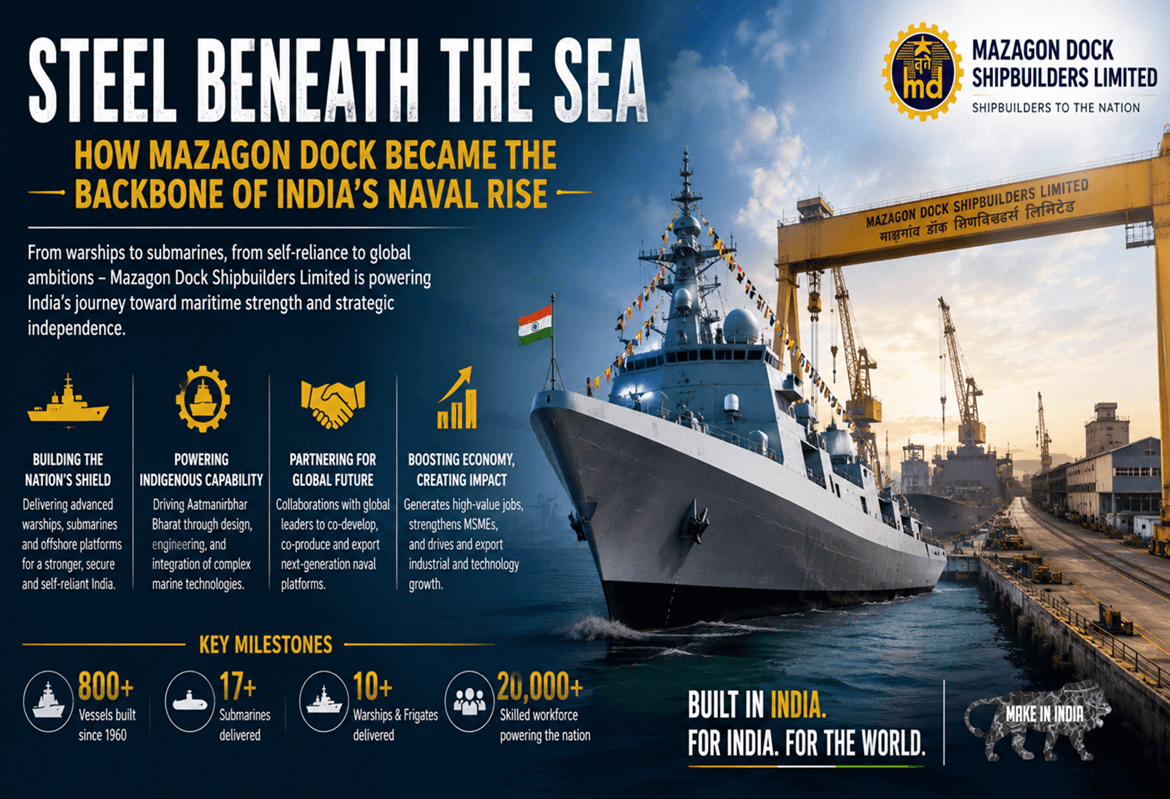
India’s maritime ambitions are no longer limited to safeguarding coastlines. They are now shaping a strategic industrial ecosystem capable of building destroyers, stealth frigates, submarines, and eventually exporting advanced naval platforms to the world.
At the center of this transformation stands Mazagaon Dock Shipbuilders Limited (MDL).
For decades, India depended heavily on foreign defence platforms and overseas naval technology. Today, the Mumbai-based shipyard has evolved into one of the country’s most critical defence manufacturing assets — not merely assembling warships, but building an indigenous capability ecosystem around naval engineering, combat systems integration, and underwater warfare platforms.
The recent delivery of the stealth frigate ‘Mahendragiri’ under Project-17A marks another milestone in that transition. According to the Press Information Bureau (PIB), the delivery represents the final Project-17A vessel being constructed at MDL, highlighting India’s growing self-reliance in warship design and construction under the ‘Aatmanirbhar Bharat’ initiative.
But the larger story is not about one warship.
It is about the emergence of India as a serious naval manufacturing nation.
MDL today sits at the heart of multiple strategic programmes including Project-15B destroyers, Project-17A stealth frigates, Kalvari-class submarines, and the upcoming Project-75(I) submarine programme. Industry estimates suggest the P75(I) deal alone could exceed ₹70,000–₹99,000 crore, potentially becoming one of the largest submarine manufacturing contracts in Indian defence history.
What makes this development strategically important is the nature of capability being built.
Warship construction is not conventional manufacturing. It requires deep integration of metallurgy, propulsion systems, electronics, radar systems, weapons integration, stealth engineering, precision fabrication, and lifecycle sustainment. A modern submarine programme also develops high-value vendor ecosystems that spill into civilian manufacturing, marine engineering, robotics, heavy fabrication, and advanced electronics.
This is where MDL’s role extends beyond defence production.
The shipyard is gradually becoming a catalyst for India’s broader industrial deep-tech capability.
According to industry reports, MDL has already delivered over 800 vessels since 1960, including destroyers, frigates, missile boats, submarines, offshore structures, and Coast Guard platforms. The company’s infrastructure now includes multiple dry docks, wet basins, submarine assembly facilities, heavy cranes, advanced integration systems, and specialised underwater fabrication units.
The strategic timing also matters.
Global naval geopolitics is changing rapidly. The Indo-Pacific has become the world’s most contested maritime theatre. Supply chain security, underwater surveillance capability, sea lane protection, and maritime deterrence are now directly linked to economic power.
India understands that a nation aspiring to become a global manufacturing and export hub cannot remain dependent on imported naval assets.
That explains the aggressive push toward indigenous naval production.
Recent reports also indicate that India is exploring defence export opportunities through partnerships involving MDL and global players such as Naval Group of France and Germany’s Thyssenkrupp Marine Systems (TKMS). Discussions around export-oriented submarine cooperation and next-generation conventional submarines indicate that Indian shipyards are now being positioned not only as domestic defence suppliers, but as future international defence exporters.
The significance of this shift extends into economics.
Defence shipbuilding creates long-duration industrial activity with exceptionally high domestic value addition. Unlike short-cycle manufacturing, naval projects sustain thousands of MSMEs, engineering firms, steel manufacturers, electronics suppliers, software vendors, and logistics operators over decades.
For logistics and supply chain sectors, this also opens a parallel opportunity.
Heavy engineering cargo movement, specialised steel imports, naval-grade component transportation, dock logistics, project cargo handling, and coastal industrial connectivity will increasingly become part of India’s strategic maritime economy.
In many ways, MDL represents a larger national transition.
India is moving from being a defence buyer to becoming a defence builder.
The journey is far from complete. Challenges around technology transfer, engine systems, export competitiveness, execution timelines, and private-sector integration remain substantial. Yet the direction is unmistakable.
The next decade may not only determine the strength of India’s Navy — it may determine whether India can emerge as a global maritime-industrial power.
And beneath that transformation lies steel forged quietly inside the docks of Mumbai.
Popular Posts
Explore Topics



Comments