
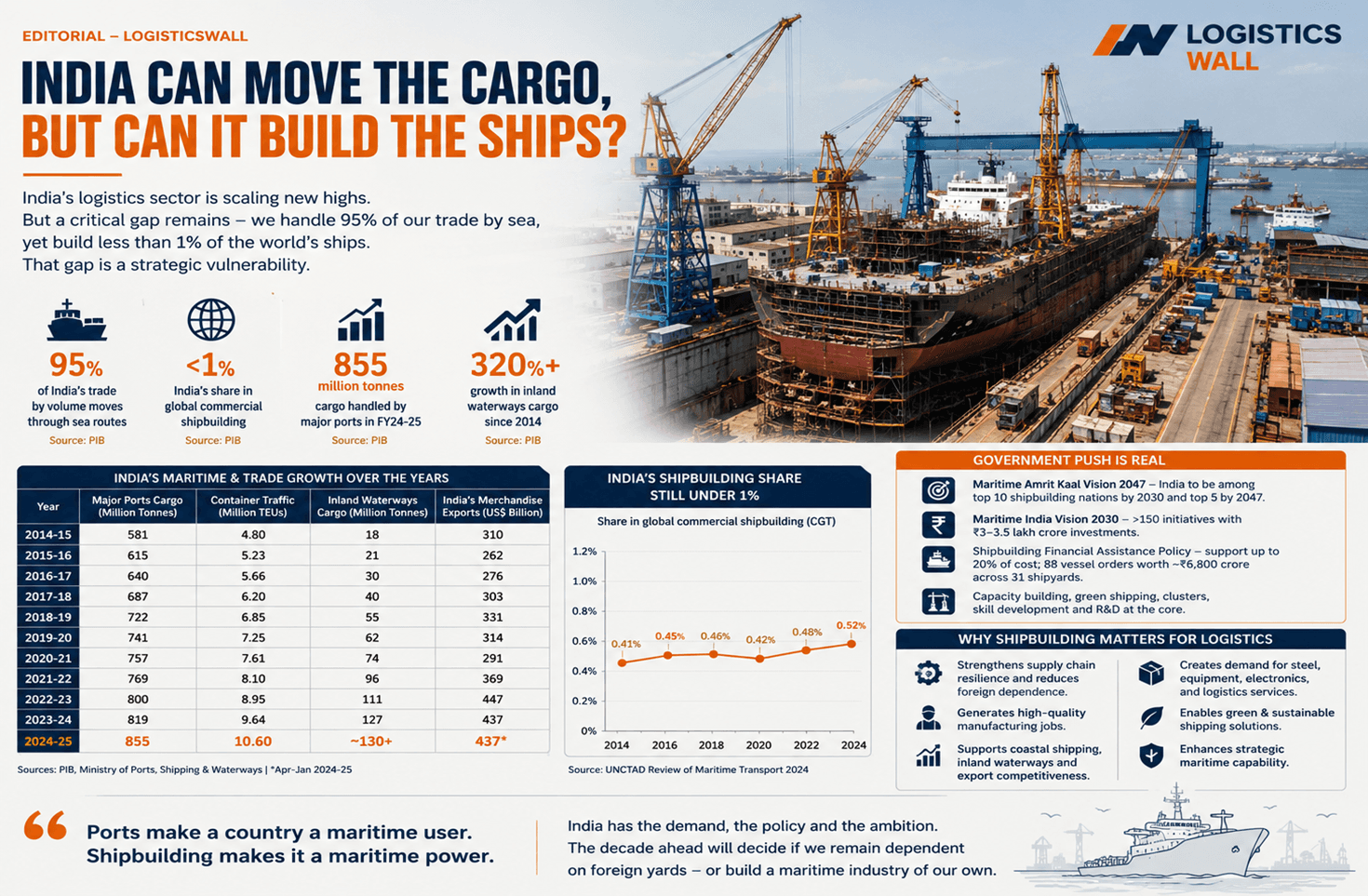
For decades, India has celebrated growth in ports, exports and logistics infrastructure. Cargo volumes are rising, port efficiency is improving and manufacturing ambitions continue to expand. Yet one uncomfortable question remains largely unanswered: if India becomes a $10 trillion economy, who will build the ships that carry its trade?
The numbers reveal a striking contradiction.
India's major ports handled approximately 855 million tonnes of cargo in FY2024-25, up from 819 million tonnes in FY2023-24, recording annual growth of 4.3%. Container traffic increased 10% year-on-year while fertilizer cargo rose 13%. Paradip and Deendayal ports crossed the 150-million-tonne mark for the first time, and JNPA handled a record 7.3 million TEUs. Port revenues and operational performance also reached historic highs.
These achievements demonstrate that India has become increasingly efficient at handling cargo.
However, cargo handling and shipbuilding are not the same thing.
Despite being one of the world's largest trading economies, India still accounts for less than 1% of global shipbuilding output. China dominates global shipbuilding, followed by South Korea and Japan. Together, these three countries control the overwhelming majority of commercial vessel construction. India remains largely dependent on foreign-built vessels for international trade. This means that while India earns revenue from moving cargo through its ports, much of the value creation from vessel manufacturing, marine equipment, ship design and maritime technology is captured elsewhere.
This imbalance is becoming more important because India's logistics growth is accelerating.
The government has invested heavily in maritime infrastructure under Sagarmala, Maritime India Vision 2030 and Maritime Amrit Kaal Vision 2047. Cargo throughput continues to expand, coastal shipping is receiving policy support and inland waterways are handling significantly higher volumes than a decade ago. The Ministry of Ports, Shipping and Waterways has set an ambitious target of making India one of the world's top shipbuilding nations by 2047.
Yet targets alone do not create industrial capability.
History shows that every major shipbuilding nation first built an industrial ecosystem. China did not become a shipbuilding giant because of shipyards alone. It developed steel capacity, marine equipment manufacturing, export finance, design capabilities, skilled labour pools and integrated supply chains. South Korea followed a similar model. Shipbuilding was treated as a national industrial strategy rather than a standalone sector.
India is now attempting the same transition.
Recent developments suggest momentum is building. Defence shipyards such as Cochin Shipyard, Mazagon Dock and Garden Reach Shipbuilders are reporting strong order books and capacity expansion plans. Market estimates indicate that combined order books of major public-sector shipbuilders could multiply significantly over the next few years as naval modernisation accelerates.
Garden Reach Shipbuilders recently reported its highest-ever turnover of approximately ₹6,400 crore, compared with ₹5,076 crore a year earlier, highlighting the scale of activity emerging within the sector.
The significance extends far beyond defence.
Every large commercial vessel creates demand across steel manufacturing, forgings, electrical systems, engines, navigation equipment, coatings, logistics services and engineering talent. A shipyard order worth ₹1,000 crore does not remain inside the shipyard. It flows through hundreds of suppliers across the economy.
This is why shipbuilding deserves attention from logistics professionals.
India's logistics discussion often focuses on ports, highways, railways and warehouses. These investments are necessary, but they address only one side of the supply chain equation. The other side is ownership and production of maritime assets.
Today India moves increasing amounts of cargo through Indian ports. Tomorrow it must also build a larger share of the vessels that carry that cargo.
The challenge is execution.
Strong order books, policy announcements and investment commitments are encouraging, but global shipbuilding is ultimately judged by delivery schedules, productivity and cost competitiveness. International buyers will not shift orders to India because of policy ambitions. They will shift orders only when Indian yards consistently deliver vessels on time, at competitive prices and with reliable quality.
That is the benchmark India must meet.
The country's port sector has already demonstrated that large-scale transformation is possible. Vessel turnaround times have fallen dramatically over the last decade while cargo handling continues to set new records. The next phase of maritime growth will depend on whether shipbuilding can replicate the same success story.
India has proven that it can move cargo.
The next test is whether it can build the ships that move it.
— Editorial Desk, LogisticsWall
Popular Posts

Explore Topics



Comments