
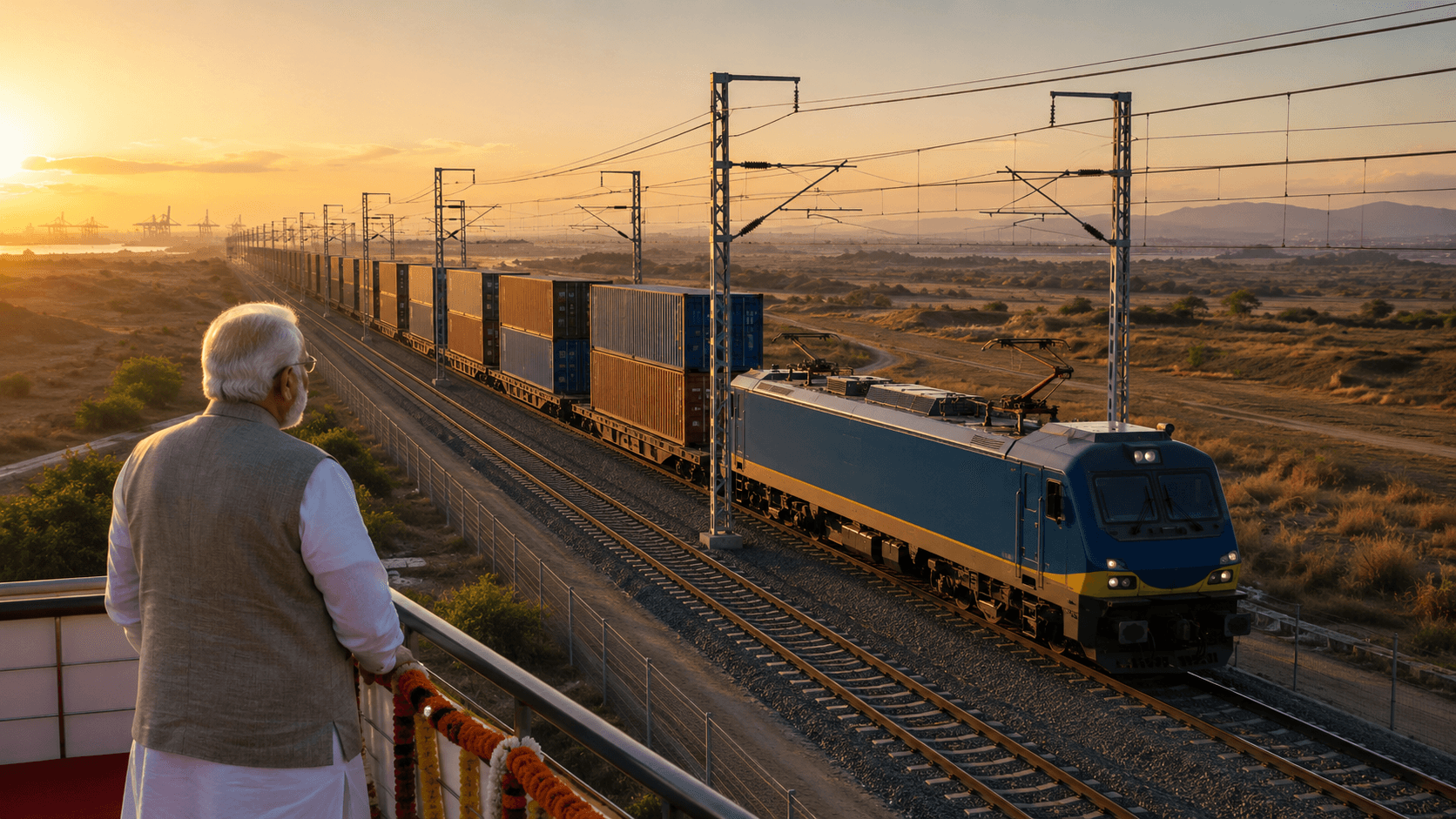
For years, countries like the United States have operated double-stack container trains using diesel locomotives. India's breakthrough was different. In June 2020, Indian Railways became the first railway in the world to commercially operate electric double-stack container trains under specially designed high-rise overhead electrification, setting a new benchmark in freight rail engineering.
The innovation is powered by the Western Dedicated Freight Corridor (WDFC), a dedicated freight network linking Dadri in Uttar Pradesh with Jawaharlal Nehru Port (JNPA) and western ports such as Mundra and Pipavav. Unlike conventional rail routes, the WDFC was designed exclusively for freight, allowing longer, heavier and faster trains to operate efficiently.
The biggest engineering challenge was vertical clearance. Standard electrified railway lines have overhead contact wires at around 5.5 metres, which is insufficient for two ISO containers stacked on a flat wagon. To solve this, DFCCIL introduced high-rise 2×25 kV overhead equipment with contact wire heights of about 7.5–7.57 metres, along with specially developed high-reach pantographs for electric locomotives.
Another key enabler is the 12,000 HP WAG-12 electric locomotive, manufactured at Madhepura under the Make in India programme. Designed for heavy-haul operations, the locomotive can haul around 6,000 tonnes while using regenerative braking to improve energy efficiency. On the WDFC, freight trains are designed to operate at speeds of up to 100 km/h, compared with an average freight speed of around 25–26 km/h on the conventional Indian Railways network.
The logistics benefits are substantial. Double-stack operations move significantly more containers in a single train, reducing the number of trips required between ports and inland container depots. Longer trains of up to 1.5 km also improve network capacity, lower transportation costs, reduce highway congestion and cut carbon emissions through electric traction. A 1.5-km-long double-stack train carrying 360 TEUs can replace roughly 270 heavy container trucks, highlighting its impact on road decongestion and supply-chain efficiency.
For India's exporters and importers, this translates into faster port evacuation, improved schedule reliability and lower logistics costs. As the Dedicated Freight Corridor network expands, these engineering innovations are expected to strengthen India's multimodal logistics ecosystem and improve the competitiveness of its global trade.
India's achievement is not simply about running taller trains—it's about redesigning freight infrastructure to move more cargo, more sustainably and at higher speeds. That is the real milestone behind the country's electric double-stack container trains.
Picture courtesy -AI
Popular Posts
Explore Topics



Comments